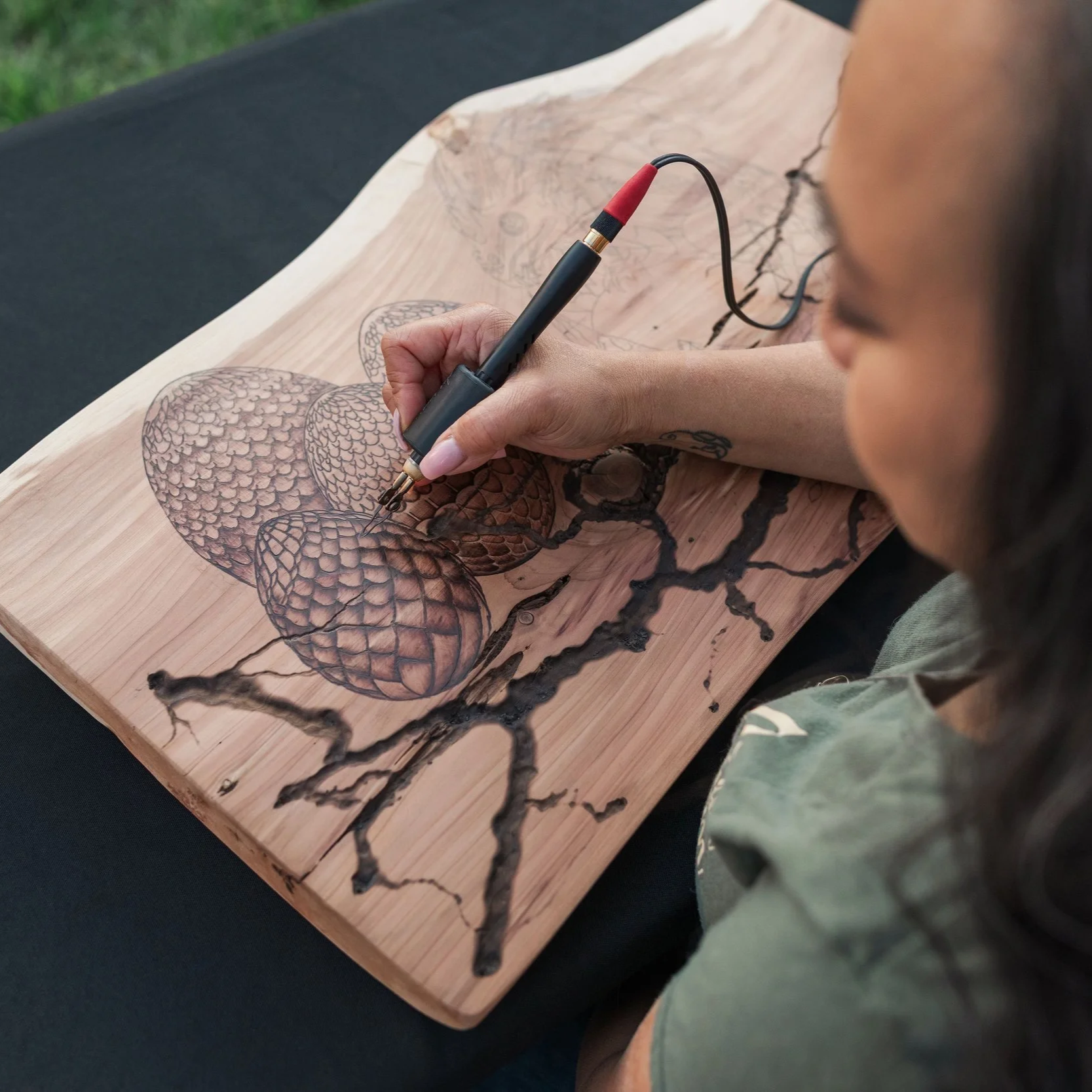
November 2025 Burn Challenge

 
pyrography-challenge
 

Each month inside Burn Club we run a Burn Challenge: BC+ members pick a single word, and everyone is invited to interpret it in their own way, in any style, any level, any tool. This time the word was “Abstract”: instead of focusing on realism or perfect detail, the goal was to play with shapes, movement, pattern, and feeling. It was all about letting go of “what it’s supposed to be” and seeing what shows up when you just respond to the word.

and the winner is…

John of @Circle8Pyrography

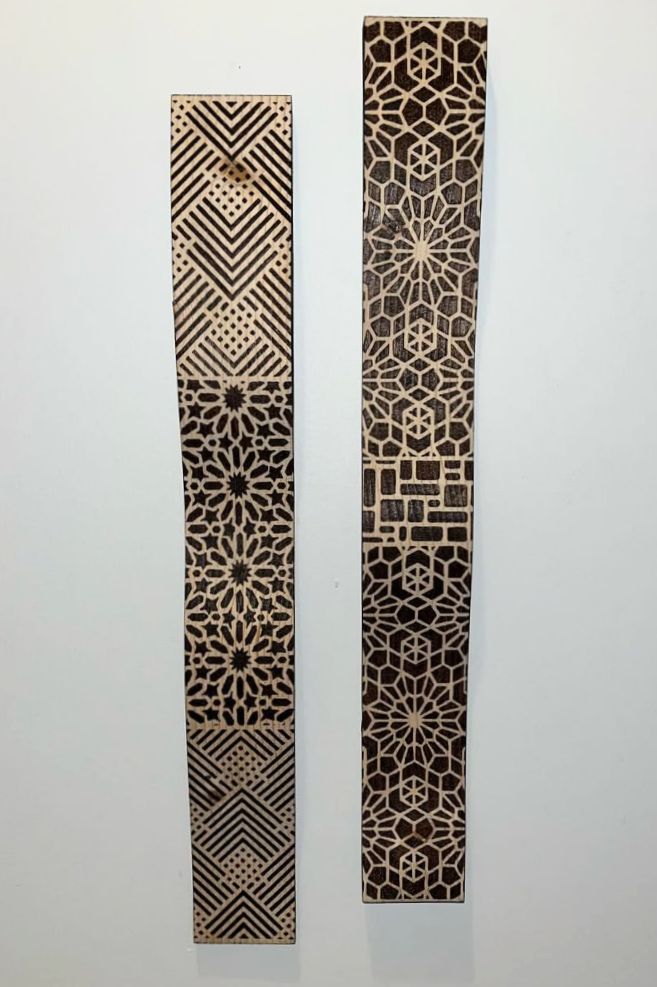
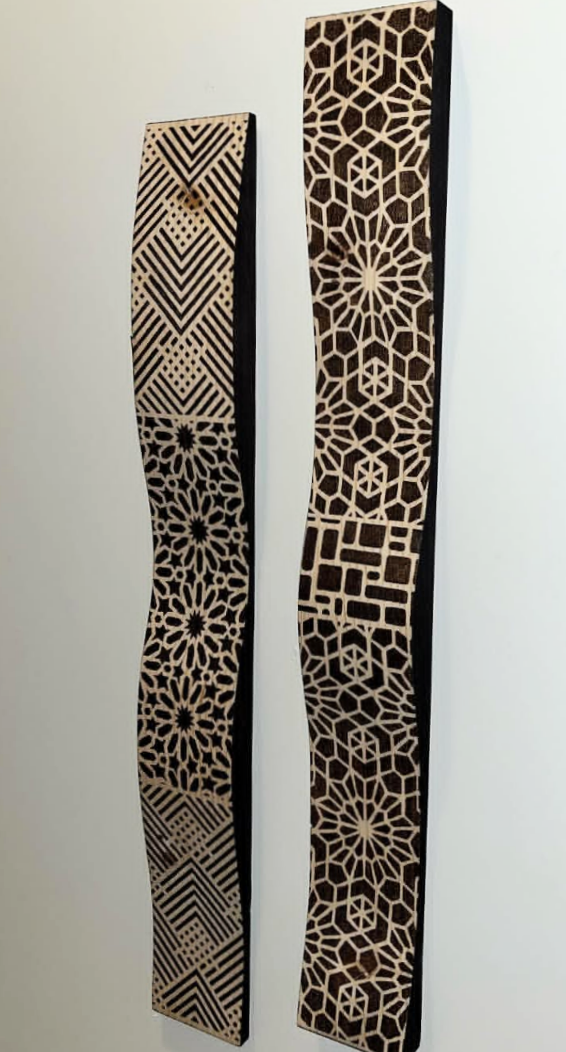
John answered the prompt with something wild and clever. The winning piece is a pair of tall, wave-shaped wall panels. He cut those curves on his bandsaw and filled them with layered geometric patterns and bold contrast.

These started out as scraps from another project that he refused to throw away. Instead of heading to the bin, they turned into this beautiful, sculptural duo. That’s very on brand for John! His work is packed with unique builds: 3D pieces, things that spin, and designs that break out of the normal flat rectangle. And he’s already talking about planning even crazier ones after this!!


To celebrate, John got to choose Any 20 templates from WBC shop!

Check out the template shop to get royalty-free and practice only templates for your next wood slice project!


Give him some extra fire on Instagram or in the Burn Club and make sure to give him a follow, if you’re not already doing so! He is always up to something extra creative and inventive!!


To learn about the challenges before the public does, join us in The Burn Club!

8 Ways Writing Nurtures Your Mind and Mental Health

It all started with "The Artist's Way" by Julia Cameron. I didn’t know it at the time, but picking up that book would completely shift how I thought about writing as well as myself. My creativity came back after some hibernation and I felt newly inspired to make things again, and start burning and drawing again. And it didn’t feel forced. I just had mental space for the fun things, thanks to releasing the not-so-fun things floating around in my mind.

But at first…

I was reluctant to start writing.

Actually, I kinda really hated it.

I remember as a teenager, there was so much pressure around making my diary sound a certain way, trying to omit spelling errors, not knowing what to really write in general…. You would think that a diary is a private space and no one would read it so why worry about those things? But I didn’t know better. No one told me not to worry about what I sound like on paper. I wrote with the mindset that someone will (or might) read it and I wanted to sound cool. I wanted to sound interesting. I wanted to NOT sound like me (it’s almost like the cringe when you hear your own voice from a recording).

So I stopped.

stream-of-consciousness-writing

Last year or two, I got a reccomendation to read this book, The Artists Way (check out that journey here: The Artists Way by Julia Cameron) and one of the daily exercises in it was the practice of freestyle, stream-of-consciousness writing.

Not for show.

Not for anyone.

Heck, not even for myself to re-read after!!

Seriously, I write so quickly that sometimes I cannot reread the chicken scratch that I wrote, and that is completely fine! Because it’s not all about the actual writing. It’s about process of it. It’s about getting the words, thoughts and ideas out of your head and onto something tangible.

It really, very quickly, gave me a peace of mind and helped me process things.

Then I stumbled across another book: The Power of Writing It Down: A Simple Habit to Unlock Your Brain and Reimagine Your Life by Allison Fallon and suddenly, the “why” behind it all snapped into focus. (here is a free audiobook on Spotify)


SO Why does this style of writing help heal and promote mental health?

This form of writing was a tool to help me heal. Almost immediately! Seriously, I noticed differences in the way I thought and what I though almost right away. It was magical.

Below are some reasons in the book, mixed in with my personal experience as to how beneficial it can be.

1. Emotional Processing & Stress Relief

Fallon emphasizes that this expressive freestyle way of writing lets you unpack what’s bottled up inside. This helps process emotions, reduce stress and anxiety, and gain emotional clarity.


2. Cognitive Clarity and Insight

By putting thoughts into words, Fallon explains how writing fosters clearer thinking, better decision-making, and goal setting. Expressive writing connects you with your subconscious, revealing clarity and helping crystallize what truly matters.

From personal experience, I found this to be really true! In my head, the thoughts are lightning fast, but my hand writing these thoughts down can only keep up so much… This forces my brain to slow down and process my thoughts without thinking 5 steps ahead and back to the beginning (goodbye rumination).


3. Provides a Safe Emotional Outlet

burn-your-journal

Journaling this way offers a private space to express thoughts and feelings without judgment, serving as a therapeutic outlet for emotions that might be difficult to share otherwise. If you are nervous someone might find it, then

writing and immediately burning or shredding or ripping it up is just as therapeutic as the writing itself!


4. Breaks Old Habits

Fallon shows how writing helps you identify and break those ruts in your brain. It helps rewire habits, reroute outdated thought patterns, and discover new pathways forward. Because once you take the time to think of these things and write them down, you see them more clearly. And once you see them more clearly, it’s much easier to do something about it!


5. Shifts your Mindset

Writing about challenges gives you space from them. It separates you, mentally and physically! You can see them more objectively, reframe the narrative, and respond with more compassion to yourself.

6. Improves Self-Awareness

Regular journaling encourages introspection, helping you recognize patterns in your thoughts, emotions, and behaviours over time. It’s not just the act of writing that matters, it’s the way handwriting naturally slows down your brain, like I mentioned in the first point. It’s creating space between thought and response. In that space, you’re able to “speak” without judgment and see yourself more clearly. Writing becomes a mirror, not just reflecting your experience but helping you look at yourself with more honesty, curiosity, and compassion.

Think of it like a muscle. The more you think about your feelings and emotions, the easier it is to recognize them!


7. Promotes Mindfulness

Mindful writing practices, such as focusing on the present moment during journaling, can enhance mindfulness, leading to greater emotional regulation and reduced rumination. I can go on for DAYS on the importance of mindfulness! There are many studies that suggest that focusing on the present can have a positive impact on health and well-being. And I feel it. This was a huge reason why I wrote my book, Presence, and a huge reason for creating The Burn Club with all it’s pyrography exercises (and non-pyrography exercises) to keep you in the here and now.


8. Strengthens Your Inner Voice

self-love

The more you write, the louder your real voice becomes underneath all the noise. Fallon describes this as a return to your intuition and inner knowing. This is huge for me because, all my life, I have unknowingly leaned into people-pleasing and perfectionism quite hard… I took more care of others, instead of myself. I am letting go of any blaming or feeling bad for myself, because kindness is this world is needed. But what I’ve learned was that I deserve my kindness too.

What writing has taught me is not only how to be kind to myself but also how to accept this kindness.


Incorporating writing into your daily routine can be a simple yet effective strategy to enhance mental health and cultivate mindfulness.

It’s very simple AND it’s FREE!

All you need is a paper and a pencil/pen.

How to write stream of consciousness style:

Writing in a stream-of-consciousness style means letting your thoughts flow exactly as they come. Write without editing, censoring, or worrying about grammar, spelling, or structure. This is not about writing well. It's about writing truthfully. Misspelled words, half-finished thoughts, tangents… It’s all welcome.

  • Setting a timer helps to give it a start and a finish, therefore making it easier to complete. It also helps you not to get tempted to pause or overthink.

  • Don't lift your pen or pause to reread. Keep your hand moving or your fingers typing, even if what you're writing is “I don’t know what to say right now.” That counts. Just keep going.

  • If one thought leads to another, go there. Even if it feels random. That’s the point. You're learning how your mind moves, not trying to build a neat essay.

  • Knowing that no one will read it (not even future you, unless you want to) frees you to be honest. If needed, plan to shred, delete, or burn it afterward. That alone can unlock a new level of depth.

If you are stuck, start by just describing what you see, hear or better yet, how you feel, even if it’s just “I’m feeling cold”. When a thought pop’s into your head, and it inevitability will, write it. Even if it’s “I have to remember to change over the laundry in 20 min”, then write that.

There are no rules.

Sometimes, I have started with a question to get me going. It can be as simple as “What am I grateful for today?” to something deeper like “Why did I react that way yesterday?” The question doesn’t need to be profound: it just needs to crack the door open.

When I. really really stuck or not in the mood, I ask ChatGPT (or you can ask google) “what do I write about today?”

I have seen a lot of resistance to writing with a special person in my life who is going through some hard times. None of these things worked for her because she didn’t think she was valuable enough to spend 5-10min writing. Or she didn’t think it would help. Or maybe she just didn’t know where to start.

So I got her this book: One Line a Day: A Five-Year Memory Book. The dates helped her keep a track of when she is writing, the spaces were small so it was quick and not overwhelming and there still aren’t any rules here; writing just words or in point-form further makes it freeing.

It’s about taking a moment to think about yourself for once! It’s not as good as the stream of consciousness writing, but it’s soemthing. And sometimes we just need to start somewhere. This is a good place for that.

Journaling with kids

Studies with school-age kids show that regular writing can ease anxiety and low mood and even boost working memory, and that expressive writing (the freestyle kind where they put their feelings into words, instead of just writing about their day) has an even stronger positive impact.

My daughter and I share our “Happy thought of the day” every night before bed where we name at least one thing that made us happy. I wanted to document that in a more concrete way and get my daughter into the habit of writing so she isn’t as traumatized about it as I used to be and so she has a habit formed early on.

So, I started a journal with her!

We write our happy thought, along with what we’ve learned and how we felt (even if it wasn’t great). Some days we wrote a simple quote out and decorated it. Some days we wrote a whole page of thoughts and events that happened, and some days we just drew a picture!

Again. There are no rules.

I’m hoping it helps her express her feelings and get to know herself, much earlier than I learned to know myself. I want it to feel like a safe place to talk to me on paper, especially as she moves into her teenage years. I also want her to have this tool for herself. So far, its gotten us to both sit down and be present in the moment in a fun and bonding way.

Writing has become more than just a creative outlet for me: it’s a lifeline. What started as morning pages turned into something deeper. It’s now a way to care for my mind, sort through tangled thoughts, and create enough calm that I actually want to show up for the things I love, like wood burning, drawing and making art.

Whether you're navigating stress, seeking clarity, or just trying to slow down in a noisy world, writing gives you a place to land. When your mind feels less crowded, it’s so much easier to feel curious, playful, and creative again.

You don’t need fancy prompts, perfect grammar, or a clear goal. You just need a pen, a bit of quiet, and the willingness to listen to what’s already inside you.

So the next time your mind feels heavy, try writing it down. Not just to get it off your chest, but to find your way back to the creative things you love.


October 2025 Burn Challenge

 
burn-challenge-prompt
 

After Dark was October’s burn challenge! Some people went for cozy night-time vibes, while others leaned into the spooky side. I definitely landed in the creepy zone myself. I was totally inspired by this month’s winner, not just by her challenge submission but also by what she shared earlier in the Inspiration channel in The Burn Club!

and the winner is…

Austine of tinibellcreations

Austine created some small pieces instead of one big burn which is such a smart way to explore an idea or technique without the pressure of a huge project!!

The eye piece has that juicy texture that pulls you in right away. It almost looks like tree bark staring at you… In the other piece, the layered trees are my favourite. The way the trunks stack and fade gives you that true night depth, and then the creepy creatures peeking through make you wonder how many more there are. I love the scratch marks on the bark too, like traces left behind as the creature is slipping into hiding…

Together the two burns play with depth, texture, what’s seen and what’s hiding. Such a fun and creative take on After Dark, and a great reminder that working small can still spark big ideas.


To celebrate, Austine got full access to The Pyrography Summit!

The summit is one huge collaboration of all things pyrography and business! My favorite part of The Summit? The 8 masterclasses with professional pyro’s sharing their techniques, tips and pyro expertise!


You can follow tinibellcreations on instagram or check out more of her awesome work in the club!


To learn about the challenges before the public does, join us in The Burn Club!

September 2025 Burn Challenge


FREEHAND was the word for September’s challenge, pushing us to put the pencil down and trust the burner. This proved to be a difficult challenge for many of us! The artist who took it to the next level is…..

Chuck of The Burning Woodchuck


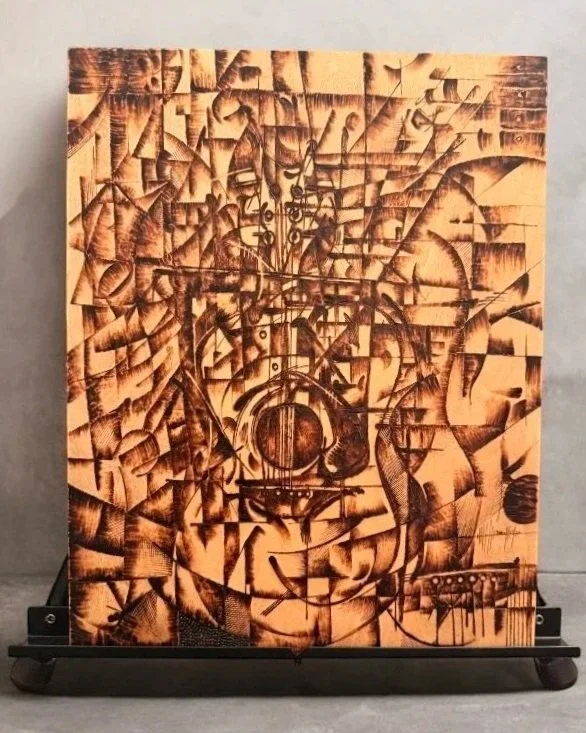
One of my favourite parts of Burn Club is seeing an idea take shape from the very beginning and then grow into a finished piece. Back in an Open Studio, Chuck mentioned wanting to explore Cubism in his work. We got to see that spark before it even touched wood, and now it’s here.

Not only did he dive in and execute the idea in his head, he burned it freehand!!

He’s got confident lines, smooth gradients, and bold crosshatching that makes the burn feel alive, almost in motion. It’s a piece that grabs you from across the room and keeps rewarding you the closer you look, until you can’t help but want to reach out and feel the textures.

Chuck sparks curiosity with thoughtful questions, brings endless creativity to the table, and always shows up with a ridiculously positive attitude. Every time.

We’re so lucky to have this gem of a human in the club!!

To celebrate, Chuck got access to a full year of Burn Club+


Check out all the ways you can support Chuck and be sure to drop him some fire along the way:

Website

Instagram

Facebook


To learn about the challenges before the public does, join us in The Burn Club!

August 2025 Burn Challenge


August’s challenge grew out of Burn Club community conversations about how pyrography can be a meditative practice, bringing us peace of mind, slowing us down, and pulling us into the present moment.

Congrats to our winner for the August challenge:

Tanja of @Hatiae.within.fire!

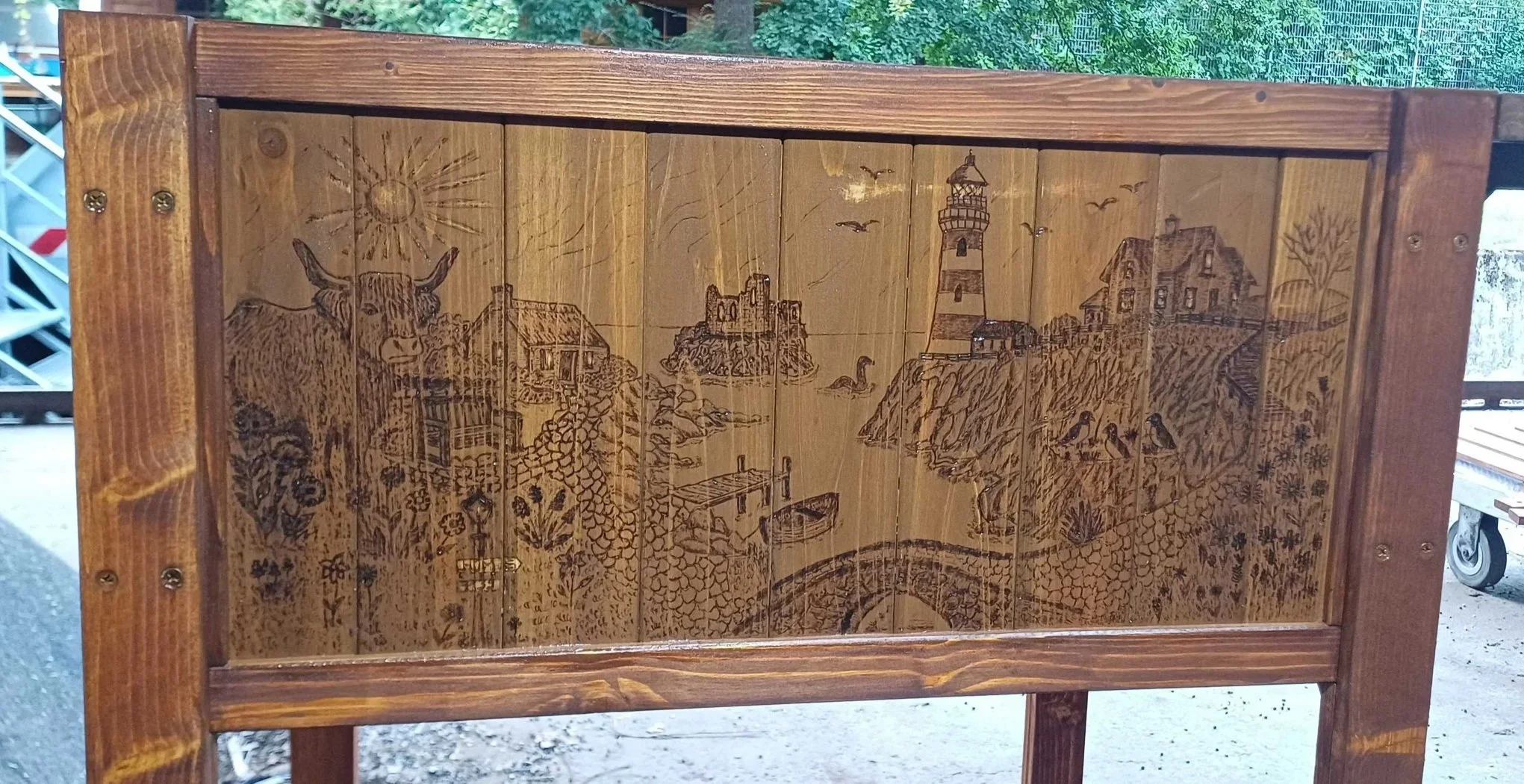
Our prompt was SLOW, and Tanja really took it to heart. On only her second try at pyrography, she went all in on a full bed frame. What started as just wanting to burn a few tendrils grew into a picture that took hours upon hours. She said she was so immersed in the process she barely noticed the time passing, but she did notice how much it did for her soul. And really, isn’t that what keeps us all burning?

We’re so happy to have her in this community and can’t wait to see what future projects she brings to life.

As this month’s winner, she’s receiving:

full access to all to The Pyrography Summit recordings!

The summit is one huge collaboration of all things pyrography and business! My favorite part of The Summit? The 8 masterclasses with professional pyro’s sharing their techniques, tips and pyro expertise!

Want to see the project and cheer her on? Head to her post HERE in the burn-challenges channel in the Club and leave her some love.

You can also find Tanja on Instagram and Facebook!


To learn about the challenges before the public does, join us in The Burn Club!

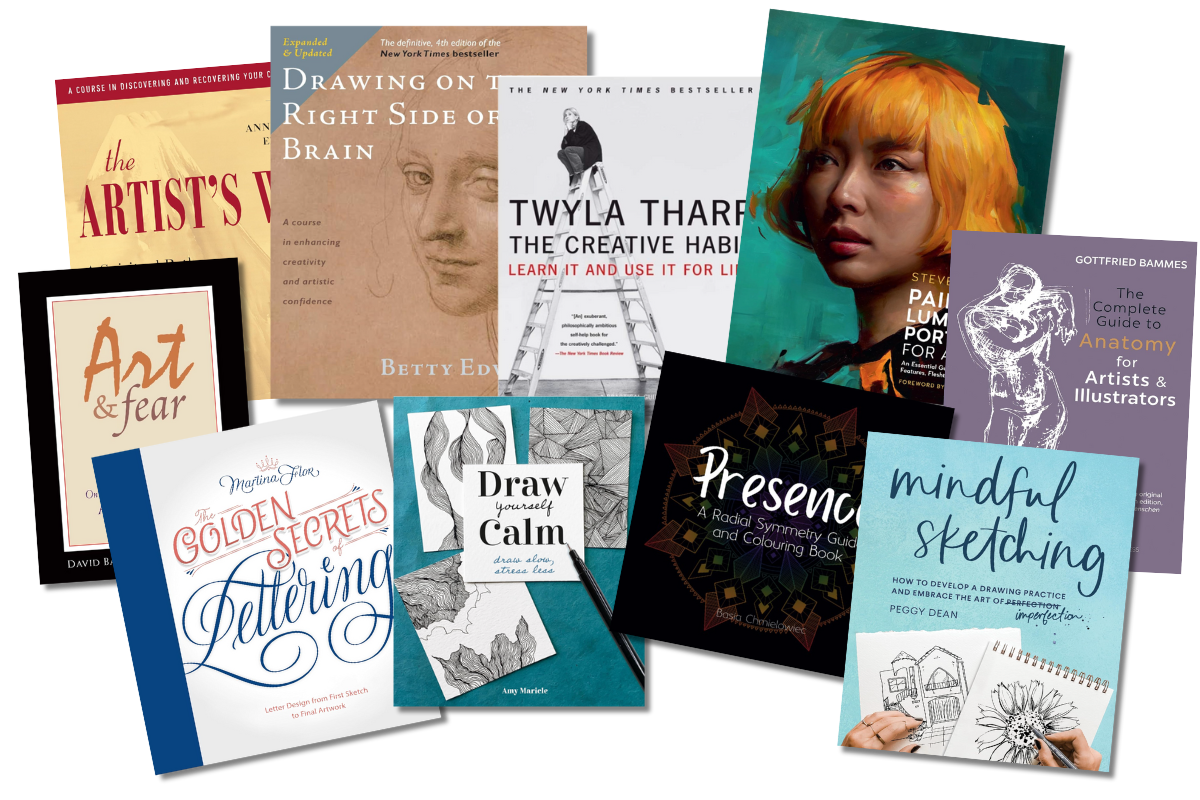
10 Art Book Recommendations

art-books-we-love

As an artist, there are countless books out there to inspire and teach. But the ones we’re sharing here aren’t “how to wood burn” books. They’re the foundation under the craft! From drawing, seeing, composition, confidence, presence. Those skills are what let you take pyrography further.

These are books we have actually read and love. The title’s are an affiliate link, and every click, at no cost to you, helps support this business. Thank you!


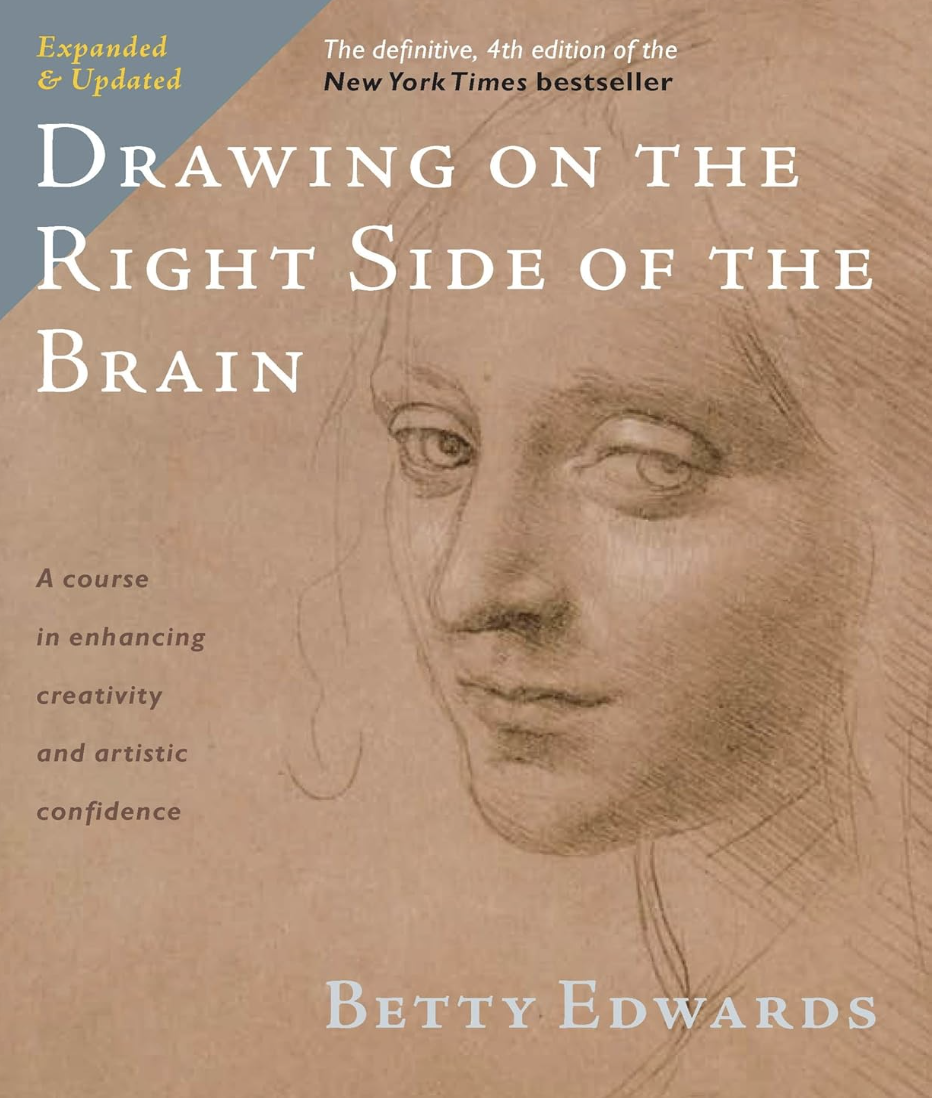
1. “Drawing on the Right Side of the Brain" by Betty Edwards

This book is a classic for a reason. It teaches artists how to see and draw objects from a different perspective, encouraging them to tap into the right side of their brain for a more intuitive approach to drawing. I love it because it rewired how I see negative spaces, edges, proportions, etc...

Pyrography takeaway: Understanding these concepts makes for cleaner linework and more accurate transfers… This means fewer “uh-oh” moments at 700°F. You’ll spot angles and gaps before you burn. You will spot AI and it’s weird irregularities before you purchase that template. For me, it created more trust in myself to burn a design that isn’t super clear on wood (like when the transfer doesn’t transfer 100% or when lines overlap and you’re not sure what is what).

 
colour-theory-on-wood

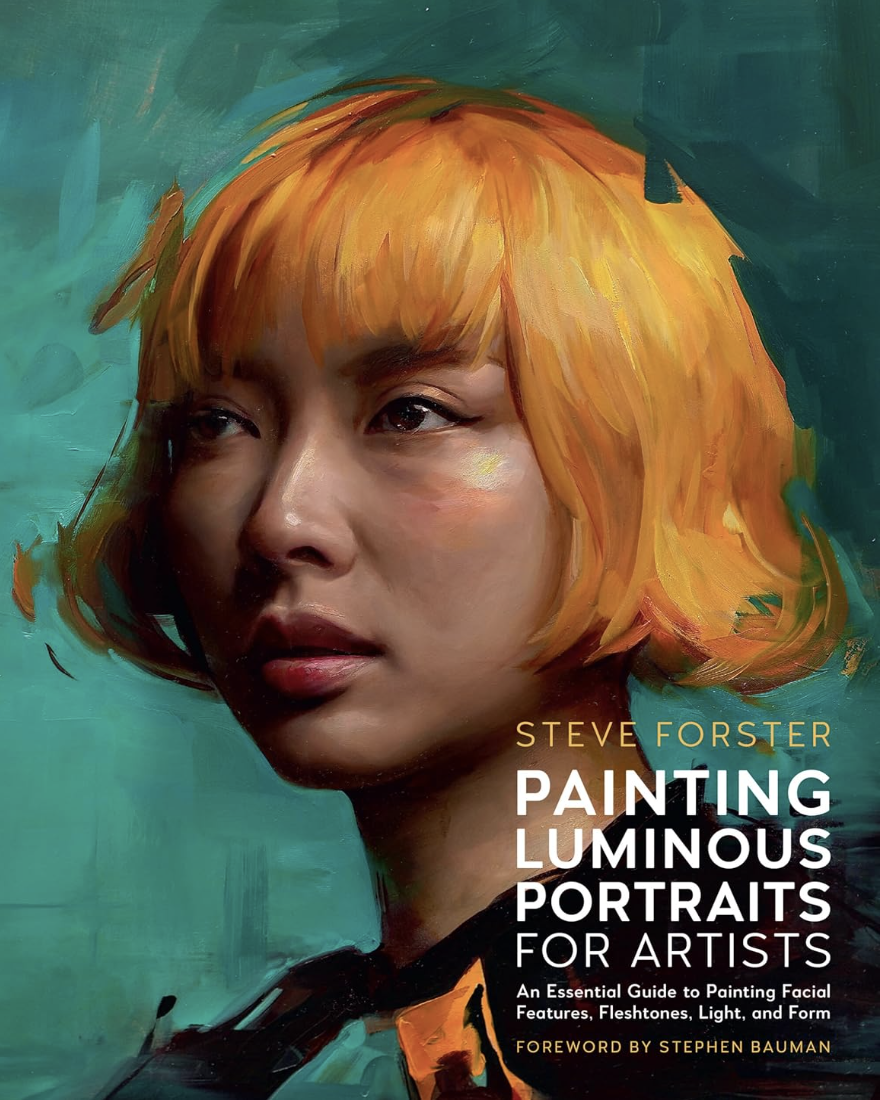
This book was recommended by a Burn Club+ member from our two-part colour class in Open Studio (watch the recording in Burn Club+ where we get to talking about the book, seeing inside it and exploring the techniques). It teaches you to build a black-and-white base, then add thin colour. These teachings apply to everything, not just faces —> plants, animals, objects, designs... Simple, step-by-step teaching on light and soft vs. sharp transitions and so much more.

Pyrography takeaway: Make a small value map. Burn from light to dark to practice shading at different depths. Add a thin colour wash over the burns to see how value affects the colours. A quick, fun exercise if you like mixing media with your burns.


This book is not just for artists but for anyone looking to unlock their creativity or get “un-stuck” when in a creative rut. It offers a 12-week program to help artists overcome creative blocks and tap into their full potential. It’s fun, it’s guided and it works!! Check out my journey with this book here —> The Artists Way by Julia Cameron

Pyrography takeaway: Every week, you are prompted to go on an artists date. Focus your dates on burning freestyle meditative art (Burn Club+ includes Burn Flows, which are just that! Guided burning exersizes in a variety of textures and styles aimed at practice and control to improve your pyro skills but in a less pressured way).


This book is a great resource for artists who want to improve their knowledge of anatomy. It covers everything from skeletal structure to muscle groups. It’s a helpful book if you want to make portraits and are interested in burning the human form.

Pyrography takeaway: Make your animal and human portraits come to life. This book will teach you how to use cylinders, planes, and bony peaks to help omit flatness and make your wood burned subject look more realistic.


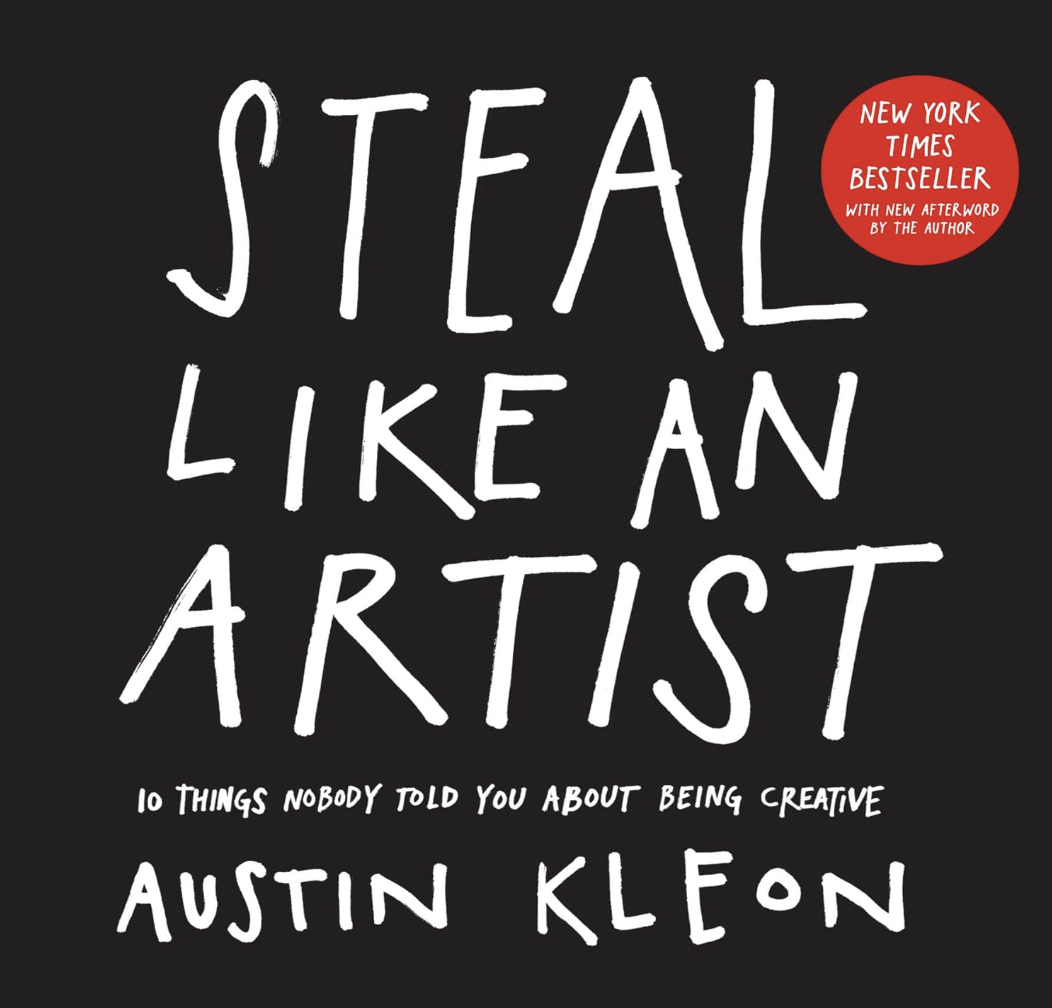
This book is a fun and inspiring read that encourages artists to embrace their influences and find inspiration in unexpected places. Often a controversial subject, Austin says: nothing is original, so embrace influence, school yourself through the work of others, remix and reimagine to discover your own path.

Pyrography takeaway: Build a collection of images or make a reference board of leaves, feathers, skulls, lettering (Check out the list of royalty-free resources or the inspiration channel in The Burn Club ) . Combine 2–3 sources, change composition, and credit influences.


This book is a must-read for any artist struggling with self-doubt and creative blocks (who isn’t though). It explores the fears that hold artists back and offers practical advice on how to overcome them.

Pyrography takeaway: Perfectionism ruins more wood slices than heat ever will (or completely doesn’t allow to start burning on the wood slice in the first place. I’ve been there too many times). Build a “sacrifice board” habit: first 3 minutes of every session are throwaway drills (or Burn Flows) to burn off jitters… Then start the piece.


Yes, this is my book. I might be biased, but I wrote it for two reasons.

First, after a lot of research and trial and error, I noticed that a many guides out there made things feel complicated and rigid. The instructions were so precise or extensive that I felt anxious about “doing it wrong.” I didn’t want that.

The second reason is more personal. Drawing (and burning) radial symmetry designs became a real mental health tool for me. It helped me slow down, focus, and breathe in a way I didn’t expect, and I wanted to share that with other people.

So I combined those two things and built this book to be simple, relaxed, and freestyle. It walks you through creating your own patterns step by step, then shows you a bunch of variations so you can use the same basics in pencil, ink, paint, chalk, and even on wood.

Pyrography takeaway: Merge the slow, relaxing rhythm of pyrography with your own radial-symmetry patterns. Create, repeat, and enjoy the calm while you burn. Burning repeating patterns is a great way to practice your techniques and improve your skills. Plus, you set the difficulty level when you learn to draw your own patterns! I created a digital version of this book so that you can easily take the designs in it and resize, print, trace then burn them as practice!


This is a friendly, picture-heavy walkthrough from rough sketch to polished lettering. It shows how to build letterforms (not just copy a font), keep spacing consistent, and add simple flourishes and layouts for quotes, signs, and nameplates.

Pyrography takeaway: Draw light pencil guidelines (baseline, x-height, slant), sketch the letter “skeletons,” then use only pyrography to burn the final letter. Lettering is often found in pyrography, but you can also find or create a font you are comfortable with and love, and make it into your signature for you to burn on your completed artworks!


This book provides gentle, low-pressure prompts that build a daily sketch habit. Short, timed exercises focus on noticing shapes, breathing through the line, and letting go of perfection. It’s a great quick and fun book.

Pyrography takeaway: Complete one of the exercises directly onto the wood! Use a pencil to follow the guidelines and then complete your artwork using pyrography. This freestyle way might just help loosen up those perfect lines.


This book is another (but more abstract) gentle, slow-drawing book with prompts (pods, pebbles, branches, simple repeats) that lower the pressure and build a steady, mindful rhythm. Short, timed exercises make it easy to show up for 5–10 minutes and leave feeling grounded.

Pyrography takeaway: Kinda like a Burn Flow, get doodling with your pyrography pen!


This book offers practical advice for artists looking to establish a regular creative practice. It explores the habits and routines of successful artists and offers insights into how to develop your own creative process.

Pyrography takeaway: This straight-talk guidance on building a repeatable creative routine can easily apply to your wood burning! Create those rituals with the steps and guidance provided.


In the end, this is our real-life stack of books we reach for (or remember lessons learned) when we want to reset our hand, push our values, or just fall back in love with making. Whether you’re new to burning or deep into commissions, there’s at least one idea here you can take straight to the board today. Grab one book, steal one tiny takeaway, and give it ten minutes, just to start.

Using household items to stain wood

natural stains on wood

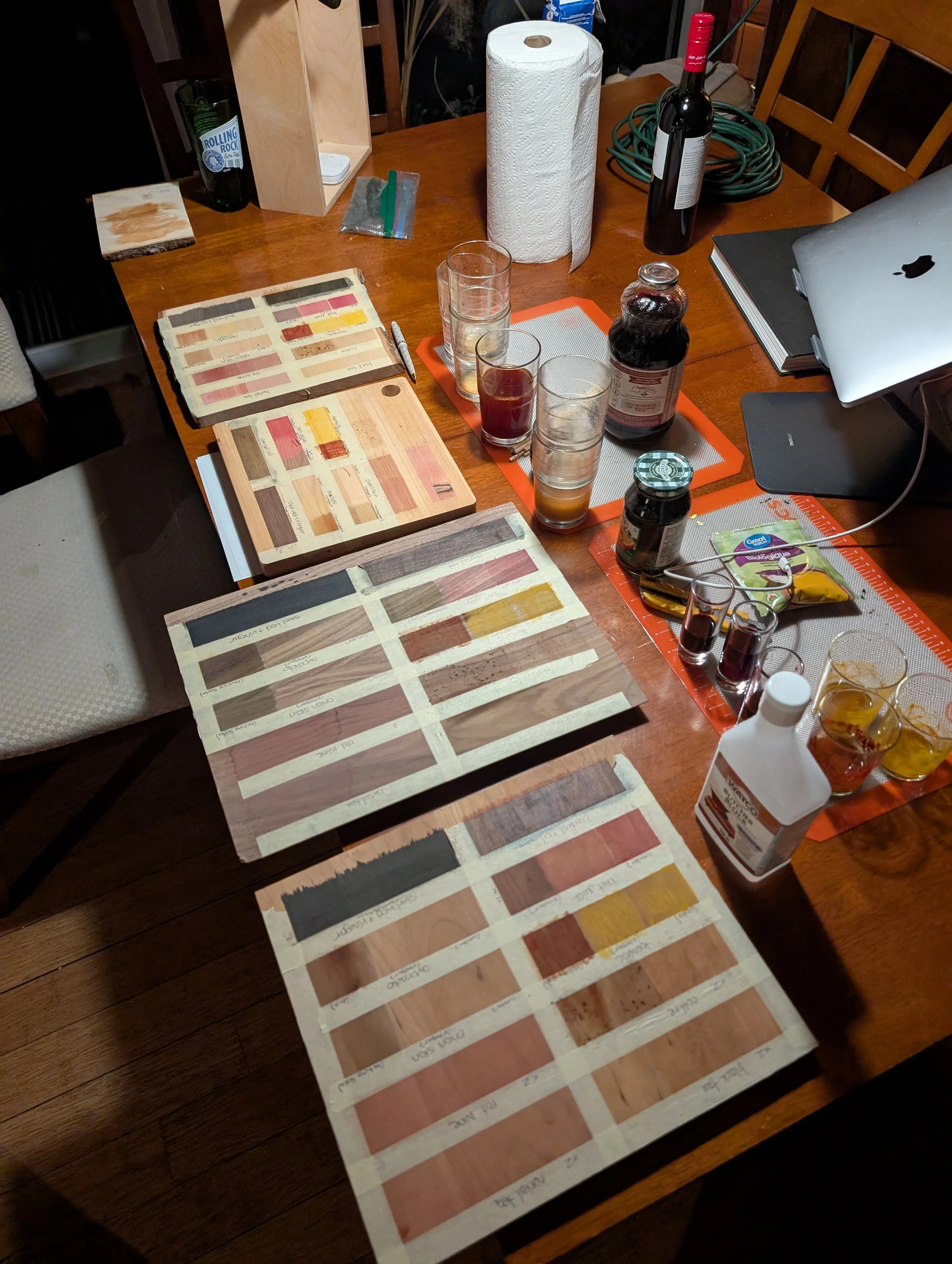
In our last live Burn Club Open Studio session, we dove into 10 natural wood stains and had a blast experimenting with them on 4 different wood species.

Everyone got to guess which stain was which on a test board, and we even played with vinegar and baking soda to see how some colours would shift right before our eyes.

Burn Club+ members have access to the replay and the extended conversation. That is where I shared photos of the piece once it has dried the next day and what they look like sealed. I’ve left them in the sun and in a little while, I want to see just how much these stains fade compared to eachother…

Below, I share four simple kitchen ingredients that anyone can try: coffee, black tea, herbal tea, and red wine.


Coffee

Coffee is packed with tannins that soak in and leave behind a soft, earthy brown.

Freshly brewed coffee gives a gentle wash, while letting it sit overnight deepens the tones and creates a richer effect.

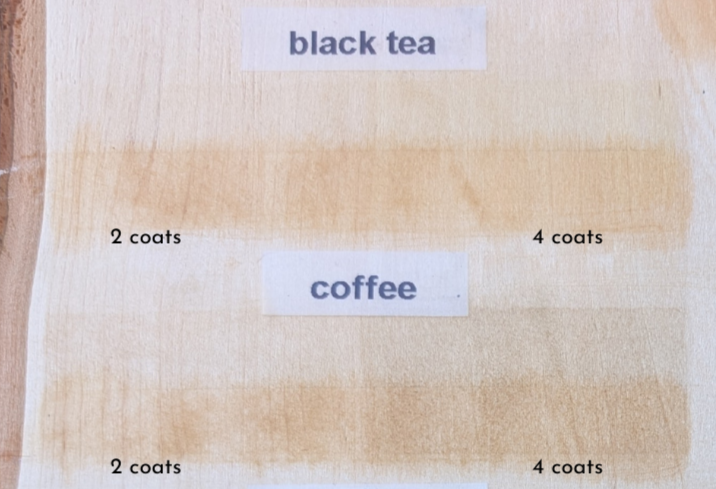
In this photo, I brewed a regular cup of coffee and even after 4 coats, it was still pretty light so go stronger if you want a darker tone. I am using Basswood here.

The bottom half of the test piece has a layer of oil/wax blend which clearly enhances the colour!

How to use it:

  1. Brew a strong cup of coffee.

  2. Let it cool, then brush or wipe it onto raw, sanded wood.

  3. Allow it to dry completely, then add more coats if you want a darker color.

  4. For an even deeper effect, let the coffee sit overnight before using; the extra strength makes a noticeable difference.

Oh and if you get little coffee grinds on it, I just let them be and wiped them away when it dried. They didn’t effect the the colours at all! I kinda wish they did, though! I envisioned them making a cool galaxy effect…


Black Tea

using-tea-as-a-stain

Tea is another tannin powerhouse. A fresh brew gives warm golden-browns. Just like coffee, if you let the leaves steep for 24 hours or more, the liquid becomes more concentrated.

On pale woods like the basswood in this photo, it can show up nice and subtly. I left the coffee example here to differentiate the two. The black tea is a warmer tone compared to the coffee.

How to use it:

  1. Brew a cup of black tea and let it steep for at least 15 minutes.

  2. For a stronger stain, steep the leaves 24 hours or more until the liquid is very dark.

  3. Apply with a brush or rag to bare wood.

  4. Let dry, then add additional coats if desired.


Herbal & Berry Teas

Berry teas often carry anthocyanins, pigments that can shift color depending on pH. You might see pinks, purples, or soft reds, especially on light woods.

The results aren’t always predictable, but that’s part of the charm (we are used to this, right? No wood is exactly the same…).

I was quite surprised with how much colour this did give. Even though I used a raspberry tea, I expected a bit more subtle earthy brown, more than this purplish tone! The bottom section is with an oil/wax mixture to see how long the stain lasts in direct sun with and without a finish (the results are all located in BC+)!

How to use it:

  1. Steep berry or hibiscus teas until the water is richly colored (for my example in the photo above, only waited 15min).

  2. Apply directly to light woods like basswood or pine for the most visible results.

  3. Build up layers if you want stronger color.

Note: These colours are more delicate and can fade quickly without sealing.


Red Wine

Red wine seeps into wood with deep purples and burgundy tones that mellow into a warm, reddish brown as they dry. At least this is true for basswood. The other woods we tried red wine on, all had varying tones of reddish/purplish brown…

Again, the bottom half has an oil/wax on it to test it against time and sun.

How to use it:

  1. Pour a small amount of red wine into a cup

  2. Brush or rag it onto bare wood.

  3. Let dry, then repeat coats for deeper color.

Tip: Like berry teas, red wine colors can shift with acidity — vinegar makes it more red, baking soda can push it toward blueish tones.


Sealing Natural Stains

Once the stain has dried fully, sealing helps protect the colour and bring out the richness of the wood. Warning! It can also take away or hide any colouring, especially if the colours were light and subtle…

For a natural finish, simple mineral oil and/or beeswax works beautifully, though both will need refreshing from time to time. These give a soft, organic look and are perfect for small projects or decorative pieces. My top favourite brands for food safe finishes are:

For a longer-lasting seal, harder finishes like shellac or polyurethane can be used, but they take the project away from a purely natural approach. I like to use Minwax Polyurethane as the spray version for most projects since it won’t smudge my added mediums, but for stains, the brush-on version works too!

No matter what you choose, sealing is what keeps the stain from fading too quickly and makes the colours come alive. For more information on this step, check out Finishing Your Wood Burned Art: How and Why to Finish Your Wood Burned Art.


Exploring natural stains is a reminder that creativity can come from the most ordinary places. A cup of coffee, a pot of tea, or even a splash of wine can completely change the character of wood and make it feel alive in a new way. Plus, these natural ingredients are better for the environment and our lungs and most likely for our wallets!

Inside Burn Club+ we take the exploration further with 6 other natural stains on each of these 4 wood species. Members also get the replay of the full Open Studio session along with follow-up photos that show how the stains deepen and shift over time.

Whether you join us there or just experiment in your own kitchen, natural stains are a simple way to slow down, connect with the process, and see what unfolds.

Can I Burn That? A Friendly Guide to Copyright for Artists

Whether you’re doodling with us in Open Studio, tracing a favourite anime still, or experimenting with Canva templates—at some point, you’ve probably wondered:

Is this okay to use?

Can I sell this?


Copyright is one of the most important and misunderstood topics in the art world.

Many artists think if they “change the medium” (like painting from a photo or burning a drawing) or “add their own twist,” it’s enough to make it theirs. It’s not. If the result is still a recognizable copy or derivative of someone else’s work, it could still be copyright infringement—even if it’s altered a lot.

And that myth about “changing 30%” to make it legal? That rule doesn’t exist. Copyright law doesn’t measure by percentage—it’s about whether the original work is still clearly present.


Lets start here: What Inspires Us?

Steal Like an Artist by Austin Kleon is a small but powerful book packed with creative wisdom. It’s written for artists, writers, designers — anyone doing creative work — and its core message is:

“Nothing is original. Everything is a remix.”

Great art comes from remixing, borrowing, and building on what inspires you. You don’t need to be a genius or wait for a lightning bolt of originality — you just need to start.

When I was 9, my family went to Disney World, and I spent the whole trip drawing Mickey Mouse over and over. As my sketches got closer to the real thing, my confidence grew. That practice — copying characters I loved — helped me believe I could draw anything. It shaped the way I learned, and I’m grateful no one told me I couldn’t draw those things.

Later, I started noticing patterns in nature — how plants, pinecones, and trees all grow outward from a single point. I filled the corners of my books with florals and spirals, then slowly moved into the center of the page. Bit by bit, my style emerged: inspired by nature, Art Nouveau and Deco, especially the lines and florals in the work of Alphonse Mucha (my favorite artist!), and repeated over time until it became my own.

That’s the thing — style isn’t born from a single source. It’s a mashup, built over time, shaped by the things you love and the ways you practice.


But while remixing and drawing what you love is a huge part of finding your style, there’s a fine line between inspiration and infringement.

As artists, we grow by learning from others — but as we share our work publicly, especially online or for sale, it’s important to understand what’s legally allowed and what crosses into copyright territory.

In a nutshell:


🚫 It’s NOT OKAY when…

  • You’re copying style and subject so closely it feels like a replica

  • You haven’t transformed the idea in a way that feels personal or original

  • You’d be uncomfortable showing it to the original artist

  • You can’t point to what you added or how you made it your own

  • You’re tracing without adding new interpretation or energy

It’s probably okay when…

  • You’re combining influences from multiple sources, not just one

  • You’ve infused it with your voice, your perspective, your weirdness

  • You could confidently say, “This inspired me,” but it clearly looks like you

  • You’d be proud to credit your inspiration, not afraid of getting “caught”

  • You’ve taken the seed, not the whole plant — and grown something different

Key idea: Changing the medium or adding your own flair doesn’t automatically make it legal. What matters is whether the result is still a recognizable copy or derivative of someone else’s copyrighted work.


What Is Copyright?

Copyright is the legal protection given to original creative work—art, writing, photos, music, etc. The moment something original is created and fixed (like drawn on paper or saved digitally), the creator automatically owns the copyright. No registration needed.


That copyright gives the creator the exclusive right to:

  • Reproduce it

  • Sell or license it

  • Display or adapt it

  • Prevent others from copying or profiting from it


🚫 Copyright prohibits artists from:

  • Redrawing or repainting someone else’s work, even in their own style, without permission

  • Reproducing it in another medium, like wood burning, embroidery, or sculpture — even if it’s by hand

  • Selling artwork that is a copy or close derivative of someone else’s copyrighted design

  • Tracing someone’s work and claiming it as their own

  • Modifying a copyrighted work and distributing it as “inspired by” or “fan art” if it’s still recognizable as the original


If Someone Copies You Without Permission

You are legally allowed to:

  • Ask them to take it down (e.g. via a *DMCA takedown or message)

  • Request credit, removal, or payment

  • Send a cease & desist letter

  • You can’t take legal action unless you register.


*DMCA stands for the Digital Millennium Copyright Act (a U.S. law), but it's widely recognized by platforms globally — like Instagram, Etsy, YouTube, Pinterest, and even Discord. You can use a DMCA takedown even if you haven’t registered your copyright. Learn more here —> https://www.copyright.gov/dmca/


Why would you want to take legal action?

Because if someone profits off your work, damages your reputation, or refuses to comply with takedown requests, registration gives you the power to actually enforce your rights. Without it, you can ask nicely—but you have no real legal ground to sue or claim damages.

You can register after infringement happens, but you can only sue from that point forward (not retroactively).


Registering Your Copyright (optional but helpful)

In Canada, the U.S., and many other countries, registration gives you stronger legal protection—especially if you ever need to sue.


Does one copyright help cover your other art?

Nope — each piece is only protected by its own copyright. Even though all your art is technically protected the moment it’s created, if you want to enforce your rights (e.g. sue or claim damages), you’ll need to register each piece (or batch) separately. One registered piece doesn’t automatically protect the rest in court.

But — having one registered copyright can help show a pattern of original authorship if someone is copying your entire style or portfolio.


How Copyright Works Internationally

Thanks to the Berne Convention, an international agreement signed by over 180 countries (including Canada, the U.S., and the EU), copyright law is pretty consistent around the world.


What if i don’t sell it? Can i redraw it, just for fun?

Fair Use or Fair Dealing can cover drawing something for fun — if it's for private, non-commercial use and not being shared widely or sold.

But…

🚫 It doesn’t automatically protect you if:

  • You post it online as if it’s yours

  • You sell prints or products with it

  • You build a following off copied work (even if it’s "fan art")

  • You claim copyright over your version of someone else’s design

Fair Use or Fair Dealing

Fair Use (U.S.) and Fair Dealing (Canada and other Commonwealth countries) are legal exceptions that allow people to use copyrighted material without permission in certain specific cases.

But they’re not the same—and they don’t mean “anything goes.”


Fair Use (United States)

Fair Use is flexible but vague. It’s judged on a case-by-case basis using four factors:

1. Purpose and character

  • Is it transformative (adds new meaning, message, or purpose)?

  • Is it commercial or educational?

2. Nature of the original work

  • More protection is given to creative works (art, music) than factual ones.

3. Amount and substantiality

  • How much of the original was used, and was it the “heart” of the work?

4. Effect on the market

  • Does your use hurt the market for the original or act as a replacement?

Example of likely Fair Use: A YouTuber analyzing a painting and showing clips to comment on techniques.

Not Fair Use: Putting a filter on someone else’s art and selling it as your own.


Fair Dealing (Canada)

Fair Dealing is more limited and specific. It only applies to certain purposes, like:

  • Research or private study

  • Criticism or review

  • News reporting

  • Education

  • Satire or parody

Even then, your use must be “fair” — courts consider:

  • Amount used

  • Purpose

  • Availability of alternatives

  • Impact on the original’s market

Example of likely Fair Dealing: A teacher using a portion of an artist’s image in a classroom presentation for educational purposes.

Not Fair Dealing: Copying an artist’s design and using it on a product you're selling.


Bottom Line for Artists

  • Neither law lets someone sell your art or republish it fully without consequences.

  • These exceptions are mostly for commentary, education, or parody—not for bypassing permission.


What About Canva Designs, Pinterest Photos or stock images?

Canva:

If you use Canva’s elements (Pro or Free), you can sell your own finished design (like a print or burned artwork), but not just the element by itself. And never resell the templates. Here is a little run-down:

  • YES: Use Canva’s elements in your designs for social posts, presentations, etc.

  • YES: Sell physical products (e.g. mugs, shirts) using your original Canva creations, if you're using Canva Pro content and following their commercial license.

  • NO: You cannot resell or redistribute Canva templates, elements, or stock photos as-is.

  • NO: You can’t upload a Canva template and sell it as your own template without major customization.

Rule of thumb: If it’s plug-and-play and you didn’t change it much, don’t sell it.


Pinterest

Straight up: grabbing images from Pinterest or Google Images and using them in your art, products, or posts can get you into legal trouble — even if everyone else seems to do it.

These are not sources, they’re search engines. However, you can use them privately for inspiration or practice.

But it’s NOT OK to:

  • Trace or copy someone’s photo or art and sell it.

  • Use Pinterest/Google photos directly in your designs, even if you “edit” them.

  • Print or post images that belong to others, even “just for fun,” if you’re gaining followers or monetizing it in any way.

  • Even if you're using 100 tiny pieces from 100 different Pinterest artworks, each one could still be protected by copyright — and you don’t automatically get away with it just because it’s small or part of something you made.


Stock Images (e.g. Unsplash, Shutterstock, Adobe Stock)

  • Free stock sites (like Unsplash): Typically okay for use in blogs, websites, etc. — but not for resale as art.

  • Premium stock sites: You need to check each license.

    • Standard license: OK for web use, not for merchandise.

    • Extended license: Needed for high-volume commercial products.

🚫 Never use a stock image as the base for a digital product you're selling unless you’ve carefully read the license and have the right to do so.


In Summary

Changing the medium or recreating the artwork in your style doesn’t make something yours if it’s still a recognizable copy. Also, just because an image is online doesn’t mean it’s free to use.

Whether you’re drawing for fun, making collages, burning them or designing with templates, it’s crucial to understand copyright rules and know what’s actually allowed.

Do your due diligence and check the original source and usage rights before including anything in your work.

You can always ask members of The Burn Club to help you out if you’re not sure.

If you want to stay safe and creative, stick with public domain resources, licensed stock photos, or your own original content. There are tons of free, legal sources out there that make it easy to build something completely yours. (I share a list of them in The Club!)

Respecting copyright doesn’t have to limit your creativity—it protects it.


Want to Read More?

Here are some solid, trustworthy resources if you want to dive deeper:

WIPO – International Copyright Law
https://www.wipo.int/copyright/en/

Canadian Intellectual Property Office
https://ised-isde.canada.ca/site/canadian-intellectual-property-office/en/copyright

U.S. Copyright Office – Fair Use Basics
https://www.copyright.gov/fair-use/

Stanford Fair Use Center
https://fairuse.stanford.edu/overview/fair-use/


How to Store Wood Properly

If you’re anything like me, you’ve probably picked up wood here and there, from art supply shops, local lumberyards, maybe even scraps from a friend’s garage, and thought, “Perfect, I’ll burn on this someday.”

I think it’s okay to hoard wood if you can stay organized…. 😅

However, if you don’t store it properly, that perfect piece might warp, crack, or soak up moisture before you ever get to touch your burner to it…

Wood is alive in a way, even long after it’s been cut. It expands, contracts, and breathes with the environment around it. Storing it with a bit of intention will save you from a lot of frustration (and wasted surfaces).

By the way, this post came out of a great question that popped up in The Burn Club. We’ve been chatting about it in the Burning Questions channel, so if you’re curious to see how people are storing their wood, or what they use to help keep humidity at bay, join the conversation here (this link will take you directly to that convo! Sign up to The Burn Club to get access).


Flat Storage versus Upright

You may hear advice to always store wood flat, especially when it comes to longer pieces, but there is more to it than that. For pyrography surfaces which are generally smaller, especially thinner rounds or panels, bowing can happen whether they’re flat or standing upright.

What really matters is that the wood is supported and exposed to air evenly. If you’re short on space, it’s completely fine to store pieces upright as long as they’re not leaning at a sharp angle or pressed too tightly together.

Below I have wood slices in an old shoe rack. They are not fully upright but enough to save space without them bowing. They are on a slight angle which makes it easy to look through and take them out. In this case, I do not have spacers here (and there are little cookies at the bottom stacked on top of each other) because these are in constant rotation.

Also, the ones in this picture that are wrapped in plastic have been professionally kiln dried from a well known company which I have used many times so I know there is no moisture in there!


Flat stacks can work too, but always give them breathing room (using stickers or spacers, see air circulation below) so moisture doesn’t get trapped. And if a piece does pick up a bit of a bow, don’t panic: light warping often flattens out once you tape or clamp it down for a period of time (faster if there is more humidity or heat in the air. In the end, it’s less about position and more about airflow.

Some ideas for storage can include:

  • Magazine racks or file organizers – perfect for upright storage of panels and slices, and easy to flip through like papers.

  • Dish drying racks – they already have built-in slots that keep pieces separated with airflow.

  • Wire baskets or milk crates – stackable, breathable, and easy to move around.

  • Pegboard with hooks – hang lightweight rounds or thin slabs like art in progress.

  • PVC pipe sections – cut into lengths and stacked like cubbies to slide wood slices into.

Air Circulation is Key

Wood needs to breathe. If you stack your pieces, don’t press them tightly together like pancakes. Place thin strips of wood (called stickers in woodworking) between each layer so air can circulate. This keeps moisture levels balanced and reduces the risk of mold or mildew.

If you’re working with smaller pyrography surfaces (rounds, plaques, offcuts), you can improvise stickers from:

  • popsicle sticks

  • thin offcuts

  • even cardboard strips (not ideal long term, but works in a pinch)


Avoid Direct Sunlight and Heat

Too much direct heat or UV exposure will dry out wood unevenly. Cracks, splits, and discolouration are all risks. Instead, aim for a cool, dry, shaded spot — a closet, basement shelf, or dedicated storage bin.


Watch the Humidity

If you live somewhere humid, or with fluctuating temperatures, like I have in Canada, you’ll want to keep an eye on moisture. A dehumidifier in your storage area can work wonders for super humid spaces. On the flip side, if your air is bone-dry, consider adding a little humidity so your wood doesn’t get brittle. The goal is balance.

For smaller pieces, if you’re storing wood in a bin:

  • Skip airtight plastic bins. They trap humidity inside like a greenhouse. Any moisture that’s in the wood (or the air the day you closed the lid) will stay there, which can lead to mold.

  • Go breathable if you can. Cardboard boxes, wooden crates, or cloth bags allow air exchange. If you do use plastic bins (because hey, sometimes it’s the easiest option), keep the lid cracked or drill a few small holes for airflow.

  • Add a moisture buffer. Toss in a handful of silica gel packets (like these or make your own) or a small dehumidifier pouch that will absorb excess moisture (I use these Charcoal Air Purifying Bags. What’s awesome about these are that they last for 2 years! All you need to do is dry them out in the sun once in a while; I do that about once every 2 months and there really is a difference - I have a sensitive nose and any smells that were present all disappear).

  • Don’t stack tight. Just like before, use stickers or at least avoid pressing pieces flat against each other. Even inside a bin, you want air circulation.


Keep Surfaces Clean and Protected

Dust, oils, or chemicals can seep into wood and make burning unpredictable and even toxic. Store your surfaces in a clean space, and if you’re keeping them long-term, wrap them in brown kraft paper or cotton cloth (breathable, but protective). Avoid plastic wrap, which traps moisture.


Label Your Stockpile

This one might sound a little extra, but the future-you may thank present-you. If you’ve got different species of wood, you may want to consider labelling them. They all burn differently and recognizing them after you’ve ripped off the labels might be tricky. Having them organized means less guessing when inspiration strikes.

Besides airflow, at the end of the day there isn’t just one right way to store wood. What matters is that your surfaces stay stable, dry, and easy to grab when inspiration strikes.

Sign up to The Burn Club to join in on conversations, participate in wood burning challenges and learn everything you need to know about pyrography!!

Why Is My Pyrography Fading? (And What You Can Do About It)

One of the most common and heartbreaking frustrations in pyrography is when a piece that once looked rich and beautiful starts to fade over time — even when you've sealed it! I recently got a message from a fellow pyrographer, Mary, who's been burning for years but noticed her pieces fading within 6–12 months, even when they're kept out of direct sunlight. She’s using UV-protective Varathane (both oil- and water-based), applying 2–3 coats, and still watching her art disappear.

So, what’s going on?

Well, first just know that you are not alone. One thing every pyrographer learns eventually — sometimes the hard way — is that wood is alive, even after it's cut. It breathes, it shifts, it absorbs, and it ages. No matter how careful you are, no matter what finish you use, wood will change over time. And so will your artwork.

Why? Because wood is porous, hygroscopic (a material that can absorb moisture from the air), and reactive. It contracts and expands with the seasons. UV light, even in small amounts, can affect its color. Finishes can deepen, amber, or dull. And depending on the species, the burn may sink into the grain or slowly soften as the wood moves.

Sometimes these changes are visible (especially with thinner pieces of wood - they may bow slightly) and sometimes you wouldn’t have a clue that wood can actually shift so much.

This doesn’t mean you should stop burning — it means you’re working with a living canvas. Understanding how wood changes helps you anticipate, adapt, and choose the right methods to give your work the longest life possible.

Let’s explore the possibilities and what you can try to prevent fading:

1. Burn Depth and Darkness Matters

If the burn is very light or surface-level, it may not stand up well, even under varnish. Try burning a little deeper and darker on test pieces — even a small difference can help the image hold up over time.

To be honest, this is ALWAYS my main advice.

Especially when you want the art to be finish-free, try to burn deep.

The way I burn my art is more like carving into the wood, I don’t do very much traditional shading. I generally use linework with my chisel tip.

And to create darkness or for covering larger areas, I love to stipple because its super satisfying and allows me to go deep into the wood.

However, your style is your style and the piece might have no other option (especially in realistic burns, or portraitures and such) than to shade using other techniques to achieve a smooth gradient shade (or tonal shade) and so we move on to other options below.


2. Know Your Finish


Not all finishes are created equal.

Most finishes (especially water-based ones) and most wood species (especially dark toned ones) can soak into the wood and the burn, slightly diluting or softening the edges of your burn marks. This can reduce the crispness and contrast you worked hard to create — especially if your burn was on the lighter side. Check out this isolation coat trick to prevent this first step in protecting your burned art from fading: Isolation Coat/Primer and Wood

Glossy finishes (even clear ones) can reflect light in a way that makes the burn appear lighter or less defined, depending on the viewing angle. This effect can be stronger on lighter woods or if the piece is seen under strong lighting.

Always test first and check out this post for finishing your artwork: Finishing Your Wood Burned Art: How and Why to Finish Your Wood Burned Art

3. Pre-Sealing or Fixative Tricks


A coat of UV-resistant finish is your best bet. There are some options here from most intense (and best) to least strongest:

1. Marine Spar Varnish: It’s designed for boats, so it holds up in harsh environments, but it can yellow slightly because it’s oil based. Can be easily reapplied every year or two (or when needed). You just have to clean it, give it a light sand and reapply!

2. Spar Urethane: Easier to work with since it’s water-based. Also easy to reapply when needed.

3. Epoxy Resin (with UV stabilizers): This add a thick clear coat which is beautiful and long lasting, but make sure you get one that is resistant to UV. Most resins tend to yellow over time and if the environment is harsh, they still can crack. Re-applying requires a lot of work (sanding it down properly). It’s also a very pricey option that is messy to work with.

4. Acrylic UV-Resistant Spray: This one is the easiest to apply and reapply (just spray on which is great if you have colours since they will not smudge) but it will not last quite as long as the above options.

5. SunShield Outdoor Furniture Wax: It’s not so much a ‘finish’… It’s a wax. It’s designed to protect both the wood finish and wood colour from sun fade.

As mentioned in the previous step, Isolation Coat can be used as a pre-seal: Isolation Coat/Primer and Wood. It creates a clear, non-reactive barrier that protects your burn from the final varnish soaking in or shifting tones. It will NOT work with the wax. Wax is meant to soak into the wood! But it works well under both water-based and oil-based varnishes and sprays and can also be used on top of other mediums, like watercolour.


4. Wood Type and Prep


Soft woods like pine or basswood absorb burns differently than hardwoods like maple or cherry. Make sure your surface is well-sanded and dust-free, and consider experimenting with harder woods if fading is a frequent issue (or if piece will be exposed to harsh elements).

The way wood is dried before you burn on it can make a big difference in how it performs over time. Kiln-dried wood is heated in a controlled environment to quickly remove moisture. It’s more stable than green or freshly cut wood and less likely to warp or crack after burning. This makes it a common choice for pyrography, especially for pre-cut blanks.

But here's the catch: kiln-drying doesn’t eliminate all movement. Wood still responds to its environment. Humidity changes, heat, and light will continue to affect it, even after it's been dried.

Air-dried wood, on the other hand, is dried slowly and naturally over months (or years), which some woodworkers believe helps the wood retain more of its natural character. But it can also be a bit less predictable — and if it’s not fully cured, it might still release moisture or warp as it continues to dry post-burning.

But, no matter how it’s dried, wood will still expand and contract, and that motion can subtly affect your burn lines or the way finishes sit on the surface.


5. Time and Environment

This piece here was hung outside and battled the intense Canadian weather for about 4-5 years now, which is not actually too bad!

faded-pyrography

It was finished with resin - and even with the strongest kind of finish, it still aged greatly. I think when I re-do this sign, I will use the boat varnish and just reapply every year or two…

This piece however, was done around the same time and is as crisp as day one:


It’s been in my studio, up on a shelf out of the sun…

But even pieces kept out of sunlight may still be exposed to UV light or fluctuating humidity levels but your best bet is to keep it our of direct sunlight and out of moisture (no bathrooms or near kitchen sinks), no matter how it’s finished.

Store or hang your art in dry, stable environments when possible, and educate customers on ideal display conditions.

Extra Tips:

  • Even UV finishes degrade over time—reapply yearly if kept in direct sunlight.

  • Avoid placing it in direct window sunlight if possible—UV glass or films on windows can help.

  • Use archival ink or pigments underneath your finish to resist fading better.


Have your own tip or experience with fading burns?

Drop a comment or or join the conversation in The Burn Club!

11 Tiny Pyrography Project Ideas

Sometimes, the best way to hone your pyrography skills isn’t by tackling big, time-consuming projects—it’s by embracing the small ones. Tiny pyro projects are perfect for quick practice, thoughtful gifts, or even selling at craft fairs. Whether you’re a beginner or an experienced wood burner, these 11 ideas will inspire you to create something small but impactful.

*For safety reasons, make sure your surface is UNFINISHED, clean and dry. Check out our safety tips here: Safety in Wood Burning

**Some of the products or materials mentioned in this post may include affiliate links, primarily through Amazon. This means that if you purchase through these links, I may earn a small commission at no extra cost to you. I only recommend items I have tried and love.


1. Guitar Picks

Burn cool designs onto wooden guitar picks for a customized, artistic touch. Add initials, music notes, or tiny flames to make each pick unique.


2. Hammer

A wooden-handled hammer is the perfect canvas for a functional yet artistic pyrography project.

Whether engraving a name, a special date, or intricate designs along the handle, burning into wood transforms an everyday tool into a meaningful keepsake.

A personalized hammer makes a great gift for woodworkers, DIY enthusiasts, or anyone who appreciates craftsmanship with a personal touch.


3. Bookmarks

Create beautiful, durable wooden bookmarks that will last a lifetime! Using thin wooden strips, burn floral borders, geometric designs, or even your favorite book quote.

A simple ribbon or leather tie at the top adds a perfect finishing touch.


4. Tiny Magnets

Wood-burned magnets are a fantastic way to add personality to any fridge or magnetic board.

Use small wood rounds or squares, burn designs onto them, and attach a magnet to the back.

Personalized initials (or the whole alphabet!), miniature animals, or symbols are great choices for these tiny canvases.

Check out our full tutorial on these cute little magnets here: Make Mini Fridge Magnets


5. Keychains

Small enough to carry everywhere but detailed enough to make a statement, pyrography keychains make perfect gifts, souvenirs, or even small-scale art for sale.

With endless design possibilities, each burn brings warmth, character, and a little piece of nature into your pocket. Try burning on these classic wood slices, leather or other wood designs for this fun project!


6. Earrings, Pendant or Jewelry Charms

Lightweight wooden shapes can be transformed into custom earrings or necklace charms. Burn intricate patterns, abstract designs, or tiny flowers onto them, then add earring hooks or jump rings for an instant wearable art piece.


7. Pocket Affirmations

Create small wooden tiles or small paper ones with positive affirmations or tiny symbols of encouragement. These can be carried in a pocket or a wallet and kept or given as little reminders to friends and loved ones.

Below are some pyrography themed ideas that can turn a small piece of wood into a meaningful keepsake:

  • Burn bright

  • Ignite your passion

  • Steady as the roots

  • Embers never fade

  • Flame within

  • Grow like the forest

  • Fuel your fire

  • Rooted in strength

  • Let it smolder, then blaze

  • Carve your own path

  • Let sparks fly

  • The forest whispers wisdom

  • Rise like smoke

  • From ash, we rise

  • Fire and focus

  • Stand tall like the trees

  • Glow softly, burn fiercely

  • Wood, fire, spirit

  • Kindle your light

  • Forge your way


8. MAgic wand

Challenge yourself by burning on a small branch or chopstick. Sand either to make your surface smooth and look like a wand! This tiny project is perfect for adding intricate details like swirling vines, celestial symbols, or ancient runes along the shaft.

Burned textures can create a natural grip, while spirals or tiny stars give the wand an enchanted feel. Whether used as a whimsical desk ornament, a costume prop, or a personalized gift, a hand-burned wand brings a touch of mystery and creativity to any collection.

Finish with a light wood stain or natural beeswax to enhance the details and give it an aged, mystical look.


9. Mini Plant Markers

Upgrade your garden with handcrafted plant markers. Burn the names of herbs, flowers, or vegetables onto small wooden sticks or popsicle sticks.

Not only are they functional, but they also add a rustic charm to any garden or indoor plant collection.

Check out this blog post for step by step instructions: DIY Wood Burned Plant Marker


Burned by Aly of @alyoopsartistry

10. Music Box

A small wooden music box is a perfect canvas for pyrography, allowing for intricate designs on the lid and sides.

You can create a vintage feel with aged wood effects or carve out tiny borders for added elegance. This tiny project is a great way to add a personal, artistic touch to a functional keepsake, making it an ideal gift or sentimental treasure.


11. Dice or Game Pieces

Love tabletop games? Make your own custom dice or game pieces by burning numbers, symbols, or even tiny illustrations onto small wooden cubes.

Whether you create a simple tic-tac-toe set or a fully customized RPG (Role-Playing Game) dice set, this project is a fun challenge.


Tiny pyrography projects are a fantastic way to practice your skills without committing to large pieces.

They’re quick, satisfying, and make wonderful handmade gifts. Whether you’re making something for yourself or selling your art, these small projects prove that even the tiniest burned details can leave a big impression.

What’s the smallest pyrography project you’ve ever made? Let me know in the comments!

Metallic Gold and Wood

I am obsessed with metallics—there’s something about the way they catch the light and shift with every angle that makes them feel almost alive. But what I love even more is pairing that shimmer with something completely opposite, like the raw, organic texture of wood. There’s a contrast between the two that makes the shine feel even more dramatic.

metallic-medium-on-woodslice-gold

Here is how this started.

A single mushroom and a gold gel pen. The idea was simple—just a touch of shimmer to highlight the design. But as I slowly filled it in, I realized how long it was taking (I was using a gel pen), and my mind started wandering. Were there better ways to add metallics to wood? Could I get the same shine with less effort? Or MORE shine????? That curiosity sent me down a rabbit hole, testing as many metallic mediums as I could get my hands on. As you can see in this little mushroom, I ran out of room…

So, I grabbed a wood round and an end grain piece and tried out a variety of metallic mediums to see how they performed. The results? Not as much difference between the two wood surfaces as I expected, but definitely some interesting discoveries when it came to the materials themselves.

Oh, I also experimented with adding an underlayer (check out: Isolation Coat/Primer and Wood) but I did not see a massive difference with or without it. I think the most important piece here is to have the wood sanded smoothly.


Here is what I tested

(from my most favourite to least) and the results I found:

  • Gold foil

  • Gold leaf

  • Acrylic markers

  • Watercolors

  • Calligraphy ink

  • Metallic gel pen

  • Metallic pencil crayons

  • Water-based paint markers


Gold foil

This is my dream medium! I only tried the Deco Foil brand in gold but it comes in SOOOO many different colours including the classic rainbow irridescent one. All of them are so solid and so juicy looking.

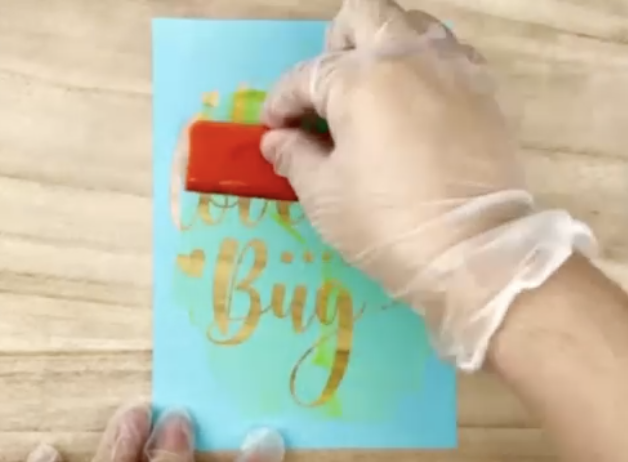
It’s fairly easy to apply: Put a liquid down solution down, it dries, then you apply the gold foil. The liquid part of gold foil (and gold leaf) application is typically called gilding adhesive or size. It does dry, but it stays tacky until the gold foil/leaf is applied. It seems straightforward but, as you can see in the video at the beginning, it does take a little bit of practice. Here are some tips I learned along the way:

  1. You need patience: I tried to put the foil on too quickly and it was not fully dried so it didn’t stick.

  2. Do not overapply: Its hard to get a smooth consistent thickness. If it’s too thick, it can stay gummy and not dry evenly.

  3. Do not underapply: If it’s too thin, the wood can absorb it and so it dries without the tackiness. I think that is what happened on some of the edges of the mushrooms with both the gold leaf and foil. The leaf/foils just didnt adhere perfectly, especially in the tiny spaces.

  4. Better on flat surfaces: The application process, as you can see in the picture, is the gold medium on a plastic film. Once you press the gold side to the gilding adhesive, the gold sticks and the plastic part is clear. Tis is not ideal for rounded, bumpy or imperfect surfaces (like if you want the bark gold).

For the perfect finish, next time I will ignore the burn lines and my details and just add the foil on top and then use an tiny knife or needle to gently dig them out if the burn lines if they do get stuck in there. It’s a delicate medium so its not difficult and I think it’s worth the work to have a perfect edge.

There were two different ways of applying the liquid. First was a pen/marker style and the other a paintbrush.

  • Marker Style: I really disliked this. I found it took really long in large areas and was hard to get into super small areas because the tip was so thick. If I went over some spots to make it thicker, it would almost scratch the first layer off.

  • Paintbrush: This applied like white glue. It just flows out of the bottle. It says not to leave strokes but that was really tricky, especially if the wood is not sanded perfectly. BUT I was able to use different sized brushes, getting into the nooks and crannies of my design. It was a much more pleasant experience than the marker, even being able to see some strokes. This liquid was actually meant for the gold leaf, but works with the deco foil too.

metallic-medium-on-wood-gold-foil

This is the pen/marker style applicator.

metallic-medium-on-wood-gold-leaf

This one applies like a white glue (link is to the deco foil brand).

Gold leaf

Gold leaf is VERY comparable to the gold foil in the final look.

The application however... It is the same process as the foil; the gilding adhesive (liquid solution) is applied and the leaf sheets placed on top (once the adhesive dries and becomes tacky).

But the gold foil is very delicate. The sheets are super super thin and I felt some was wasted because they stuck to my fingers - you’re supposed to use tweezers but when I tried, it was too aggressive and ripped little pieces off… At one point I laughed too hard and pieces blew all over the place.

I just used the paintbrush application as I did not like the marker style one.

It’s a little more forgiving than gold foil when it comes to adhesion. I felt the foil was finicky and needed a perfect glue application but the leaf, because it’s so delicate, adhered to more.

Also, if you want to cover round areas, or bark that is jagged and imperfect - gold leaf would be ideal. It’s easy to get into any uneven space, not like the gold foil.

There are different colours now and even cool variegated patterns (having multiple colors or variations in color, often in a random or patterned way). These kinda look like weathered metal. I am yet to see the classic rainbow iridescent one (which I will be using in the gold foil for my next project so stay tuned)! I announce these fun things in The Burn Club, so if you aren’t signed up to this monthly(ish) newsletter and want to know what I am up to, sign up here.


Acrylic markers

I LOOOOOVE THESE oil-based paint pens! They have such good coverage, and they are supply easy to apply - just colour it in like a regular marker!

Artistro has a water-based version so make sure you get the acrylic one because there is a day and night difference!

These ones are no gold leaf or gold foil but still are shiny and metallic.

Use the coupon code WBC at checkout for an extra 10%off!

You need to shake these up to make sure the metallic-ness comes out. The tip comes unused so it needs a bit of pumping at the beginning, but it doesn’t take too long.

I was worried about them drying up, but I have let mine sit for a few months and it still flows nicely!
I used them in my sketchbook (on paper) and they are just as beautiful!


Watercolours

metallic-medium-on-wood-watercolor

Soft, shimmery and controllable shine! So close to the acrylic markers, but because you need water and a brush for these, I chose them to be in 4th place.

The shine is stunning though!

These are from Zahra Ammar and she handmakes them! Check her shop out here. She sells other things, so you can peruse through her stunning artwork, or scroll to the bottom to see what she has available.

I will probably dive into watercolours themselves and experiment with a few brands because they are fun and versatile - you can add a thin layer of gold so you can see your beautiful wood grain AND have a shimmer or you can lay it on thick so there is no transparency. The acrylic markers can’t do this…

In the meantime, if your interested and have some watercolors already, check out: Adding Watercolor to Wood


Calligraphy ink

This ink medium really surprised me. I love the tone of gold compared to the others. It is more yellow than green (but that is something you can usually choose). It also came out more metallic than I expected.

The application was interesting. Normally, it is meant for a pen like tool, like this one I am holding. Using this tool, you can get a very consistent gold line - great for outlines and details.

I, however, wanted to fill in the whole mushroom cap, so I dropped it on the wood with the dropper and then used a paintbrush to spread it. It spread nicely but the liquid was a little finicky. You need to let the bubbles settle after shaking it up, otherwise it comes out a little curdly. Or I didn’t shake it enough… You need to shake this up a lot!


Metallic gel pen

These gel pens are really good (the silver and white are equally awesome). The application was smooth and from all the brands I’ve tried so far, I like this one the best (but it was also brand new, so maybe that has something to do with it…). I guess more experimentation is needed.

The shine is present, but still not super metallic.

I love this though because it’s easy to control - like a normal pen, and you can get super super small details!

Going over one spot creates a little bit of scratch lines which I really don’t like, so I think i will stick to using this for details instead of larger areas (which is fine because it takes a while to fill in a large area with such a small tip).


Water-based paint markers

Same as the acrylic version of these, the application is amazing - just colour in like a regular marker. The coverage is good, but the shine is nothing compared to the acrylic ones. I feel like you need to mix/shake them very very very well - more than the acrylic… These are the ones I used.

Use the coupon code WBC at checkout for an extra 10%off!

What I did like about them was that they are still “metalic” looking, AND they are easy to wash away, because they are water-based. This means I can let my daughter use them freely.


Metallic pencil crayons

metallic-finish-on-wood

More texture, less shimmer. I like my colours rich and heavy, and these fell a little flat, especially compared to all the other options.

Pressing hard while using them felt like I was denting the wood a tiny bit making it look a little scratched… SO I had to do layer by layer.

I also don’t love that its not solid metallic, its more sparkly. It’s like a goldish tone/colour but has tiny little silver sparkles in it. Not super metallic….


Have you tried metallics on wood before? What’s your favorite medium?


What Do Tree Rings Mean?

Trees aren’t just big, beautiful leafy giants. They’re like nature’s diary, quietly keeping track of what’s been happening year after year.

Tree rings tell the story of a tree’s life, reflecting years of growth influenced by environmental conditions.

When working with wood for pyrography, the natural grain and growth patterns play a big role in how the wood responds to a heated tool.

Variations in the rings create differences in wood density, which can affect how evenly it burns. Some areas may require more heat to achieve the same depth of burn, while others might be prone to cracking. Understanding these natural patterns helps artists choose the right wood and adjust their techniques for the best results.

Lets Start At The Beginning.

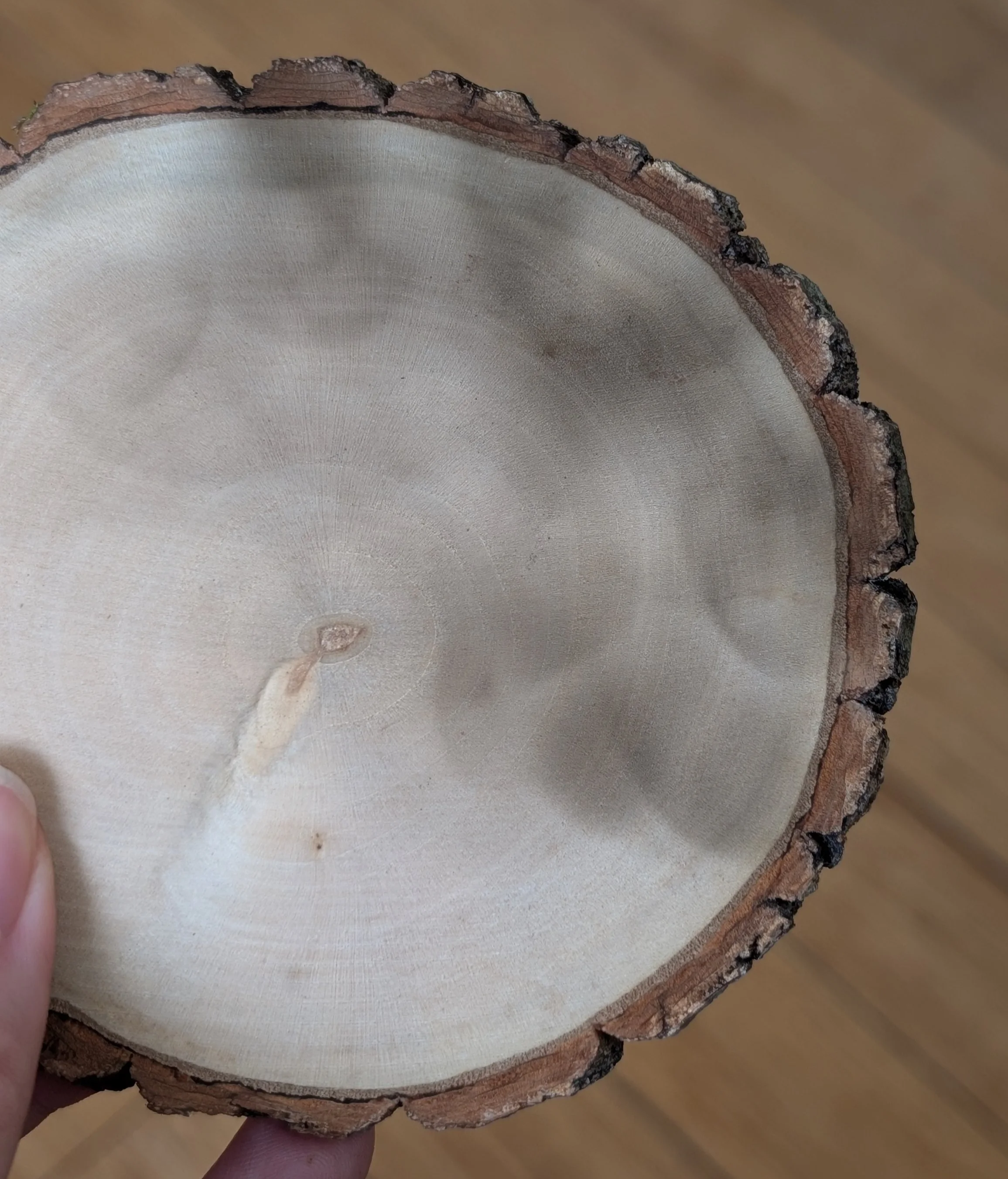
The center of the tree rings is called the pith.

It’s the very first part of the tree that formed when it started growing as a seedling. The pith is important because:

1. It Helps Identify Growth Patterns

The position of the pith in a wood slice can tell you how the tree grew:

  • If the pith is in the exact center, the tree had even growth on all sides.

  • If the pith is off-center, the tree may have experienced uneven growth due to environmental factors (e.g., leaning toward sunlight, growing on a slope, or stress from wind).

2. It Shows How the Tree Handled Stress

  • If a tree experienced injuries, disease, or environmental challenges, the rings around the pith may be uneven or distorted.

  • In this image above, the fact that there seem to be two centers suggests the tree may have faced early damage or split growth. More on that below.

3. It Affects the Wood’s Strength and Usage

  • The pith is often softer and weaker than the surrounding wood.

  • In woodworking or pyrography, we should try to avoid using wood slices with cracks around the pith because they are more likely to split over time, unless of course that is part of the vibe. Often the working with the natural cracks and knots of the wood is the most fun!


It Looks Like This Slice Has Two Piths

The appearance of two centers in the wood slice suggests the tree experienced early disruption, such as a forked growth where two competing trunks merged or a large branch fused into the trunk. Both scenarios result in irregular growth patterns, affecting the wood’s density and stability.

For pyrography, these variations can impact how evenly the wood burns, with denser areas near knots requiring more heat and potentially causing uneven burning or cracking.


What Tree Rings Say About a Tree’s Life

By counting the rings from the center outward, you can estimate how old the tree was when it was cut (for most tree’s - but not all of them)!

Each ring shows a year in the life of the tree.

Each ring is comprised of a light colour and dark colour ring: during spring and early summer, there is more water available and trees grow faster, forming a lighter, wider band called “earlywood.” As the year winds down into late summer and fall, moisture is reduced and growth slows; the tree adds a darker, denser band called “latewood.” Put those together, and you’ve got one year of growth.

Count the rings from the center to the edge, and you’ve got the tree’s age. But the story doesn’t stop there—the size, color, and little details in the rings reveal a lot more about what’s been going on.

Here is a good example image from NASA’s Global Climate Change News!

Good Times vs. Tough Times

  • Wide rings: These happen during good years with plenty of rain, sunshine, and solid nutrients in the soil.

  • Narrow rings: These pop up during tough years when there’s drought, bad weather, or not-so-great soil conditions.

Fun fact: Tree’s that grow in dry climates, versus wet ones can be the same age but the one growing in wet conditions are double, triple or more the size because their rings are wider!

Big Events Tree rings can capture snapshots of major events, like:

  • Fires: If a tree survived a fire, you might see scars or weird patterns in the rings.

  • Floods: Rings can look a little funky when the soil stays soaked for too long.

  • Drought: Dry years usually mean skinny rings.

  • Other Damage: A storm, pests, or even people can mess with a tree’s growth and leave marks in the rings.

  • Disease: Some tree illnesses can leave their own signature in the wood.


Trees, History and Climate

Tree rings are like a cheat sheet for studying natural events in the past and also how the climate has changed over time. They give us a glimpse into weather patterns, temperatures, and even big shifts in the atmosphere. All this info helps us understand what’s happening now by looking at what’s happened before.

For example, in this article: A multifault earthquake threat for the Seattle metropolitan region revealed by mass tree mortality (Science Advances, 27 Sep 2023) scientists used tree rings from submerged forests in the area to uncover evidence of past earthquakes. A major quake around 900 C.E. caused landslides that drowned trees, and their sudden growth changes mark the event. This research helps date ancient earthquakes and shows the risk of multifault ruptures, which could lead to bigger, more destructive quakes in the future!


A Wood Burner’s Perspective

As someone who loves pyrography, I think tree rings add extra magic to every piece. Each burn interacts with those natural lines, bringing out the unique story in the wood.

The density and grain pattern of the wood will influence how a pyrography tool interacts with the surface. Woods with tighter grains may require different techniques compared to those with wider grain spacing. Got some knots in your wood?? These slow down the process even more than the rings do. On top of that, the species matters as well as the conditions it grew in. So wild!

Generally speaking though, the grains on the wood are more dense, therefore they will take just a pinch more time/heat to burn through which can make for some “blobbing” or inconsistent lines…

My best advice

Go slow. When you move fast, you need to act fast. But when you move slowly (start with a lower temperature), it gives you a chance to understand your wood slice and the grains in it.

Super bonus if you can practice on the back of the slice or on another slice of the same species.

In summary

Tree rings aren’t just about counting years… they shape the way your burn behaves! Softer rings can catch your tip and darken quickly, while denser ones slow things down or resist the heat quite a bit. They can guide your linework, interrupt your flow, or add unexpected texture. Understanding them doesn’t just help you work with the wood, it helps you read its story. Every piece holds its own rhythm, shaped by weather, drought, and time. The next time you sit down to burn, take a second to trace those rings with your eyes before your tool. It’s nature’s way of saying, “Here’s what I’ve been through. Now it’s your turn.

To learn more about wood, check out: Intro to Wood as a Pyrography Artist

OR join the Burn Club Community on Discord to learn even more.


The Best Hanging Options for Your Wood Art

When you've spent hours crafting a beautiful wood-burning piece, the last thing you want is to struggle with how to display it properly. Hanging wood art requires a secure method that complements the piece while ensuring durability. Whether you’re working with thick slabs, lightweight panels, or odd-shaped pieces, there are multiple options to consider. Here’s a breakdown of the best ways to hang wood art, from traditional to creative solutions.

*This post may contain affiliate links, which means I may earn a small commission at no extra cost to you if you purchase through the provided links. This helps support my work and allows me to continue sharing valuable content. Thank you for your support!

1. Sawtooth Hangers

These are my go-to for when I started making art pieces, and now, when I am in a time crunch (if I have the option, I will go for the keyhole hanger). Sawtooth hangers are easy-to-install and one of the most common. The link here is to a large quantity of them which is good if you are making many pieces. Stores like Home depot or Rona sell them individually but buying them one by one means you are paying much more per piece.

They are small metal brackets with serrated edges that grip onto nails or screws. Simply hammer or screw them onto the back of your piece, and it’s ready to hang. These work best for lightweight to medium-sized wood pieces.

Since the hanger is long, you have a little more forgiveness with the placement of the hanger. Unlike the rest of the hanger options below, this style is great for oval or misshaped wood where its tricky to tell the center gravity point..

Pros:

  • Affordable and easy to find

  • Quick installation

  • Ideal for small to medium pieces

  • Ideal for misshaped wood slices

Cons:

  • Not suitable for very heavy wood

  • May not work well with uneven or rough wood backs


2. D-Ring Hangers

D-ring hangers offer a more stable option for heavier wood pieces. These are metal loops that screw into the back of your piece, allowing you to attach hanging wire or hook them directly onto nails.

Same as above, buying them individually will cost you a lot more per piece than buying them in bulk.

Pros:

  • Great for heavy pieces

  • Provides more stability than sawtooth hangers

  • Can be used with wire for adjustable hanging

Cons:

  • Requires precise placement for even hanging

  • Needs additional tools like a drill and screws


3. Wire Hanging System

For larger wood-burning pieces, using a wire system with D-rings a great solution. Attach 2 D-rings to the back and then the wire to both, allowing for easy wall placement. You can get wire system that attaches to a screw, instead of using 2 a d-rings.

Pros:

  • Adjustable height after installation

  • Supports slightly heavier pieces

  • Works well with gallery-style displays

Cons:

  • Requires more setup and tools

  • Wire may stretch over time and need adjustments

  • D-rings may still not be strong enough if wood is large and very heavy


4. Eye Screws

hanging-wood-burned-art

A great option for very small pieces! Eye screws are a simple yet effective way to hang wood slice art - they are also really cute! These small metal screws feature a loop at one end, allowing for easy attachment to hanging wire, chains, or hooks. To use them, drill a small pilot hole in the top of your wood slice and twist the eye screw in by hand. They provide a rustic and natural way to display artwork.

Pros:

  • Easy to install with minimal tools

  • Great for hanging with twine, chains, or wire

Cons:

  • Not suitable for very heavy pieces unless using multiple screws or larger ones

  • Can be visible from the front, depending on placement


5. Keyhole Hangers

Keyhole hangers are embedded into the back of the wood piece, allowing it to sit flush against the wall. This method provides a sleek look and secure hold. It’s also an environmentally friendly option because it doesn’t require any metals or plastics to be used (except for what is going into the wall).

Learn how to make your own keyhole hangers here: How to Make a Keyhole Hanger by Hand

Pros:

  • Professional and clean finish

  • Very secure

  • Works well for heavy or high-end pieces

  • Earth friendly

Cons:

  • Requires a router or keyhole bit for installation

  • No room for adjustment once installed


6. French Cleat System

For extra-large or unusually shaped wood pieces, a French cleat system is one of the best choices. This method involves attaching one wooden or metal strip to the back of the artwork and another to the wall, allowing the piece to interlock securely.

You can choose a metal system, or check out this blog post by Little House On The Corner to learn to make your own wooden one.

Pros:

  • Extremely strong

  • Ideal for large or heavy pieces

  • Even weight distribution

Cons:

  • Requires more materials and installation time

  • Not ideal for small pieces

  • More expensive


Choosing the Right Hanging Method

The best hanging method depends on the size, weight, and shape of your wood piece. If you’re displaying a small decorative panel, sawtooth hangers may be enough. For heavy or irregular pieces, D-rings, keyhole hangers, or French cleats provide greater stability.

No matter which option you choose, always ensure your hardware is properly secured to the wood slice to prevent damage to your artwork or wall. ALSO, make sure the hardware you use for the wall is also properly secured (I ALWAYS opt for and prefer to pay more for metal anchors, or at least the heavy duty anchors or the metal ‘butterfly’ screws).


Non-Hanging Options to Display your art!

A major advantage of all the options below is that they require minimal or no installation, making them easy to set up and adjust as needed. They are also highly versatile, accommodating various sizes and shapes of wood slices. However, a downside is that they take up shelf or table space rather than serving as wall-mounted displays, which may not be ideal for those with limited surface area. Additionally, some options may not provide enough stability for larger, heavier pieces.


  1. Display stands are an excellent alternative. They provide a flexible, non-permanent way to showcase artwork on shelves, desks, or tables. Stands come in various materials such as metal, acrylic, or wood, and can be customized to match the aesthetic of your piece. You can even make your own wooden stands!

2. Hanging with Twine or Wire – Drill a small hole close to the top of your wood slice and use twine, ribbon, or wire (often used as ornaments in a tree).

3. Shadow Box Frame – Place a wood slice inside a deep frame for a refined look.

4. Floating Shelf – Lean or prop slices on a floating shelf with other decor.

5. Embedded in Resin – Encapsulate in clear resin for a modern and polished look. This one takes a lot of work.

6. Tabletop Display with a Peg – Attach or drill in a dowel or peg to the back so it stands slightly tilted. For round pieces, you may need two.

7. Incorporated into Furniture – Use as a tabletop, coaster, or embedded decor in larger pieces.

Have any favorite methods for hanging wood art that I didn’t mention?

Let me know in the comments!

The Secret to Organizing Without Overwhelm

Growing up, Sundays were designated cleaning days. My three brothers and I would rotate tasks. Each task would include a section of the house; such as cleaning a bathroom, vacuuming the entire house or helping in the kitchen which included taking out all the garbage everywhere.

My dad had a ruthless rule. Sunday cleaning waited for no one and if things were left on floors in our bedrooms before it was time to vacuum, everything would get dumped on our beds.

One weekend, my room was a disaster, and he piled it all—books, toys, clothes—onto my bed, forcing me to deal with it before I could sleep in my bed.

I didn’t love the process, but I eventually learned something: tackling a mess is easier when everything is in one spot first.

It was easier to sort through everything when you can see it all at once.

This was revolutionary (Thanks, Dad!)

I consider myself very lucky because I genuinely love organizing. I love sorting and compiling everything around me.

I love doing it even more for others. Over the years, I’ve helped organize other people’s homes, both professionally and just for fun. Yes, for fun. It’s a LOT easier to organize for other’s as I am not sentimentally attached to anything… I don’t spend time thinking about what I want, its more of a logical choice.

When I took all peoples things and consolidated it all one place, like my dad did to me, people could see what they had and, with my guidance and support, were able to make choices of what to keep or not. It made me realize that consolidation didn’t just work for me, it helped others too.

Professionally, I needed to know how to charge them. I needed a plan of what we are tackling and how long it would take. When doing it for friends, I couldn’t tackle too much at a time otherwise they would be left with a disaster when it was time for me to go home, so a plan needed to be made.

This made me realize another thing. Choosing a focus or theme just made sense for timing and to not feel overwhelmed.

And so the steps were created:

STEP ONE: Choose a Theme

When there is a theme, or a space that I need to focus on, it makes it easier and faster to complete. 

I’ve realized that often when I try to organize a space or deep clean without a focus, I get sidetracked, overwhelmed, and stuck.  I end up jumping from room to room which turns into the entire house and very often leaves me in more of a mess than before… I start putting away one thing, notice something else that needs attention, and before I know it, I’m overwhelmed and nothing gets finished. But when I focus on a single theme, it’s so much easier.

You can choose as narrow of a theme (marker brands) or as wide of a theme (art supplies) as you want. Generally the more stuff in that theme, the more narrow you can usually get.

If you know you get overwhelmed easily, start with a small theme.

There is no hard rule here as themes can sometimes overlap (for example the dreaded junk drawer - it tends to have every theme you can think of in it!). Sometimes a theme is not related by similar items, but by location!

SMALL HACKs FOR CHOOSING A THEME:

If you are stuck on a theme, choose a space. Choose an area in your house that needs your attention: Where are you getting frustrated loosing items? Where do you avoid going? What do you avoid putting away? For example: 

  • Is your front closet overflowing? Take everything out of it and you will see a theme emerge.

  • Do you keep loosing your sponge or rubber gloves under the sink because it gets lost in all the stuff? Take out everything from under the sink, this is your theme.


Everyday themes You Can Organize:

If everything feels like a mess and you’re not sure where to start, another strategy is to choose an everyday category:

1. Hobby or creative supplies

🎨 Art materials (I am not a hoarder but I have A LOT of art materials. When I am organizing my art materials, I break it down even further, for example pens and markers, paper, sewing, beads and jewelry, oil pastels and chalk pastels etc.)
🔥 Pyrography tools
🪵 Wood for burning (or all burnable surfaces)
📚 Books & sketchbooks

2. Home and living essentials

🛏️ Bedding & towels
🍽️ Kitchen gadgets & utensils
🕯️ Candles & home decor
🔋 Random junk drawer items (this one is a tough one… It always takes the longest because everything is, well, random)

3. Clothing and accessories

👕 T-shirts & sweaters
👖 Jeans & pants
👟 Shoes
👜 Bags & accessories

4. Paper or office supplies

📂 Important documents
🖊️ Pens & markers
📒 Notebooks & planners
💌 Old greeting cards & letters

5. Sentimental and miscellaneus

This one takes long too so give yourself extra time for anything sentimental! this one is mentally taxing too so breaking it up into different days helps.

📸 Photos & keepsakes
🧩 Board games & puzzles
🛍️ Seasonal decor
🛠️ Tools & hardware


Again, if you get easily overwhelmed, choose a small area to sort, one that brings you joy (I can organize my art supplies for days…) or tackle one that has been a constant irritation.

STEP TWO: Consolidate

This is that fun moment of throwing everything into one heaping pile. Yes, it’s also terrifying as there is no turning back after you do this.

I can’t prove my dad throwing everything onto my bed was the moment that shaped my approach to organizing, but as an adult, I’ve realized that the best way to get organized is to consolidate everything into one place before sorting.

During the consolidation process, (if you don’t want to just dump it all at once) I try to sort slightly as I remove everything from it’s current spot:

  • Designate a spot on the floor or a corner of the room for the beginnings of categories: i.e.. if i am sorting my art closet: I will try to put all my scissors in one pile, all my paper in another pile, all my pyro stuff in another and so on. This is a rough sort (more or less) until the closet is empty. Stuff that takes more than a couple seconds to decide where it goes, goes right in the the center as a miscellaneous pile.

  • Throw out obvious garbage right away.

  • If there are items that aren’t garbage but you know immediately that you do not want them, put them in a “donate” pile. Try to locate this pile the furthest away from where you are organizing so it’s “out of sight, out of mind” as much as it can be.

  • If there are items that belong in another room or section of the house, put them in a pile by the door. Don’t go organizing these things, but get them out of your line of sight by placing them in a pile FURTHER away and by the exit.

  • I usually make a “to fix” pile at this point too.

Don’t to think too hard about this part. It’s more of a rough categorization (I’ll give you some examples later on). The goal is to just clear the space. So, if starting to categorize is slowing you down, then just do the dump.

STEP THREE: Categorize

I absolutely love organizing things into categories and groups. There’s something so satisfying about gathering similar things together, seeing exactly what I have, all in one space. 

Make sure everything is in a category that makes sense. Put items together that match by type and or function.

For example, if you’re organizing the front closet, all the shoes (type) would go in one pile, all the jackets (type) in another pile, all the umbrellas in another, dog leashes in another etc… you may be surprised how many duplicates you have. 

You can then sort by function. All winter gear would be categorized (mittens, hats, boots) and the winter section would be a functional category because these items work in the winter and can be put away in a deeper location until they are needed).

The key here is to zoom in on each category of item so you can deal with the item.


STEP FOUR: Finish

In each category, you will have three options (if you haven’t already started doing this during the dump).

  1. Keep

  2. Donate

  3. Trash

Donating and trashing items are self-explanatory.

Now. The keep items.

Essentially we want to designate a spot for each category of items. This means to put them away and give them a permanent home. This is the moment where you can start putting back the items where they came from.

Some tips to remember:

  • I like to fix items that are easy to fix right away. If it takes longer than a few minutes, I designate a place in my house for things I need to fix/repair that will take longer and get to them when I have time.

  • Put loose things that belong together in one container (i.e. all charged batteries in a small plastic bin, all batteries that need charging in another small plastic bin - label these for less confusion).

  • Labelling may sound a little much but a label goes a long way (even if its just temporary). I use masking tape and a sharpie and keep the label on for a little while until everyone in the house learns the new spot. Often, I will make a nicer looking label with a label maker but sometimes I just leave the tape on forever or eventually take it off once the habit to put the item it’s spot is created.

  • Make it accessible according to their function. For example, Winter holiday stuff can go in a box and be put away deeper than other boxes, or at the bottom because you take them out once a year. Art supplies, however, should be more accessible and easy to take out and put back in. 

  • You don’t need to spend money to have an organized space. Sure, it’s nice to have the perfect pantry with all matching clear boxes organized in rainbow colours... But the idea is to have accessible and functional storage that makes sense to what you are storing. I use boxes that I have on hand, like shoe boxes and plastic bins, even food containers!

HOW I ORGANIZE: An Example

I use this method every time I clean. Instead of tackling an entire room, I

  1. Choose and focus on a theme. In this case: puzzles.

  2. Gather all the puzzles I own (consolidate) and put them in one place.

  3. Then I sort them (categorize). In this case, the categories are:

  • My puzzles (I have a couple puzzles that go high up in a place no children can reach because they are very special to me)

  • Kids’ puzzles

  • The rest of them (I put the kids on one side and more difficult ones on the other)

During this process. I make sure to:

Fix up any broken boxes or peeling pieces—tidy the boxes, tape up any worn edges, and make sure all the pieces are there (this step is obviously easy for kids’ puzzles. for larger puzzles, I just wait to complete them). For boxes I cant fix, I will put all the loose parts in a container.

Donate the ones I no longer love (after they have been repaired)

Trash any that have no hope

And then I store them neatly so they’re easy to access and give them a designated spot on my shelf.

A Bigger Example:

I recently used this method to organize two really big categories in my house. 

how-to-organize

First was Christmas stuff (step one: theme)

I collected and gathered everything in one room (step two: consolidation). Once the holiday season was done, I took all the decorations and supplies, along with a bunch of hand-me-downs from my parents (which live part time in Mexico so they spend winter down there and they had a lot of Christmas stuff to give away).

There were boxes that have seen better days, ribbons from presents everywhere, lights, and general decorations….

Once it was all there, I started sorting (step three: categorize).  I took anything that was broken and either fixed it, took it apart to use in other ways or tossed it. This allowed me to see more clearly what I have.

Then I sorted everything into categories.

I put all the ornaments that could break in small boxes (which I taped up and fixed), I tied up all the lights with this awesome reusable Velcro straps made for cables, and put anything breakable in tissue paper or brown packing paper.

There was one section of the Christmas stuff that was kinda big: gift wrapping stuff. I found I had a lot of different ways to wrap gifts, so I further sorted this category:

  • Gift bags

  • Wrapping paper

  • Tissue paper

  • Gift boxes

  • Gift tags


Then I found the gift wrapping items a home (first part of step four: finish)

As you can see below, I used random boxes that made sense and fit all the items. I could have put everything in a large box, but instead kept them like this in the shed because I like to be able to pull individual ones out when I need them. I don’t do all my wrapping at one time, so this will be more accessible and convenient to see and find the right size during the holidays.

Large Gift Bags, Tags, Boxes and Soft Bags

wrapping-paper-organization

Wrapping Paper (new and used that I will reuse)

Small Gift Bags

tissue-paper-organization

Tissue Paper

The tissue paper is actually a category that overlaps. I keep it accessible all year-round with the gift bags and wrapping paper that is not holiday themed.

I labelled each box and put everything away in the shed (step four: finish).


The other theme I tackled was all my pyrography supplies and books—especially since I got a lot of goodies from Rachel recently. I gathered everything in one spot, sorted and categorized into the following categories: 

  • Wood and surfaces to burn on

  • Burners

  • Tips and pens

  • Other accessories (erasers, cleaning tools)

  • Tracing things (graphite paper and all designs)

  • Books 

I put everything in a large box and kept the items I used most out for now. Since it’s getting warmer here, I will be bringing everything out to my garage art space and will write a detailed blog about how I organize my wood burning supplies in the next few weeks! I will show you all my hacks for storing wood and cables and tools etc…

Even just doing this step made such a difference and now finding things is easy!

Some themes are more fun than others, but in the end, when things are easy to find and look neat, it’s totally worth the effort!


Last bit of advice and final thoughts:

Organization isn’t set in stone—it requires some upkeep, especially for items used often. The easier it is to put things away (physically), the longer your efforts will last.

It’s much easier to keep track of your belongings when you can see them, which is why clear containers are ideal for frequently used items. Being able to quickly spot what you need helps prevent overbuying, misplaced items, and clutter from piling up. But when clear containers aren’t an option, labels are the next best thing. A simple, well-placed label removes the guesswork, making it just as easy to find and put things away.

Since belongings fluctuate (things get donated, new items come in, and some break), having a little breathing room in containers allows for flexibility and prevents constant reorganization.

Staying organized doesn’t have to mean massive overhauls (although sometimes things get so out of hand, they need to be big steps). Essentially small, consistent steps make a big difference. Taking a few minutes to return things to their place, decluttering one drawer at a time, or doing a quick reset at the end of the day prevents mess from piling up. These small habits add up, making organization feel effortless rather than overwhelming. A little effort now saves a lot of time and frustration later.


Do you have an organizing trick that works for you? Let me know in the comments—I’d love to hear!


Isolation Coat/Primer and Wood

When adding a new medium, besides pyrography, to your wood slice, do you find your colours or paints sinking into the wood and loosing their richness?

Here is a little hack for you!

Adding a layer of isolation coat or primer can help prepare the surface so that your mediums do not get lost. It can also act as a barrier to your wood when applying finishes that tend discolour your wood slice, like resin or varnish. Read on to learn more.

What is primer?

primer-sealer-for-wood

A primer is a preparatory coating applied to a surface before painting. Its primary purpose is to create a suitable surface for paint to adhere to, ensuring better durability and finish of the final artwork or project. Primers can be used on various surfaces like wood, canvas, metal, or walls, depending on the type of painting or medium. Gesso is a common primer used for canvas and other surfaces. I have found a primer, the Folkart primer, which works the same way as isolation coat and is less expensive.

Another alternative is to use a wood sealer designed for wood specifically. However, wood sealers are usually intended for large areas (like a deck or furniture) so you need to buy a large amount at one time. The products I show here are more specialized for artist so they are available in smaller quantities at a smaller price.

What is isolation coat?

An isolation coat is a transparent layer applied to a painting (after painting), typically in acrylics, before the final varnish. It serves as a protective barrier between the painting surface and the varnish. This isolation coat prevents the varnish from sticking directly to the paint, allowing for easier removal of the varnish if necessary (e.g., for cleaning or conservation), without damaging the artwork underneath.

Golden's isolation coat product is specifically designed for use with acrylic paintings. It is a ready-to-use fluid medium that can be applied directly to a fully cured acrylic painting to protect the paint layers before varnishing. It makes the varnish layer easy to remove which means you can take off and reapply the varnish without messing up the paint underneath. Artists love this stuff because it helps their acrylic pieces last longer and stay looking great.

Aly of @alyooposartistry, introduced us to this magical liquid at The Burn Club Retreat back in 2018. She uses it as a layer on top of her finished wood burned piece that she finishes with resin, before the resin is applied. Resin, as with majority of finishes, darkens woods (generally, all woods change color and/or darken when a finish is applied).


before resin

after resin


This mushroom above was burned and watercolored on cherry wood. The resin made the grains pop and the redness super rich. ***There was no isolation coat or primer added here.

To learn more about finishes, check out this blog post: Finishing Your Wood Burned Art: How and Why to Finish Your Wood Burned Art.

Isolation coat doesn’t darken the wood as much, but you can see a slight difference.


Here you can see a triangular cherry wood slice. The primer darkens the surface slightly, but looking at the bottom, you can see that without any primer or isolation coat, the wood got considerably darker!

Applying isolation coat or primer before adding resin or Varnish is helpful to maintain the colour to what you see when it is unfinished

The darkening of wood can be great, but it can also make burn marks much less visible, especially if you are not going very deep, like with shading.

Some woods do not darken as much as others, so if you are unsure, do a little test on the back! Usually, darker woods get much darker then their original color and lighter woods do not darken as much.


How Else can isolation coat or primer be used in the world of wood?

Often, these products can be used to prepare the surface for another medium. I use them to create a barrier on the wood so that the medium I am using does not sink into the wood and get lost. The best example would be watercolour, which requires, well, water. The water often gets absorbed into the wood and the colours can loose their richness.

To learn about how and why different mediums get lost in wood, check out: Intro to Wood as a Pyrography Artist where I explain how the grain of wood and the way its cut can have an affect on mediums applied and pyrography itself!

Other mediums you can use on top of isolation coat are gold foil (which require a liquid glue for the gold to adhere, or paints that are more liquid/watery.

For wood-based art, a base coat serves crucial functions before painting:

  • It improves adhesion, ensuring paint doesn't peel or flake

  • It seals wood pores for uniform paint application, saving paint and reducing coats

  • It enhances colour vibrancy by blocking the wood's natural hue from altering paint appearance

  • It smooths out wood imperfections, providing a better surface for detailed work

  • It blocks natural wood resins that can cause discoloration.

  • The type of primer can even affect the final sheen of the paint, enhancing glossiness or creating a matte finish.

However, keep in mind:

  • It can also make watercolor (or any liquid mediums) to behave more like acrylics, sitting on top of the surface rather than absorbing into it… Primer is more “clingy” than isolation coat (isolation coat is a bit more slippery) and this can cause watercolours to not bleed or blend as they would on paper or raw wood. It will still work, just the outcome will be slightly different.


How do they effect the wood?

In this example below, you can see that both isolation coat (on the left) and primer (on the right) darken the wood slightly. I tried both isolation coat and primer on an end grain (rounded slice) and face grain (rectangle slice) as the grain direction makes a difference! To learn more about the differences, check out: Intro to Wood as a Pyrography Artist.

The end grain (round) slice is maple and the face grain (rectangular) slice is basswood.

 
pyrography-hack-for-adding-color.
 

The instructions on either medium says “add multiple layers as needed”.

One layer gives a slight sheen, but the more coats added, it seem that the more shinier the surface gets (on both end and face grain).

The end grain (round) slices definitely require a couple coats as either product soaks in.

Woods that are lighter like this (basswood, pine etc…) are generally less effected by finishes. This slice below, is cherry wood and it is easily darkened by any finish.


So Should I use isolation coat or primer?

After some testing and experimenting, the verdict is so close that the two are essentially the same. My thoughts are, if you plan on sealing before adding colour AND after, then use isolation coat. Isolation coat is meant for going on top so therefore, instead of buying primer and isolation coat, you can just use isolation coat first, add your paint, and then add an isolation coat after.

If you want a durable finish, I still recommend finishing off your piece with a varnish in order to fully seal or protect your artwork after the medium (such as watercolor or acrylic) has been applied.

To learn more about finishes, check out this blog post: Finishing Your Wood Burned Art: How and Why to Finish Your Wood Burned Art.

A sealer or varnish are designed specifically to:

  1. Protect: They create a protective layer over your artwork, safeguarding it from dust, moisture, and UV light.

  2. Enhance Appearance: Varnishes can provide different finishes, such as matte, satin, or gloss, depending on the look you want.

  3. Preserve: Sealers and varnishes help prevent fading, cracking, or other damage over time.

Thank you for reading!

We hope this information is useful and helps you in your journey discovering the world of pyrography.


Pyrography Troubleshooting Guide

a wood slice with a pyrography tool used to wood burn mushrooms onto wood

Pyrography, or wood burning, is a beautiful and rewarding art form, but like any craft, it comes with its challenges. Whether you're a seasoned artist or just starting, it's common to run into problems that affect the quality of your burns.

In this guide, we’ve made it super easy to find solutions to common pyrography problems. Just scroll down and click on the issue you're dealing with to get quick tips and fixes. Whether it’s adjusting your heat settings, picking the right wood, or fine-tuning your technique, we’ve got you covered.

Find your issue below and get back to burning with confidence!


Burn Quality Issues

  • Cause: Varying pressure or inconsistent heat distribution.

    Solution:

    • Ensure the tip is fully heated before burning. Allow the tool to reach its working temperature for consistent burns. Some tools heat up super quick, others take longer.

    • Practice even hand pressure. Try a few test strokes on scrap wood before working on your project.

    • Use a smoother wood surface to avoid uneven grain affecting the burn quality. Check out: Sanding Your Wood: Before and After You Burn + Prepping Wood Surfaces for Pyrography

  • Cause: Dirty tip, uneven wood grain, or resin in the wood.

    Solution:

  • Cause: Low heat setting or quick hand movement.

    Solution:

    • Increase the heat setting gradually, especially for harder woods.

    • Slow down your hand movements to give the tool enough time to burn the wood. Patience (and consistency) is the key with pyrography.

    • Clean the tip if it's dirty or has residue build-up. To learn more, check out: Tool Care for your Wood Burning Tool

  • Cause: Excessive heat or too much pressure.


    Solution:

    • Lower the heat setting or use a lighter touch with the tool. You should never be pressing too hard onto the wood anyways! But if you like to burn hot, then reducing the pressure and moving faster will help.

    • Not always the best solution, but you can try to use fine-grit sandpaper to reduce overly dark areas. This will most likely not take away the burn marks, but can lighten them a little. This is not the best solution though as sanding can damage the surrounding design and create a different look to your burn marks compared to what you do not sand...

  • Cause: Wrong tip choice or excessive pressure.

    Solution:

    • Use finer tips for detailed work and intricate lines.

    • Reduce pressure when burning, as pressing too hard widens the burn line.

    • Consider using adjustable heat settings to create finer burns with lower heat. Lower and slower is the motto for thin and crisp lines.


Line Control and Precision

  • Cause: Lack of hand control or movement.

    Solution:

    • Use a stable surface and proper support for your hand. I see many artists prop up their wrist with a bean bag or elevate their hand using another wood slice.

    • Practice straight lines and curves on scrap wood to improve steadiness.

      • Usually pushing the nib away from you is easier, but try pulling it towards you as well.

      • Rotate the wood to find the most comfortable and best angle.

      • Try different angles of the pen too. Experiment which one feels most comfortable.

      • You can try using different nibs. Ones with a sharp edge can often be easier to make lines with. A curved sharp edge is also very different than a straight sharp edge...

    • Consider using a stencil or guide to help keep lines smooth and consistent. A metal ruler for example could work great to keep a long straight line looking straight.

  • Cause: Excessive heat or movement that is too slow

    Solution:

    • Lower the heat setting to reduce the amount of heat radiating from the tip.

    • Use a faster, controlled hand movement to limit the time heat is concentrated in one area.

    • Sand the wood after burning to remove the glow. To learn more about that, visit: Sanding Your Wood: Before and After You Burn + Prepping Wood Surfaces for Pyrography

    • Choose a wood that is less prone to scorching, like basswood or maple, which tend to produce less "glow" than softer woods like pine.

  • Cause: Unstable positioning and/or awkward wood size.

    Solution: Try one of the following but also make sure to take a lot of movement breaks (I like to set a timer for that).

    • Use a stable surface and proper support for your hand. I see many artists prop up their wrist with a bean bag or elevate their hand using another wood slice.

    • For tiny pieces of wood: use masking tape, roll it into a circle (sticky side out), stick it to the back of your small wood slice and onto a larger piece of wood for stability.

    • For large pieces of wood, try a turntable, an art easel, or propping against a wall.


Wood Surface and Tool Interaction

  • Cause: High heat or resinous wood.
    Solution:

    • Lower the heat setting to prevent sticking and charring.

    • Keep the tip moving steadily to avoid lingering in one spot.

    • Clean the tip regularly to remove sticky residue. To learn more, check out: Tool Care for your Wood Burning Tool

  • Cause: High heat or burning on resin-heavy woods.
    Solution:

    • Lower the heat setting to reduce excessive smoke.

    • Work in a well-ventilated area or use a small fan to disperse smoke.

    • Avoid working on damp woods or highly resinous woods such as pine or cedar.

  • For tiny pieces of wood: use masking tape, roll it into a circle (sticky side out), stick it to the back of your small wood slice and onto a larger piece of wood for stability.

  • When the wood slice is too big, it can be hard to get a good angle and be comfortable with the process. Two options here can include using a turntable or an art easel.

    If you still find the piece is too large for either option, try proping it on the wall and burning.

    Remember to take a lot of breaks to avoid any pains.


Tool and Equipment Troubles

  • Cause: Faulty tool, loose connection, or dirt build-up.

    Solution:

    • Check the power cord and make sure all connections are secure.

    • Clean the tip. Visit the following post for different ways on how to do that: Tool Care for your Wood Burning Tool

    • If you are using an interchangeable nib, ensure that it is properly installed. To learn more on which nib you have, check out: Wire Tip Vs. Solid Tip Burner

    • If the tool continues to malfunction, consider replacing the tip.

    • If you still don't have any luck contact the manufacturer for further information.

  • Cause: Using a high heat setting for too long.

    Solution:

    • Use lower heat settings for longer sessions to prevent overheating.

    • Take breaks during your work to allow the tool to cool down and maintain consistency.

    • Use multiple tools or tips to switch out and give each time to cool.

  • Cause: Low quality tool or using a high heat setting for too long.

    Solution:


Design and Transferring Issues


Troubleshooting in pyrography is all part of the creative process. Don’t let a little smoke or uneven lines get in the way of your masterpiece! With the tips and fixes from this guide, you’re now equipped to tackle those pesky issues and get back to making beautiful, detailed woodburned art. Remember, every artist faces challenges—it's how you handle them that helps you grow.

If you come across any issues we didn’t address, feel free to drop a comment in the section below, and we’ll do our best to help out.

Keep practicing, stay patient, and most importantly, have fun with your craft.

Happy burning!

Branding Irons: Traditional vs. Electric

Branding irons are a tool used to burn designs into wood or other materials. When it comes to branding irons, there are two main types: traditional branding irons and electric branding irons.

A traditional branding iron is typically heated with fire (i.e. on a stove top) or with a torch.

Anf an electrical branding iron which uses electricity to heat the iron to a consistent temperature.

Each type has its own set of pros and cons though, and the choice between the two will depend on your individual needs and preferences. I own an electric branding iron and have used it time and time again to both add the Wood Burn Corner logo to art pieces, and to brand other products.


Traditional Branding Irons:

Pros:

  1. Cost-effective - Traditional branding irons are often less expensive than their electric counterparts.

  2. Customizable - You can easily create custom branding irons with unique designs, initials, or logos to add a personal touch to your work.

  3. Portable - They are usually small and easy to transport, making them ideal for artists and craftspeople who work in different locations.

  4. No power required - They don't require electricity, making them ideal for use in remote locations or areas with limited power access. You just need a heat source. Many people heat them with a blow torch or their stove top.

Cons:

  1. Limited precision - Traditional branding irons require more skill and practice to achieve precise, detailed designs. The temperature may not be the same consistently for every burn.

  2. Time-consuming - They require heating over an open flame, which can be time-consuming and inconvenient.

  3. Risk of burns - Traditional branding irons can be dangerous, as they require heating over an open flame and can cause burns if not handled properly.


Electric Branding Irons:

Pros:

  1. Precise designs - They allow for precise and detailed designs, making them ideal for professionals who need high-quality results.

  2. Consistent heat - They heat up quickly and maintain a consistent temperature. This makes it much faster and easier when needing to brand multiple products.

  3. Time-saving - Electric branding irons require some heating time, but tend to be so quicker because they don’t require heating between each burn.

  4. Safer - They don't require an open flame to heat up.

Cons:

  1. Expensive - Electric branding irons are generally more expensive than traditional branding irons.

  2. Limited customization - They may not allow for as much customization as traditional branding irons, as they often come with fixed designs or logos or sizes.

  3. Power required - They require electricity to function, which can be limiting in remote locations or areas with limited power access.

  4. Less portable - Electric branding irons are often larger and less portable than traditional branding irons.


In conclusion, both traditional and electric branding irons have their own set of pros and cons, and the choice between the two will depend on your individual needs and preferences.

Consider the level of precision you need, the amount of time you have, your budget, and your power access when making your choice between traditional and electric branding irons.

I have loved my electrical one, but can also see why having one I can heat up on my stovetop would be useful. Either way, it is certainly faster for branding branding than traditional pyrography. (See what I did there?)


How to Manifest Your Business Goals

Manifesting business goals involves applying the principles of the law of attraction to draw in the success, opportunities, and resources needed to achieve them. While some may dismiss it as fluff, it can genuinely lead to life-changing results. Even if you're skeptical about the 'magic' of manifesting, consider the logical aspect: regularly reminding yourself of your goals and maintaining a positive, motivated mindset helps keep you on track and fuels your drive to succeed.

Here are some steps you can take to manifest your business goals. They are not set in stone. Make them work for you. This is what has worked for us!

Set clear and specific goals

Define your business goals clearly and specifically, and write them down. Be specific about what you want to achieve, and by when. Check out our blog post on how to clarify your goals: Focus Five - The 5 Things That Describe Your Business

Visualize your success

Use visualization techniques to see yourself achieving your business goals. Imagine yourself already in possession of the resources, opportunities, and success that you desire. Basia loves creating Pinterest mood/vision boards to encapsulate her goals, and Rachel loves visualizing through a hand written goal list. Do what works for you!

Remind yourself daily what your goals are

  • A fun idea is to create a vision board. Place the board somewhere you see every day, like your office or bedroom.

  • Or, make a digital one! Leave it to the Pinterest Queen, Basia, to use Pinterest as her digital vision board to collect images that inspire and motivate her, and words that speak to her. She created her own affirmations, like this one here, (click here to see them), which then are easily enabled onto a phone, as a widget via Pinterest (they can even can rotate hourly on a daily basis) so every time you see your phone, you are reminded about what you want!

  • Make a digital collage and use it as as a screen saver.

  • Write them out and repeat them each morning to help reinforce them in your mind.

  • Write your goals on small index cards or sticky notes and carry them with you or place them around your workspace for constant reminders.

  • Journal daily

  • Use a habit tracker or planner to note down daily actions that align with your goals. Checking off progress will keep your goals top of mind.

  • Spend a few minutes each day visualizing yourself achieving your goals. Set an alarm if you are busy or forgetful, like me.

  • Share your goals with a friend, partner, or mentor who can help remind you and keep you accountable.

Practice gratitude

practice-gratitude

Be grateful for what you already have, and focus on the positive aspects of your business. This will help you maintain a positive and optimistic mindset, which is essential for manifesting success. Not only is it essential for manifesting success, but it also points out your current successes, which is so important. Rachel calls these her “Ta-Da List.”

Take action

While manifestation involves visualization and positive thinking, it's also important to take action towards your goals. Be proactive in seeking out opportunities and taking steps towards achieving your goals. Even taking the smallest steps towards reaching your goals is better than taking none. Rachel says “if it seems too big, then make the next step smaller, and do that.” Just keep going.

Surround yourself with positivity

Surround yourself with people and things that inspire and motivate you. This can include reading books or listening to podcasts that focus on success, networking with other business owners who share your goals, and creating a positive work environment. Basia and Rachel have weekly chats, where this happens, and it makes all the difference. Choose people who are turly in your corner! There are plenty in this community who would love to be a positive accountability partner to you. Just ask.

Let go of limiting beliefs

Let go of any limiting beliefs that may be holding you back. This can include negative self-talk, fear of failure, or a belief that success is not possible. This can be hard (like really hard), but whenever it pops up, remember that, it is the audacity to try that is what makes most successful people stand out from the rest, not necessarily talent. Don’t let yourself stop you.


Remember that manifesting success takes time and effort, but by staying focused on your goals, maintaining a positive attitude, and taking action towards your goals, you can manifest the success you desire in your business.

Digitizing Your Wood Slice for Extra Revenue

In today’s digital age, pyrography artists have more opportunities than ever to expand their reach and monetize their art beyond traditional sales. By digitizing your wood art, you can transform physical creations into digital assets, opening the door to a variety of new revenue streams. Instead of just selling a design once, you now have to options to sell it numerous times in numerous ways.

Whether you're creating high-resolution scans or professional photographs of your work, digitization allows you to share, sell, and promote your art on a global scale.


So, how do you decide if you want to take photos or scan your art?

When deciding between scanning and photographing a woodburned wood slice, there are several factors to consider, as both methods offer distinct advantages and disadvantages:

1. Quality of Detail:

  • Scanning: Scanners capture very high-resolution images with consistent lighting, making them ideal for showcasing intricate details like fine lines or subtle shading in pyrography.

  • Photography: A high-quality camera with proper lighting can capture detailed textures, giving a more three-dimensional look to the woodburned surface. The texture of the wood, shadows, and natural imperfections will be more visible, which can enhance the piece's appearance but might require careful lighting to avoid glare or overexposure.

2. Colour Accuracy:

  • Scanning: Scanners generally provide more accurate colour reproduction, especially with flat artwork. However, woodburned slices can be uneven, and the light from the scanner might not capture the natural wood grain or the depth of the burn as authentically as a camera could.

  • Photography: Depending on your camera and lighting setup, you might have to tweak settings or adjust in post-production to achieve colour accuracy, especially if natural lighting changes or creates warm or cool tones. Personally, this one was my toughest issue. After experimenting with what I thought was consistent lighting, the photos were not all exactly the same and this drove me crazy! I set up a light in my living room and blacked out the sun, but it was such a hassle and took over my entire living space…

3. Lighting:

  • Scanning: The lighting is always even and consistent, which is excellent for avoiding shadows and glare but can flatten the appearance of the wood's texture.

  • Photography: Photography gives you full control over lighting, allowing you to experiment with different angles and intensities. This can highlight the texture of the woodburning but requires careful setup to avoid shadows or highlights from uneven lighting. Same with the colour accuracy though… If you're not sure what you’re doing, this is a hard one to get consistent.

4. Ease of Use:

  • Scanning: A scanner is easy to use for smaller pieces. You simply place the wood slice on the bed, scan it, and get a high-resolution image. For larger pieces, this can be limiting as the wood slice might not fit properly. However, there are companies that offer large-format scanning services, which are ideal for digitizing oversized or three-dimensional pieces.

  • Photography: Photography gives you more flexibility for larger or irregularly shaped pieces like wood slices. You can photograph the piece in natural light or a controlled studio environment. However, it takes more time and effort to set up the shot, manage lighting, and ensure focus. Also, consistency is key and this may be difficult if you do not have a studio set up…

5. File Size and Versatility:

  • Scanning: Scanners can create very large, high-resolution files, which is useful if you want to print the image at a larger scale. However, the files might be unnecessarily large for online sharing.

  • Photography: A photograph can be just as high-resolution, depending on your camera, but it allows for more flexibility in post-editing for various uses like social media or print.

6. Textural Appearance:

  • Scanning: Scanning tends to flatten the texture of the wood, making it appear more like a 2D image. This is great for many uses such as stickers, prints etc…

  • Photography: Photography, especially with angled lighting, can better capture the 3D texture of the woodburning and the natural grain of the wood slice. Depending on the look you are going for, this can be a hit or a miss!


Generally, if you're aiming for a flat, highly detailed reproduction (for example, to use in print), scanning might be the better option. However, for a more dynamic and natural feel that captures the texture and shape of the wood slice, a high-quality photograph would likely be more effective.


My art is digitized. Now what?

  1. Prints: Digitize the wood burned design and create high-quality prints to sell as posters, art prints, or greeting cards.

  2. Stickers: Turn the design into stickers, which can be sold individually, in sets, or as part of themed collections. Here is a great example that Chelsea Glade of @oopschelseaarted (formerly pickleshopcuriosity) made.

  3. Digital Downloads: Offer a digital download that customers can purchase and print at home.

  4. Merchandise: Create merchandise such as T-shirts, mugs, phone cases, and tote bags through print-on-demand (POD) services. There are tons of options available, always get a sample before selling to ensure great quality.

  5. Calendars: Incorporate the design(s) into a calendar, either as part of a collection of wood burned art or as a unique feature for a particular month.

  6. Gift Wrap and Tags: Create gift wrap paper and gift tags featuring the wood burned design.

  7. Journals and Notebooks: Print the design on the covers of journals, notebooks, and planners.

  8. Home Decor: Produce items like cushions, blankets, or tapestries with the wood burned design printed on them. There are may POD services that can do this!

9. Books and Bookmarks: Use the design for custom books, book covers, bookmarks and more, either for personal use or to sell to others. Heidi Clinite of @ember_maypop wrote a children’s book called Sassy Susie Sasquatch Sets Sail and used her wood burned art for the cover, as well as throughout the entire book!

10. Art Prints: Enhance the design with digital art techniques and offer as limited edition art prints.

11. Custom Stationery: Create stationery sets including letterheads, envelopes, and notepads with the design.

12. Wall Decals: Turn the design(s) into removable wall decals.

13. Puzzles: Create custom jigsaw puzzles featuring the wood burned design.

14. Fabric Patterns: Use the design to create fabric patterns, which can then be sold to crafters and designers.

15. Digital Wallpapers: Offer the design(s) as a digital wallpaper for computers and mobile devices.

With the growing technology, the options to make extra revenue with your art are continuously growing. By embracing digital tools, you can scale your creative business while staying true to the craftsmanship that makes wood art so unique.