Top 5 Wood Burning Books Ranked and Reviewed

Getting into pyrography can be a fun and rewarding experience, whether you're just starting out or looking to take your skills to the next level. There are some fantastic books out there that can help you along the way, offering tips, techniques, and plenty of project ideas.

In this review, we'll take a look at FIVE great reads that can guide you through your woodburning journey. From learning the basics to mastering realistic animal portraits, these books have got you covered.

Let's dive into what makes each of these resources invaluable for any pyrography enthusiast.


Creative Woodburning: Projects, Patterns and Instruction to Get Crafty with Pyrography

“Creative Woodburning" by Bee Locke is a comprehensive guide suitable for both beginners and experienced pyrography artists. The book starts with a thorough introduction to the basics of woodburning, covering essential tools, materials, and safety practices, just to start. Locke delves into various techniques, from basic shading and texturing to more advanced methods like stippling and crosshatching, burning feather textures and more. The book includes a wide range of projects, each with detailed step-by-step instructions and patterns, ensuring there's something for everyone. Additionally, the inclusion of original designs and motifs provides ample inspiration for readers to develop their unique style.

One of the book's strengths is the organization of all the clear and detailed instructions, which make it accessible for beginners and easy to find. The troubleshooting section is particularly helpful, offering solutions for common mistakes. Overall, "Creative Woodburning" is a valuable resource for anyone interested in pyrography, providing a balanced mix of instruction, inspiration, and practical tips.


"The Wood Burn Book: An Essential Guide to the Art of Pyrography" by Rachel Strauss

"The Wood Burn Book: An Essential Guide to the Art of Pyrography" by Rachel Strauss is an excellent resource for both novice and experienced pyrography artists. The book opens with a thorough introduction to the basics of woodburning, detailing essential tools, materials, and safety practices. Strauss covers a wide array of techniques, from simple line work and shading to intricate texturing and pattern creation. Each technique is explained with clear, step-by-step instructions and accompanied by high-quality photographs, making it easy for readers to understand and follow along.

What sets this book apart is the variety of projects it offers. Strauss includes a broad range of ideas, from decorative household items to personalized gifts, ensuring there's something for every skill level and interest. The book also features unique and original designs, providing plenty of inspiration for readers to develop their own creative projects. Additionally, Strauss's passion for pyrography shines through in her engaging writing style, making the book not only informative but also enjoyable to read.

Overall, "The Wood Burn Book" is a valuable and inspiring guide that offers a balanced mix of instruction, practical tips, and creative inspiration, making it a worthwhile addition to any pyrography artist's library.


"Wood Burning Realistic Animals" by Minisa Robinson

"Wood Burning Realistic Animals" by Minisa Robinson is a specialized guide focused on creating lifelike animal portraits through the art of pyrography. This book is particularly valuable for artists who wish to enhance their skills in rendering detailed and realistic animal figures. Robinson begins with a thorough introduction to the basics of pyrography, including essential tools, materials, and safety tips, which makes the book accessible to beginners.

The core of the book lies in its detailed tutorials for creating realistic animal portraits. Robinson provides step-by-step instructions, accompanied by high-quality photographs and detailed line drawings, to guide readers through each stage of the process. She covers various techniques such as shading, texturing fur, and capturing the intricate details of animal features, all aimed at bringing a lifelike quality to the woodburned artwork.

One of the book's strengths is its focus on realism. Robinson shares her expertise in capturing the essence and character of different animals, offering tips on how to achieve precise details and depth. This makes the book an excellent resource for artists looking to challenge themselves and elevate their pyrography skills.

Overall, "Wood Burning Realistic Animals" by Minisa Robinson is an exceptional guide for pyrography artists interested in creating lifelike animal portraits. Its detailed tutorials and expert tips make it a valuable resource for advancing one's skills in realistic woodburning.


"The Great Book of Wood Burning" by Lora S. Irish

"The Great Book of Wood Burning" by Lora S. Irish is an extensive and detailed guide for pyrography artists, whether they are beginners or more advanced practitioners. The book starts with a thorough introduction to the basics of wood burning, covering essential tools, materials, and safety practices, which is particularly beneficial for those new to the craft.

One of the book's major strengths lies in its exploration of various techniques. Irish meticulously explains everything from basic line work and shading to advanced texturing and layering methods. Each technique is presented with step-by-step instructions and detailed photographs, ensuring readers can easily follow along and practice effectively.

The book also stands out for its wide range of projects. It includes designs suitable for different skill levels, from simple patterns to more intricate artworks. Each project comes with clear instructions, patterns, and helpful tips, making it easy for readers to recreate the designs or use them as inspiration for their own creations.

Another highlight is the extensive collection of original designs and motifs, ranging from nature-inspired scenes to abstract patterns. This wealth of design options is excellent for sparking creativity and helping artists develop their own unique styles. The link is to an extended version which has even more designs, techniques and projects!

Overall, "The Great Book of Wood Burning" is a valuable and inspiring resource, offering a balanced mix of instruction, practical tips, and creative inspiration for anyone interested in pyrography.


"WoodBurning Workshop" by Court O’Reilly
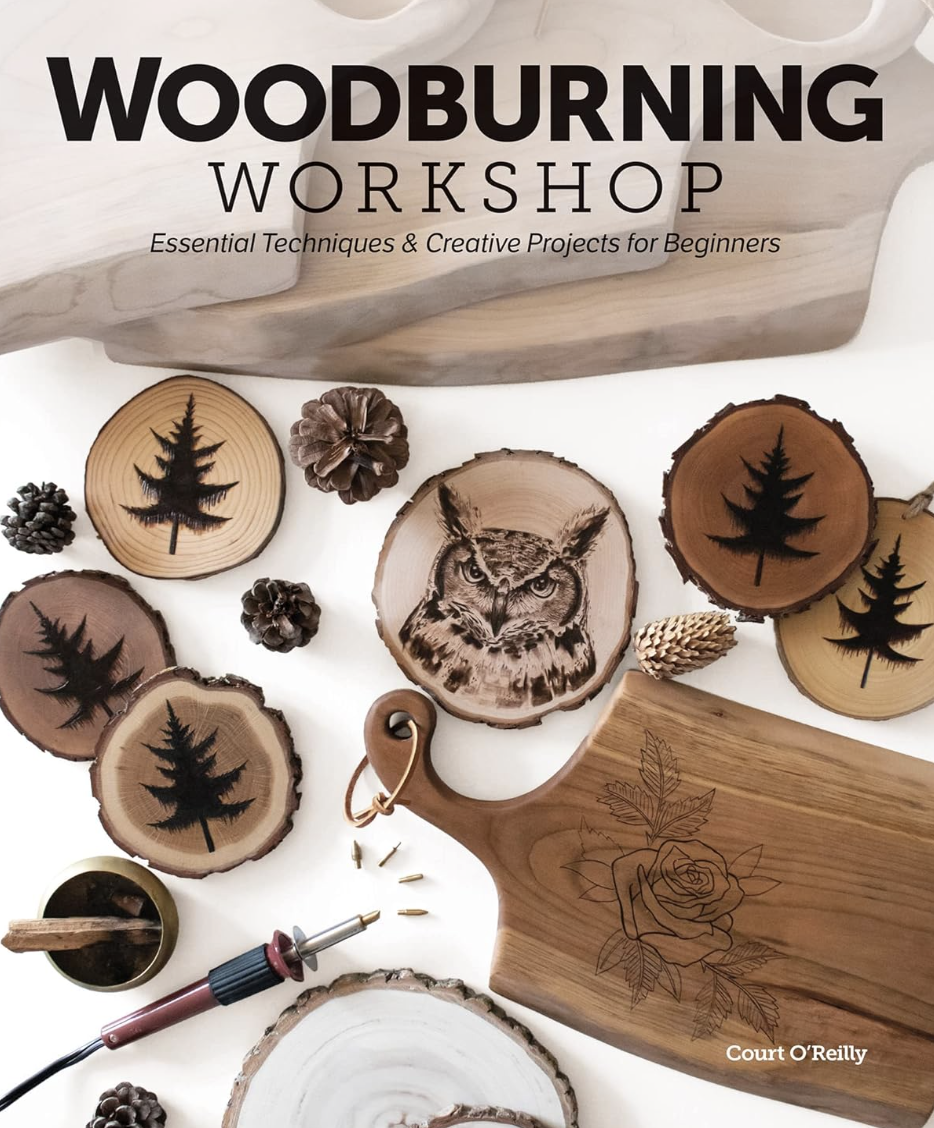
"Woodburning Workshop" by Court O’Reilly is a practical and comprehensive guide designed for pyrography enthusiasts of all skill levels. The book begins with an in-depth introduction to the basics of pyrography, covering essential tools, materials, and safety practices. This foundational knowledge is particularly beneficial for beginners, ensuring they have a solid understanding before progressing to more complex techniques.

O’Reilly excels in providing detailed, step-by-step instructions for a wide range of wood burning techniques, from basic line work and shading to advanced texturing and detailing methods. The book includes a variety of projects tailored to different skill levels, each accompanied by high-quality photographs and clear instructions.

Additionally, the wealth of original designs and motifs, ranging from nature scenes to abstract patterns, serves as a rich source of inspiration for artists looking to develop their unique styles. Overall, "Wood Burning Workshop" is a valuable resource that balances practical instruction with creative inspiration, making it a worthwhile addition to any pyrography artist's library.


Leveraging Technology in Your Pyrography Business: Canva

In the digital age, leveraging technology can significantly enhance your business, and specifically your pyrography business. Canva, an online design tool, offers a wide range of features that can help you create stunning designs, marketing materials, and more. This guide will explore how you can use Canva to boost your pyrography business.


Why I Love Using Canva

1. User-Friendly Interface

Canva’s intuitive interface makes it easy for anyone, regardless of design experience, to create professional-looking designs. There are many good online tutorials too, if you get stuck.

2. Versatile Design Tools

With a vast library of templates, fonts, images, and graphics, Canva provides all the tools you need to create a variety of designs, from logos to social media posts. The paid version has more stock images and features available, but the free version still lets you complete tasks and create beautiful content.

3. Accessibility

Canva is a web-based platform accessible from any device with an internet connection, allowing you to work on your designs anytime, anywhere. I have tried to use my phone AND my iPad to create on the go, however, it was not as easy to use as on a computer or laptop. In a pinch I was still able to get done what I needed, but I prefer using the computer.

4. Collaboration Features

Canva enables real-time collaboration, making it easier to work with team members or clients on design projects. This was a game changer for me!! Instead of downloading your design from the program, uploading to email or a folder in google drive, then emailing it to whomever I wanted to share it with, just to have them download it, all I do is share a link directly to the source. I can make the design editable too so if I am working on a design with someone, we can both change it together in real time. We can leave comments or each other too! This is one of my favorite features.

Getting Started with Canva

Create an account HERE and choose your level. As mentioned before, the free version really does everything you need it to do. It is a great way to get started with the program without paying while you are learning and exploring.

Designing for Pyrography

1. Creating Patterns and Templates

  • Custom Dimensions: Start a new design with custom dimensions that match the size of your wood pieces!

  • Templates: Use Canva’s pre-made templates as a starting point and customize them to suit your needs.

  • Shapes and Lines: Utilize shapes and lines to create intricate patterns and designs.

  • Import your own designs and photos: Easily add layers to your own content to create new and unique content.

why-i-love-using-canva

2. Experimenting with Fonts and Text

  • Canva offers a wide range of fonts. Experiment with different styles to find the perfect one for your designs.

  • Use text effects like shadows and outlines to add depth to your designs.

3. Adding Visual Elements

  • Graphics and Illustrations: Access Canva’s extensive library of graphics and illustrations to enhance your designs.

  • Photos: Upload your own photos or choose from Canva’s stock images to incorporate into your designs.

Marketing Your Pyrography Business

1. Social Media Content

  • Templates: Use Canva’s social media templates to create eye-catching posts for platforms like Instagram, Facebook, and Pinterest.

  • Consistency: Maintain a consistent brand aesthetic across all your social media channels using Canva’s brand kit feature (available with Canva Pro). This is really cool because once you save your brand kit, it is easy to create content that is on brand with just one click!

2. Promotional Materials

This is what we use Canva for the most and is probably the most common use.

The image here of the book is not a real book on wood. It is a digital image, shadow added and put on a background of wood making the vibe completely different than a standalone book…

The bonus is that you can create content to be printable and digital! Below are a just a few ideas, but the world is really your oyster here. You can do so much more. We’ve even created published books using Canva!

  • Flyers and Brochures: Design professional flyers and brochures to promote your pyrography workshops and products.

  • Business Cards: Create customized business cards to hand out at events and craft fairs.

  • Thank you cards: create content that is personalized for your clients!


3. Online Presence

  • Website Graphics: Design banners, buttons, and other graphics for your website.

  • Email Marketing: Create visually appealing email newsletters to keep your customers informed about new products and promotions.


Enhancing Your Customer Experience

1. Custom Orders

  • Mockups: Use Canva to create digital mockups of custom orders for clients. This helps them visualize the final product. I like to insert the image onto the actual wood slice I will be burning on so they can almost see the finished product before I burn it.

  • Approval Process: Share the mockups and designs with clients for approval before starting the actual burning process. This step really eliminates any miscommunication or mistakes.

2. Instructional Guides

  • Create step-by-step guides and tutorials for your clients, helping them learn how to care for their wooden items in a neat and on brand way. Remember, these can be printed or sent via a digital document!


Canva is a powerful tool that can greatly enhance your pyrography business. Whether you’re designing patterns, marketing materials, or customer guides, Canva’s versatile features and user-friendly interface make it easy to create professional-quality designs.

Handling Burnout and Staying Motivated as an Artist

Burnout is a common issue for many creative professionals, including pyrographers. I know because I’ve been there… It can stem from the pressures of constant creation (especially when you’re trying to keep up with social media algorithms), running a business, or balancing multiple responsibilities. However, with the right strategies, you can manage burnout and reignite your passion for your art, finish those wood slice projects and create art that is true to you.

Understanding Burnout

Burnout is a state of physical, emotional, and mental exhaustion caused by prolonged stress. In artists, it can manifest as a loss of creativity, lack of motivation, and even physical fatigue (among many other symptoms).

Recognizing the signs early can help you take proactive steps to address it.

Signs of Burnout

  • Persistent tiredness or fatigue

  • Decreased motivation or interest in work

  • Feeling overwhelmed or anxious

  • Difficulty concentrating or making decisions

  • Physical symptoms such as headaches or insomnia


Strategies for Handling Burnout

1. Take Regular Breaks

Incorporate short breaks throughout your day to rest and recharge. Step away from your work, stretch, or take a walk outside. Regular breaks can prevent mental fatigue and maintain your focus.

Short breaks during work sessions are great and long breaks between projects can prevent burnout on another level. I feel incredibly recharged after a 3 day camping trip where I am able to unplug from technology and life for an extended amount of time!

2. Set Realistic Goals

Avoid overloading yourself with too many projects at once. If you are like me, and have multiple projects on the go, try to focus on the top 2 to 3 so that you can actually complete some and feel good and motivated to continue completing more.

Also, make sure if you are feeling overwhelmed, try breaking down your tasks into manageable steps and setting achievable deadlines. This will help you stay organized and reduce stress.

Using tools to help you achieve your goals can help. Calendars can help you plan goals. I love using a calendar because I can easily see my other commitments and can plan accordingly.

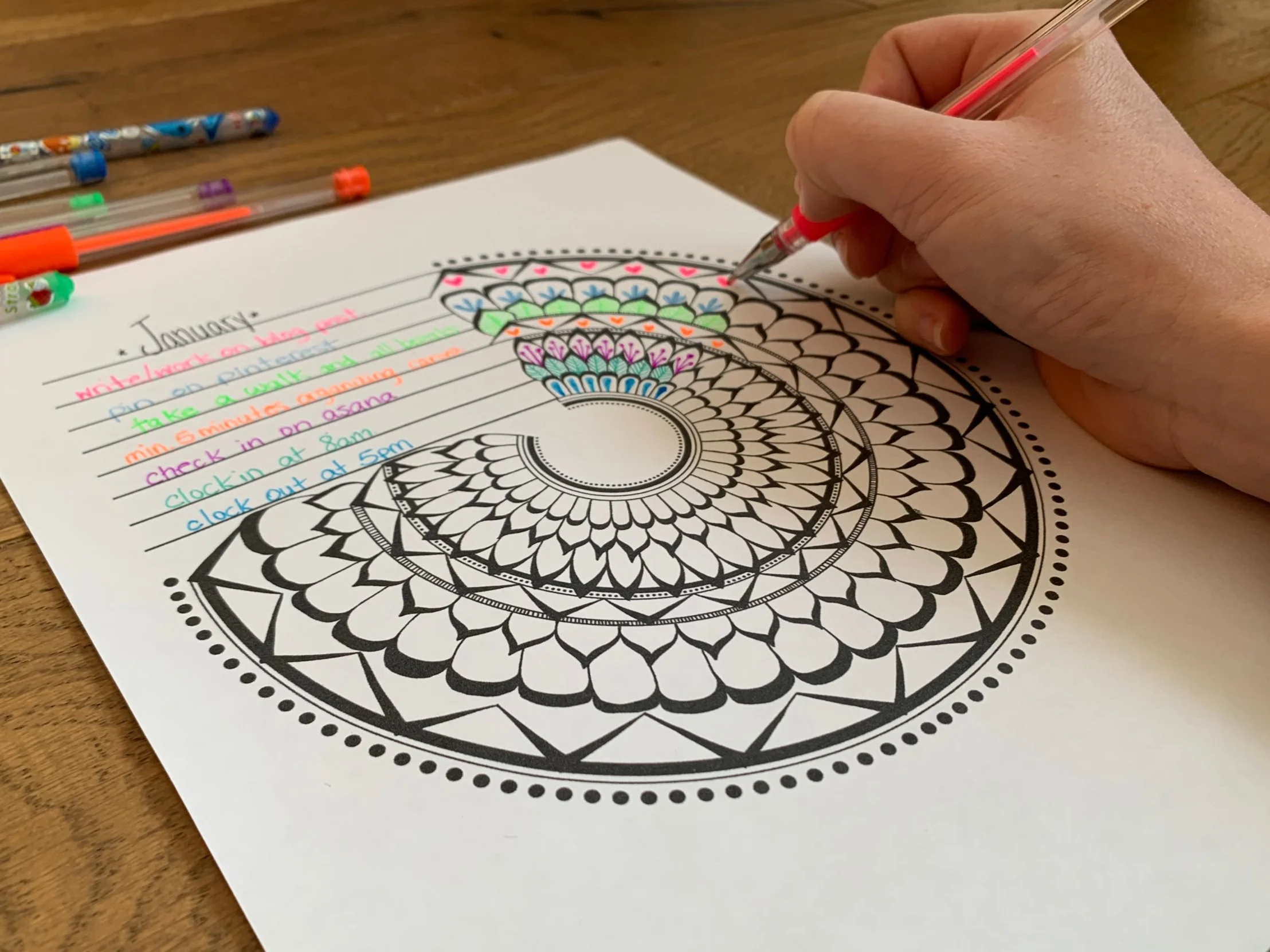
Another tool I live by are these trackers. They have monthly goals or habits for short term planning as well as yearly goals for longer term projects. Game changers!

3. Practice Self-Care

This is an obvious one, but usually overlooked. Make time for activities that nourish your body and mind. This can include exercise, meditation, hobbies, or spending time with loved ones. Self-care is essential for maintaining overall well-being and avoiding burnout.

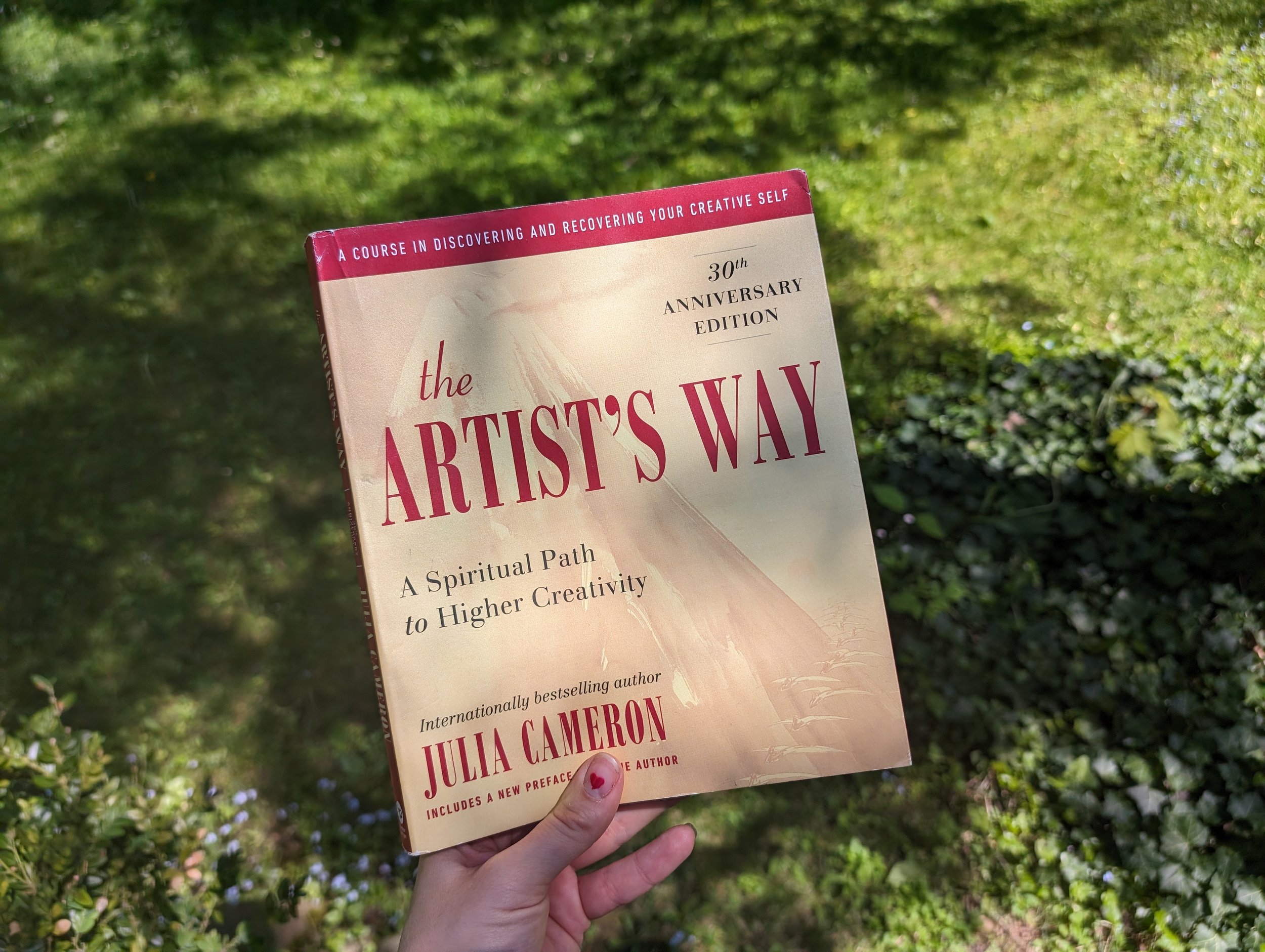
I suffered from burnout and one thing that helped me in the hardest moments was writing morning pages, as suggested by "The Artist's Way". This book is great to help clear your mind, process thoughts, and uncover new ideas. The journaling is just part of the journey in this book. The thing I like most about it is that it makes self-care part of the homework and forces you to make time for yourself in special ways.

4. Stay Connected with Your Creative Community

Engage with fellow artists and like-minded individuals. Join online forums, attend workshops, or participate in local art events. Sharing experiences and ideas can provide support and inspiration.

5. Create Art for Yourself

Sometimes, making art just for the joy of it, without the pressure of external expectations, can be the most motivating. Go create for creating’s sake.

I often try to do things with the intention of them being something. Something perfect, something for instagram, something for someone. But doing art without that intention, just for yourself, is very very freeing and is not only a good way to stay motivated but also to help burnout while still being creative.

I love to create art with kids. It creates a no pressure and fun way to unwind when you work side by side with them or make something together!


6. Set Boundaries

Learn to say no to projects or commitments that overwhelm you. (This can be hard and takes practice). Prioritize your workload and allocate time for rest. Setting boundaries ensures you have the energy to focus on what truly matters. If it doesn’t allign with your values, your business, your goals, or doesn’t excite you, just say no.


7. Reflect on Your Achievements

Take time to acknowledge and celebrate your accomplishments, no matter how small. I love a good Ta-Da list where you celebrate your accomplishments. Reflecting on your progress can boost your confidence and remind you of your passion for your craft. Instead of looking at others, take time to look at yourself and how far you've come! If you’re a visual person, keep a journal or portfolio of your work. Sometimes I even like to scroll to the beginning of my instagram profile to see where I started. Looking back on your progress can remind you of how far you've come and inspire you to keep going. Celebrate all of your wins.


8. Seek Professional Help if Needed

If burnout persists, consider seeking help from a mental health professional. Therapy or counseling can provide valuable tools for managing stress and improving your mental health.


Staying Motivated

1. Seek Inspiration

Explore different sources of inspiration, such as nature, books, music, or other artists' works. Inspiration can come from unexpected places. I love to visit museums, art shows or craft fairs just to get me excited about creating again.

2. Experiment and Play

This is one of my favorite exercises when I am feeling stuck, uninspired or unmotivated. Experimenting with different forms of art or techniques within pyrography, not only expands your skills, but can reignite your creativity and keep your work exciting.

Allow yourself to experiment with new techniques, materials, or subjects. Playing and exploring can reignite your creativity and make the process more enjoyable.

Sometimes, doing something completely different, like reading, cooking, or gardening, can refresh your mind and spark new ideas. Collaging is one of my favourite things to do as all it requires is to just flip through some magazines and feel out what inspires you. It really gets my creative juices flowing to pick through images and put them together until I get an unexpected design!

3. Set Personal Challenges

Create personal challenges or goals to keep yourself engaged. This could be learning a new pyrography technique, completing a series of artworks, or participating in an art competition. The smaller and more achievable, the better, especially if you’re already feeling some signs of burnout.

4. Create a Vision Board

Visualize your long-term goals and aspirations by creating a vision board. Include images, quotes, and reminders of what inspires you. This visual tool can keep you focused and motivated. It can also be a push to try a new medium, like collage art, mixed media or even digital art.

I love Pinterest for this! I collect all my ideas visually in a board and then further divide ideas and inspiration into sub boards! What is great is that you can keep this private so only you can see it. AND if you want it to show up on your phone, here are instructions on how to do so!

vision-board-using-pinterest

5. Maintain a Balanced Routine

Establish a daily routine that balances work, rest, and recreation. Consistency in your schedule can provide structure and help you stay productive without feeling overwhelmed. Especially being an entrepreneur, it’s easy to just do things with the flow of what we feel like. That’s a perk of working for yourself. However, it can feel like you are very busy but get nothing done… Creating a routine, or at least keeping track of what you’re doing and how long things take can help you understand many things about your workflow and tasks.

6. Document Your Creative Journey

journal-your-journey

Keep a journal or blog to document your creative journey. Reflecting on your experiences and progress can provide insight and motivation. Keep it private or share your journey with your audience to connect and inspire others.

This can be an art project in itself, or it can be as easy as keeping photos in a folder on your computer with dates on them!

7. Find a Mentor or Coach

Seek guidance from a mentor or coach who understands the challenges of being an artist. Their experience and advice can provide valuable perspectives and encouragement.


Take care of yourself, and your art will flourish.

With mindful practices and proactive strategies, you can manage burnout effectively. You can maintain your passion and continue to thrive as a pyrographer with practicing the points above.

Remember, your art is not just your work—it's a reflection of your unique vision and creativity.

The Artists Way by Julia Cameron

how-to-spark-your-creativity

"The Artist's Way" by Julia Cameron a 12-week adventure designed to help anyone rediscover their creative mojo.

Each chapter mixes motivational essays, fun exercises, and some serious soul-searching tasks aimed at breaking down the barriers we set up against our own creativity.

It’s Basia here and I just wanted to take a moment and share this book and the beginning of my journey through it.

Rachel has completed the book several times and said that each time, she seemed to uncover new depths of herself as well as her creativity that even she didn't know existed. She recommended that I give it a try, and I'm embarking on this journey once again, alongside her.

Especially since moving an hour up North, I was in the thick of change and needed some guidance. I felt stuck with which direction to go, art wise, as well as in other facets of my life.

There are a bunch of tasks, and activities and such which go with each week, but there are two things you need to complete every week, consistently.

ONE:

The first is an artists date. This is a date with yourself, the artist, doing whatever it is you want to do! It can be as simple as going for a walk, to visiting the museum, to making a new art piece... It’s a chance to intentionally treat yourself!

My last date included going to the a small local greenhouse with a gardening store attached to it. I didn’t go with the intention of buying anything; I went with the intention of perusing slowly through the isles and looking at all the flowers, taking photos, getting inspired by all the colours, textures and nature. It’s such a simple thing, yet it made a big impact on my mood and inspired me in many ways… It was also really nice to slow down and literally smell the roses.

tulip
flowers
double-tulip
nature-rules

TWO:

The second part of this journey includes writing daily. It’s journaling but in a freestyle, nonsense way. More like brain dumping than anything.

I've never considered myself a writer; in fact, writing has always given me anxiety and felt like a chore. Previous attempts at journaling felt forced and were invariably brief. It took long and always came out sounding forced.

Julia Cameron suggests this freestyle way of writing that's all about just letting it out. Now I write quickly and freely, without concern for structure, spelling, or even readability. The purpose is to simply let the words flow, knowing I'll never revisit these pages (I actually burn a lot of the pages I write and my writing is so messy, i can barely read it)! This has proven to be incredibly cathartic and freeing with many many many micro epiphanies about myself, my life and everything around me!

My biggest epiphany so far is about the style of writing itself. Writing in this way allows me to slow my mental chatter to one thought at a time, helping me to process each thought thoroughly instead of letting them all swirl around unexamined (and worst of all, usually repeating). It’s a simple, yet profoundly effective, way to clear the mind, which I never knew I had to do… I really never knew this kind of expression existed and I never really knew I needed it!

If you've ever felt stuck, unsure, or just curious about what your creative mind can do, "The Artist's Way" could be a thrilling experiment for you. It’s not just about becoming an artist—it’s about becoming more yourself. You don’t need to be good at drawing, writing, or anything at all; you just need to be open to exploring what creativity means for you.

Click here to see the book on Amazon. This is an affiliate link; I strongly recommend this book to anyone in search of inspiration, self-reflection, self-exploration and motivation.

Possibly, in time, I will share more about my creations and how my dates go, as well as give insight into my journey with this book.


What Does Royalty Free Mean?

royalty-free-photos

"Royalty-free" in the context of art design refers to a licensing method where the purchaser pays a one-time fee to use the artwork without paying additional royalties or license fees for each use or volume sold. This contrasts with other licensing models, like rights-managed or editorial use, which may require ongoing payments based on usage parameters.

Here are some key aspects of royalty-free licenses:

  1. Unlimited Use: Once purchased, the buyer can use the royalty-free artwork multiple times for multiple projects without incurring additional costs.

  2. Flexible Application: The artwork can be used in a variety of applications, including marketing materials, websites, product packaging, and more, depending on the specifics of the license.

  3. Non-Exclusive: Royalty-free licenses are typically non-exclusive, meaning the same artwork can be sold to multiple customers and used by them concurrently.

  4. Upfront Cost: The initial cost tends to be higher than that of some other licensing models because it often covers broad usage rights.

** It's important for buyers to read the specific terms of a royalty-free license because restrictions may still apply, such as limitations on resale, modifications, or geographic use.

You're welcome to use our royalty-free templates to create and monetize your own content, but please remember: reselling the template as is, is not allowed. This helps keep it exclusive and valuable for all creators. All our royalty-free templates include a .Jpg, .Png, .Svg, and a .Pdf so users can easily transfer them to any medium.

Check out what templates we have that are free for you to use however you like:

Royalty Free Templates
 

Did you know?

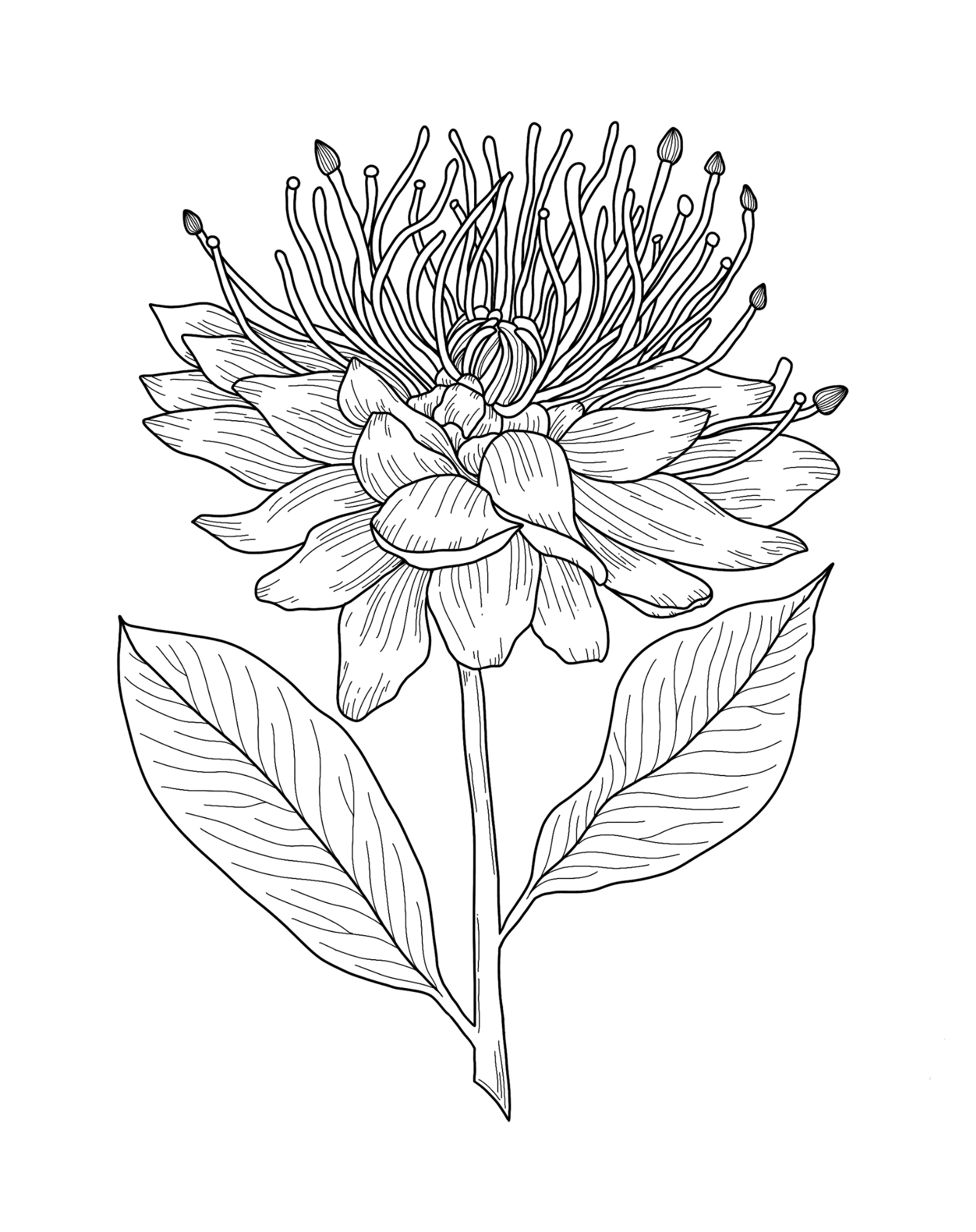
Join the burn club to receive a FREE royalty-free template each month! Last month we gave away this bergamot flower pattern. You can now find it up for sale here.

bergamot-royalty-free-tempalate

So what can you use these patterns for?

  • Pyrography of course!

  • Relief carving

  • Painting

  • Colouring

  • Tracing

  • Canva Templates

  • POD (print on demand services)

  • Creation and sale of unlimited physical items

  • So much more

WBC Templates Shop

Public Domain Images

"Public domain" refers to creative works that are not protected by intellectual property laws such as copyright, trademark, or patent regulations. This means that these works can be freely used by anyone for any purpose without needing permission from a previous rights holder.

Public domain and royalty-free both allow the use of materials without ongoing license fees but differ significantly. Public domain works are those whose copyright has expired or never existed, allowing anyone to use them freely for any purpose, including modifications and commercial use. In contrast, royalty-free refers to copyrighted works that can be used without paying additional royalties after the initial purchase, though the use may still be subject to specific conditions set by the license. While both provide broad usage rights, public domain offers the utmost freedom with no restrictions, whereas royalty-free use is controlled under the terms of a licensing agreement and may include limitations such as the type of allowed use or distribution volume.

There are many websites which offer royalty free images and public domain content. With these images, you can get inspires and make your own templates by tracing the actual image without worrying about copyright rules.


Here are our top 3 Royalty free/Public Domain sites for images & Videos

  1. Pexels:

    These are stock photos, royalty free images & videos shared by creators. You don’t need an account to use some of these images: simply hover over the image you want (ensuring it is the free version) and click “download.

  2. Unsplash:

    Very similar to Pexels. Lots of good stock photos and royalty free images and videos. Make sure you are downloading the free content before using.

  3. Smithsonian Open Access:

    These is all public domain content. Here you can download, share, and reuse millions of the Smithsonian’s images! It includes images and data from across the Smithsonian’s 21 museums, nine research centers, libraries, archives, and the National Zoo - very cool!


What is the difference between Wood Burning and Pyrography?

Wood burning and pyrography are two terms that are often used interchangeably, but there is a slight difference between the two.

We prefer the term 'pyrography' but recognize that 'wood burning' is more commonly understood so we use both terms interchangeably across all our communication platforms—ranging from our website to verbal interactions and written materials—to ensure clarity and accessibility for all our audience.


Wood burning is the general term used to describe the process of using a heated tool to burn designs onto wood.

It is a subset of pyrography.

Wood burning is often associated with the traditional use of a heated tool (like a wood burning pen) to create art on wooden items. It typically implies a handcrafted approach and may be perceived as more craft-oriented.

This term is often used to describe the process of burning simple designs onto wood, such as lettering or basic shapes. It involves less precise designs and basic patterns.

Pyrography, on the other hand, is a more specialized form of wood burning with more diverse techniques and designs.

It is considered a form of art, and it requires more skill and precision than simple wood burning.

Pyrography typically involves using a specialized tool with temperature control, various tips, and techniques such as shading to create intricate designs.

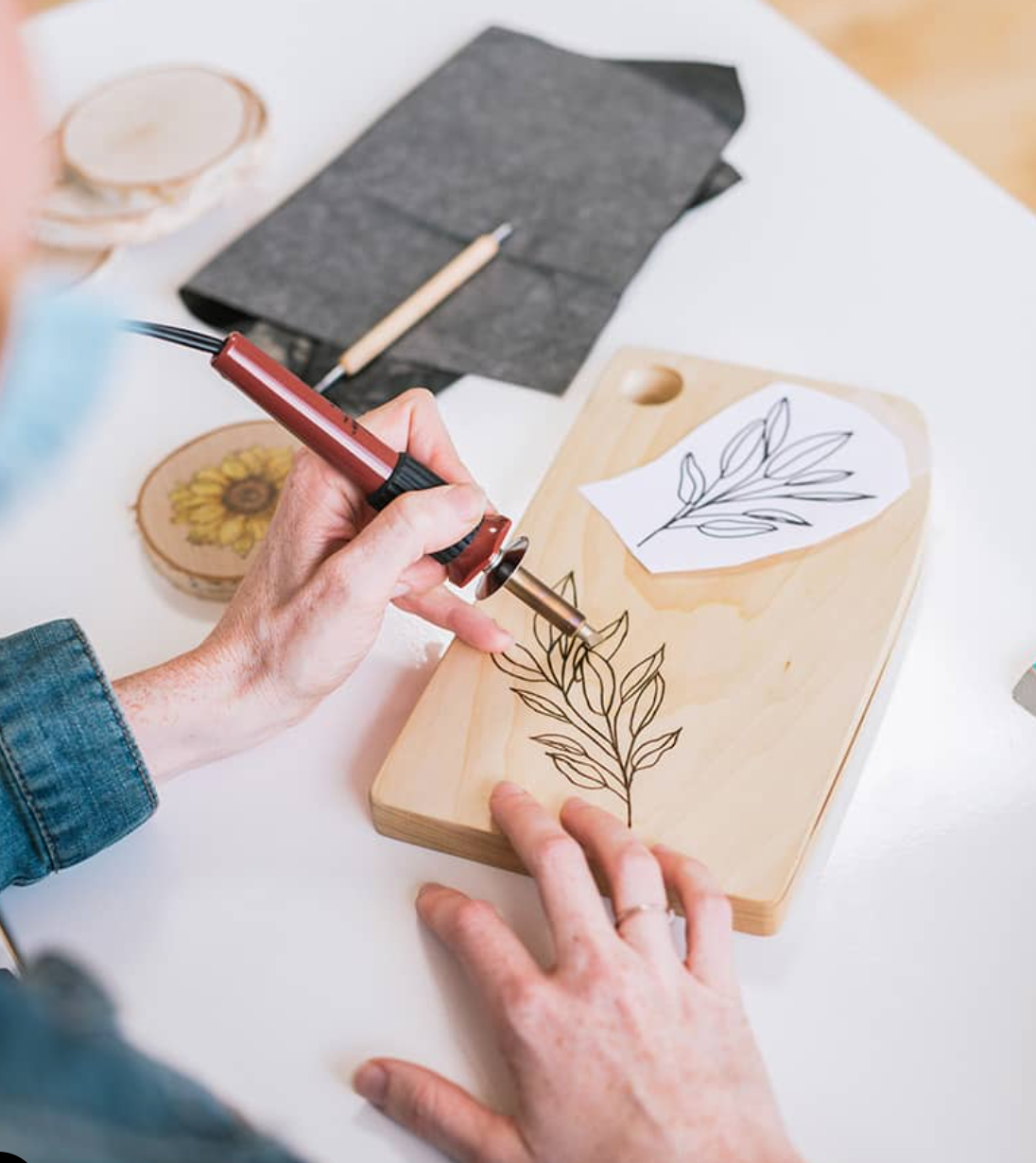
Pyrography artists may also use stencils or transfer/graphite paper to create a design on the wood surface before burning it as well as hot metal brushes, combs or other objects to create texture.

While both wood burning and pyrography involve burning designs onto a burnable surface using a heated tool,

pyrography is a more intricate and specialized form of wood burning

that involves creating detailed artwork and designs using a variety of techniques and specialized tools.


How to ask the RIGHT questions to ChaptGPT to get the best results!


When ChatGPT first came out, I think it is safe to say that many of us were skeptical. I know I was. That’s because I didn’t understand its capabilities or even how to use it. My brother, being a tech junkie, showed me the light and once I dove in and asked it a few questions, I was hooked.

I couldn’t wait to ask it more and discover what it can do. It was helping me write screen plays in the voice of snoop dog, jokes for my nephews, bedtime stories for my daughter… I used it to meal plan, learn about which plants I should add to my shady garden and the list goes on. Now I use it more than I google search! If you haven’t tried it yet, I suggest you do!

Just remember though, ChatGPT can deliver quick and impressive results, but it's not human. It's important not to take everything it says at face value, especially when it comes to facts and statistics. Always double-check the information it provides and use your own judgment to fill in the gaps.

Here are a few tips straight from the source, and from experience, for asking ChatGPT the right questions to get the best answers:

  1. Be clear and specific: When asking a question, be as clear and specific as possible.

  2. Use appropriate language: ChatGPT is a language model, so it's important to use appropriate language when asking questions. Avoid using slang or overly complex language that may be difficult for the model to understand.

  3. Provide context: For example, if you're asking a question about a specific topic, provide some background information to help ChatGPT understand the context of your question.

    One of my favourite ways to ensure that I am giving it all the context is to ask if it has any questions for me! This prompt is so good because I may be missing key information for it to fully understand what I want from it.

    More on this in the next section.

  4. Ask follow-up questions: If you're not sure about an answer or need more information, ask follow-up questions to clarify your understanding. ChatGPT is designed to provide conversational responses, so feel free to ask as many questions as you need to get the information you're looking for.

    Again, you can also ask it to give you questions to help clarify what you want.

  5. Break down complex questions: If you need to ask a complex question, break it down into smaller, more manageable parts.

  6. Avoid ambiguity: Be specific in your question and avoid ambiguous language.

  7. Be respectful: Remember that ChatGPT is an AI language model, and it's important to be respectful in your interactions. Avoid using offensive language or asking inappropriate questions, as this can undermine the quality of the responses you receive.


What are the ways in which you can give ChatGPT context?

There are several ways to provide context to ChatGPT when asking a question:

  1. Background information: Provide some background information about the topic you're asking about.

  2. Examples: It’s okay to give examples to illustrate your question or provide more information.

  3. Related topics: If your question is related to another topic or concept, mention it in your question.

  4. Keywords: Use relevant keywords in your question to provide more context. For example, if you're asking about a specific product or service, include the name of the product or service in your question.

    More on this below.

  5. Tone: Use a clear and concise tone when asking your question.

  6. Use specific qualifiers: Use qualifiers like "best," "worst," "most," "least," and "highest," to help specify the type of information you're looking for.


Does using multiple keywords in my question for ChatGPT help me get a better answer?

Using multiple keywords in your question can be helpful in some cases, as it can help ChatGPT to better understand the context of your question and provide you with a more accurate response.

However, it is important to use relevant keywords that are directly related to your question, rather than using irrelevant or extraneous keywords that may only serve to confuse ChatGPT.

Here are some tips for using keywords effectively:

  1. Be specific: Use keywords that are specific to the topic you are asking about.

  2. Use synonyms: Try using synonyms for your keywords to broaden your search and increase the chances of finding relevant information.

  3. Don't overdo it: While using multiple keywords can be helpful, don't overdo it. Using too many keywords or irrelevant keywords can lead to inaccurate or irrelevant responses from ChatGPT.

  4. Use natural language: When asking a question, use natural language that closely resembles how you would ask the question if you were speaking to a person.


Be Careful

Enjoy playing with this powerful tool but also be aware that ChatGPT is not connected to the internet and obviously, it’s not human. It can occasionally produce incorrect answers or not provide all the details... It has limited knowledge of world and events after a certain time (depending what version you have) and may also occasionally produce harmful instructions or biased content. You can get a good understanding of this when you ask it about topics you know really really well.

For example, I know pyrography really well. I tested ChatGPT and used it to ask questions all about wood burning. Since I am familiar with the art form, I could see that it was missing some information, or it was really close to getting the facts right, but they were slightly off… All the information it had was not everything about the topic.

A cool thing is that you can now ask it to create images! This also comes with some warning… here is an example of an image I tried creating for a blog post on wood grain:


To get to this awesome image, I had to try about 7 different prompts (I learned along the way…). Here are some bloopers that were funny and logically did not make sense:

wood-grain-chatgpt-blooper

You can even see the progression of the images as I learned the right way to ask it what I needed.

Along with using it for images, I like to use the app help me clarify my thoughts into words, correct my grammar or spelling, summarize my own words or give me a foundation to work with, rather than relying on it to create all my content.

For more information and support on ChatGPT visit OpenAI Help.

Oh and, do you know what else is cool? You can always ask it to give you the direct source of it’s answer - this is very helpful to know and have if you want to confirm the validity of it’s responses.

Along with that, the helpful tips in this blog post will get you the best results.


With ChatGPT, the world is your oyster - have fun!


Basia's Radial Symmetry Art (Digital Form)

Basia here! As you already know, I love to make art with patterns. Especially circular and symmetrical patterns!

I really got into creating digital art because it was just so easy to create on the go. I moved up North and while my things were packed, there were images in my head that I had to get out onto something tangible.

These will definitely inspire my future wood burning work.

Of course, I still stick to nature themed images as they continue to inspire me to create more art and also to get outside more. I moved into the forest, and plan to continue taking more photos and playing with more nature to find and create symmetrical artworks.

These digital artworks were made using procreate using my own photo’s as well as AI photos (using Midjourney).

I am addicted. It is so much fun to create these organized abstract designs!

To see my collection, and get them in a sticker, on a pillow, or even a shower curtain, check out my shop:

Visit My RedBubble Shop

Below is a time-lapse of a floral pattern I made using my photos, cut, paste, arranged and then arranged again:

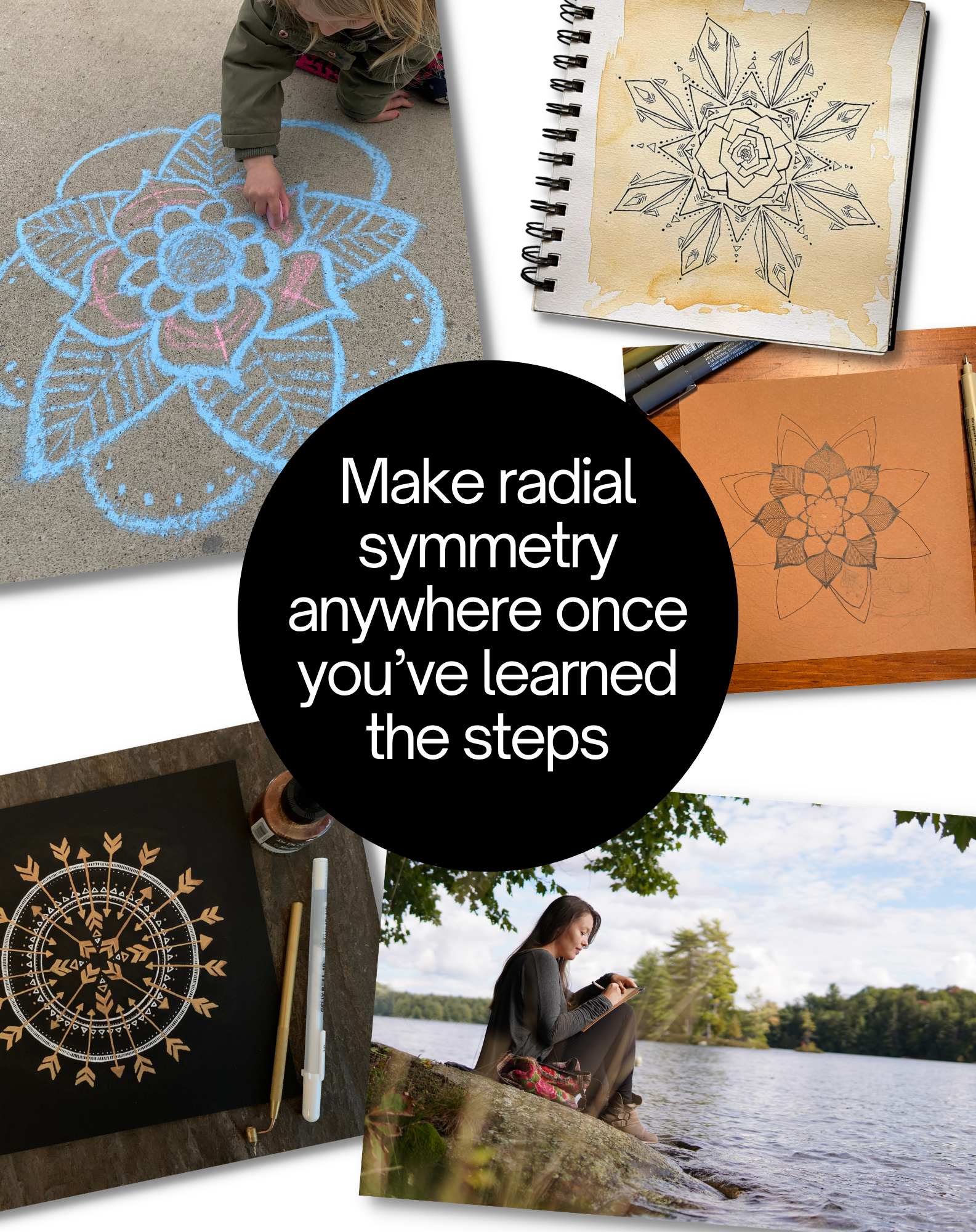
What is radial symmetry to me?

a radial symmetry pattern to me is the end result of a mindfulness journey.

It is what I get at the end of a creative meditation, a zone out, a doodle session (whatever you want to call it!)

I use drawing a mandala (wether in digital format or on paper/wood) as a form of meditation.

The repetitive patterns I make help me zone out and immerse myself in each second.


If you want to learn how to make your own pattern (non-digital form), check out the Community Book of Templates (Radial Symmetry Edition) with instructions and a variety of templates for you to transfer onto wood and burn, OR the Art Deco/Art Nouveau style bundle, which I call Presence (digital and hardcopy available) full of templates and also step-by-step instructions to drawing your own patterns.

Once you learn how to draw your patterns, you can easily transfer them (or draw them directly) onto wood!


Click through the following links to learn how to transfer your designs using heat and without using heat!


Transforming a Dull Laundry Room into a Stylish Dog Washing Station

Home Project: Laundry Room

dog

Welcome to my latest home improvement project journey! Today, I'm excited to share how I turned my uninspiring laundry room into a functional and chic dog washing station. With a little creativity and some DIY magic, I was able to breathe new life into this space and create a haven for both me and my furry friends.

Before:

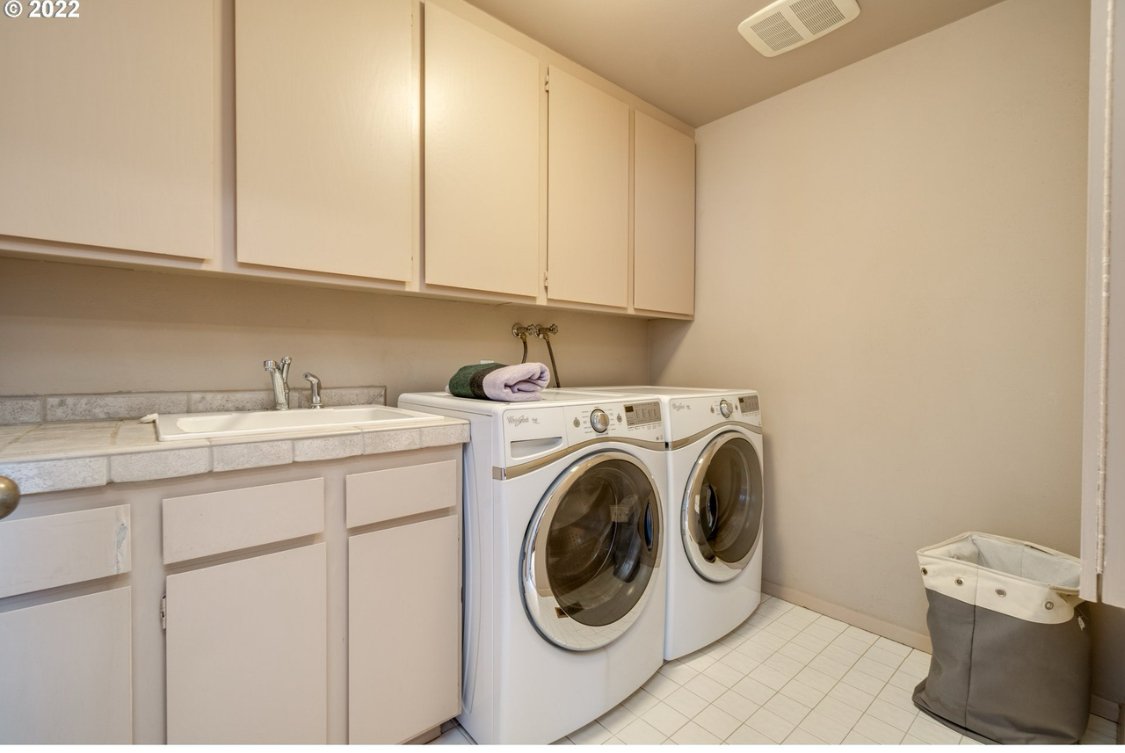
Let's start with the before photos. My laundry room was, to put it bluntly, lackluster. The walls were painted a dull boring tan shade, the sink was outdated and too small to wash my pups in, the laundry machines were old and never got the clothes clean, the paint was chipping in places, and the countertops were a gross outdated tile. It was a space that kind of served its purpose but lacked personality and charm. It wasn’t a space I wanted to spend any time in, and we wanted to make it serve multiple uses: Laundry, Storage, and a Dog Washing Station without breaking the bank.

Products Used:

Before diving into the transformation process, let me introduce you to the MVPs (Most Valuable Products) that helped bring my vision to life: (Please Note: These include some Amazon Associate Links for the products we used. WBC receives a tiny portion of sales from Amazon)

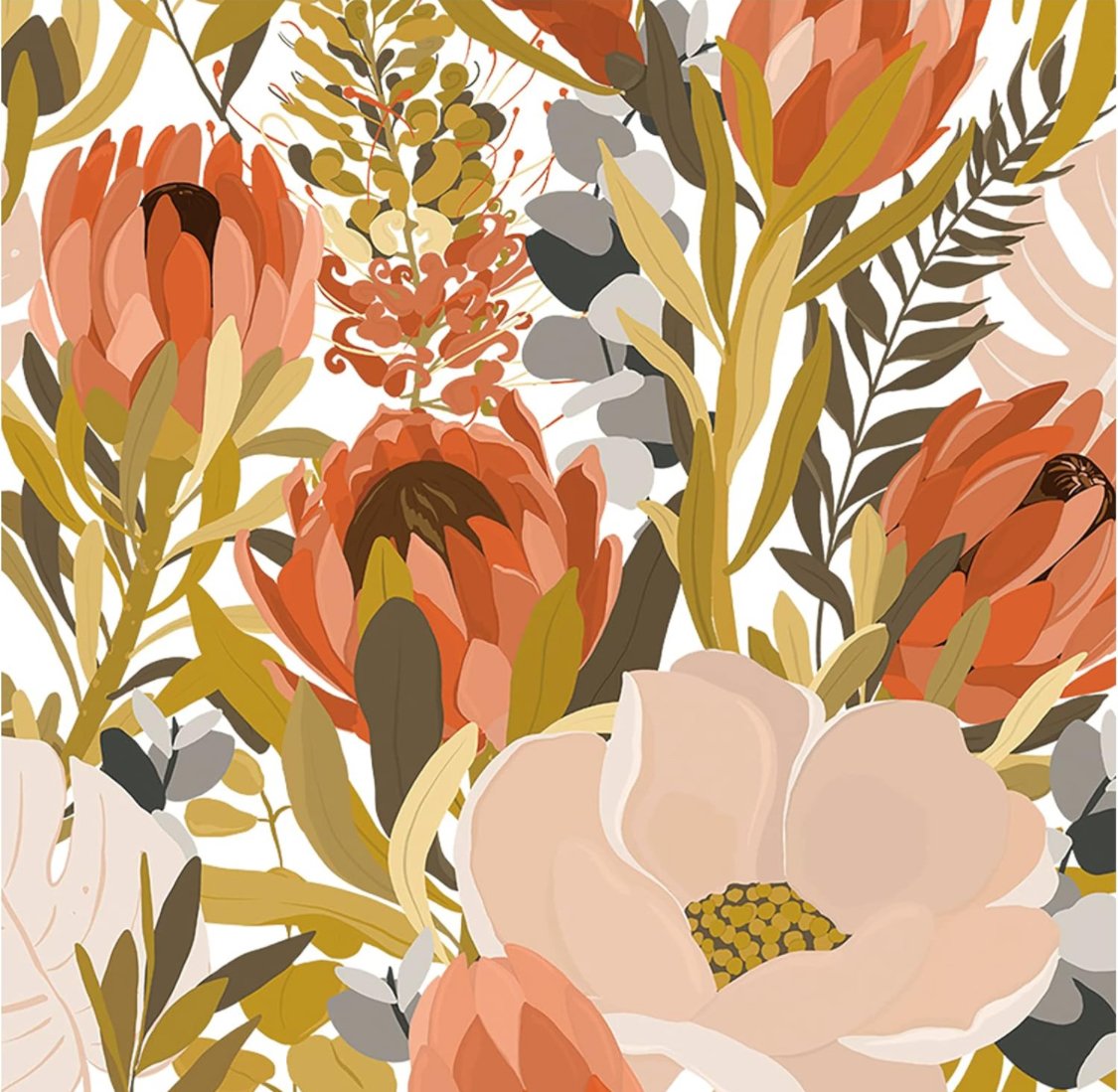
  1. Wallpaper: I chose a vibrant and eye-catching floral peel and stick wallpaper to add a pop of color and pattern to the walls. It instantly brightened up the space and set the tone for the entire room. Bonus: it is super easy to install yourself.

  2. Sink: Say goodbye to the old, dingy sink and hello to the sleek and modern dog washing station. I opted for a deep stainless steel sink. It is not easy finding a sink that is both long and super deep. This one is 12” deep and 30” wide, and is perfect for my pups.

  3. Wood Countertops: To add warmth and texture to the room, I installed custom faux wood countertops from IKEA. Not only are they beautiful to look at, but they also provide a durable surface for all my laundry and dog grooming needs.

  4. Faucet: We wanted a simple faucet with the retractable nozzle for easy dog washing, but it was also important to have the handheld off button for easy pausing. This $79 faucet was on sale for $39 on Amazon, and is perfect!

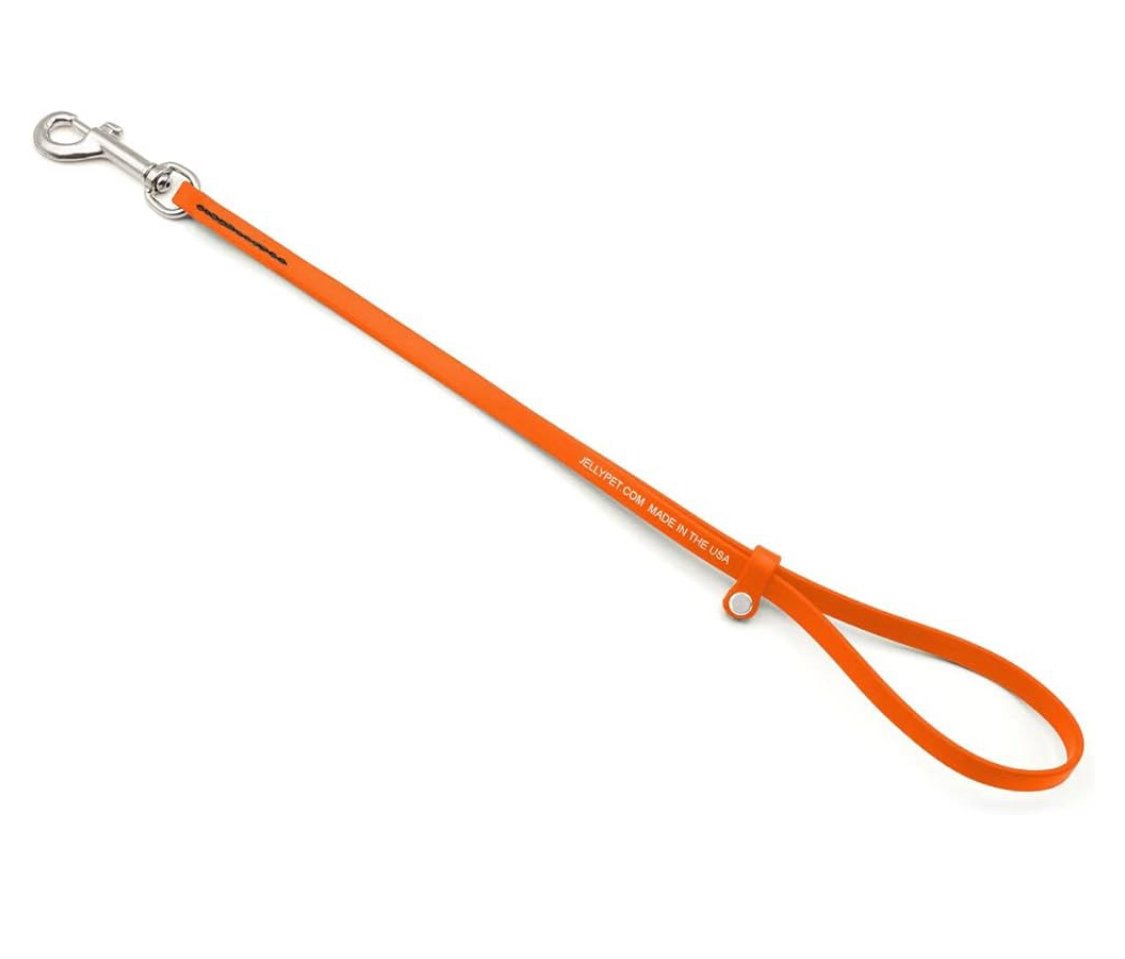
  5. Dog Grooming Loop: This is key for a successful wash in our house. These dog grooming loops make it super simple to keep your dog in the sink while they are getting clean. We secured it to the wall using an eye hook, and now we are ready to clean our dirty pups, without breaking our backs!

  6. Washer/Dryer Combos: This has been an absolute game changer! Two large capacity washer/dryer combos from GE. I put the clothes in and come back to washed and dried clothes! No more needing to rewash or re-dry clothes. No more forgetting clothes in the washing machine. This has been a huge time saver. And, it has the amazing feature of automatically dispensing detergent and softener. Laundry has become considerably more tolerable with these machines.

Transformation Process:

Now, let's talk about the fun part – the transformation process! With the help of some handy tools and a lot of elbow grease, I was able to turn my laundry room into a space that I'm proud to show off.

  1. Prep Work: The first step was to clear out the room and remove the old countertop and sink. Once the space was empty, I prepped the walls for wallpaper installation by filling in any cracks and sanding down rough surfaces. (Spackling Compound, Sanding Sponge)

  2. Wallpaper Installation: With the walls prepped and ready to go, it was time to apply the wallpaper. This step required careful measurements and precise cutting to ensure a seamless finish. After a few hours of work, the wallpaper was up, and the transformation was already taking shape. (Razor Blade Pen)

  3. Time to paint those drab lower cabinets. I wanted it to be a color in both the laundry machines themselves and in the wallpaper, and this dark grey is it! (I used a paint we already had on hand from my stairwell trim, it was the perfect color and helps tie the house together).

  4. Sink, Faucet, and Countertop Installation: Next up was installing the new sink and countertops. This involved some plumbing work and carpentry skills, but with the help of my handy hubby, measuring multiple times, some liquid nails, and a bit of trial and error, we were able to get everything installed correctly. (Liquid Nails, Quick Clamps)

After:

And now, the moment you've all been waiting for – the after photos! Drumroll, please... Ta-da! The once-dull laundry room has been completely transformed into a stylish and functional dog washing station. The vibrant wallpaper adds personality to the space, while the sleek sink and wood countertops provide both beauty and practicality.

Final Thoughts:

In conclusion, I couldn't be happier with how my laundry room makeover turned out. By investing a little time and effort, I was able to create a space that not only serves a practical purpose but also brings a bit of joy to my not so joyful chores. Whether I'm doing laundry or giving my furry friends a bath, this room now feels a whole lot better.

Thank you for joining me on this journey, and I hope you feel inspired to tackle your own home improvement projects. Stay tuned for more adventures in DIY!

Wire Tip Vs. Solid Tip Burner

The difference between a wire tip/nib burner and a solid tip/nib burner primarily lies in their design and functionality.

Each type has its own set of advantages and disadvantages.

But first, please remember: The tools we use are undeniably important, but at the end of the day, it’s all about the user and what works best for them. Many artists can create incredible work with the simplest, most affordable tools, showing that skill and creativity matter more than price. On the flip side, even the fanciest tools can feel frustrating if we are learning the craft.

The same goes for wire-tip versus solid-tip pyrography pens—both have their strengths, but the best choice is whatever feels right in your hands and helps you create with ease. In fact, deciding between a solid-tip and a wire-tip tool is a great starting point when choosing your burner, as the functionality between these two types often has a bigger impact on your experience than the differences between machines from different brands. So let’s get into these differences.

Wire Tip/nib Burner:

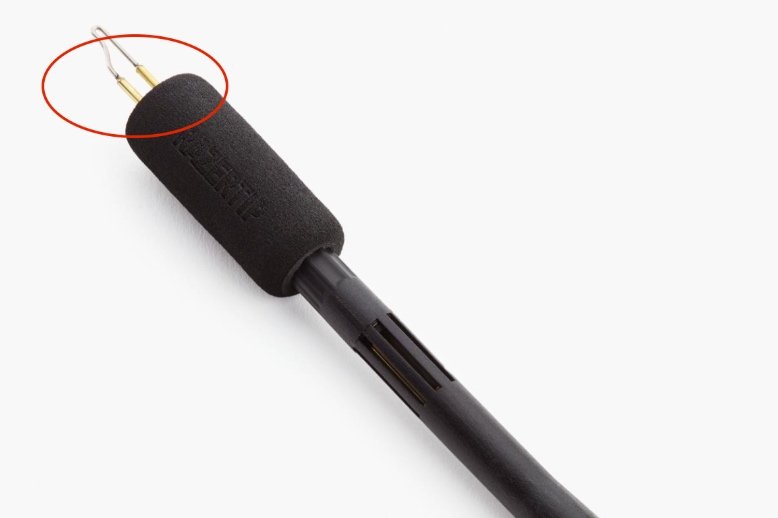
  • Design: Utilizes a closer-to-pen-like device with tips made of a looped wire or a wire nib. On some pens, these tips can be changed out, allowing for a wide variety of tip shapes and sizes (more on interchangeable nibs at the end). The pens are usually thinner and easier to hold, as the grip is located closer to the nib, allowing the pen to feel like an actual pen making it ideal for comfort, especially if you are burning for longer periods at a time.

  • Temperature Control: Wire tip burners typically offer more precise temperature control, which can be adjusted quickly. This allows for quicker and more detailed and varied shading techniques.

    I have found that some pens with a thinner handle tend to overheat so be mindful of the company you choose (check out What Wood Burning Tool Is Right For Me to learn more about choosing a new tool).

  • Durability: Generally these pens are more delicate than a solid nib making them more susceptible to damage over time. Proper care and a lighter hand will help them last longer.

  • Learning Curve: Might have a slightly steeper learning curve due to the delicacy of the wire tips and the precision required in handling them.

  • Heat Up Time: Generally, wire tips heat up and cool down much more quickly than solid tips.


Solid Tip/Nib Burner:

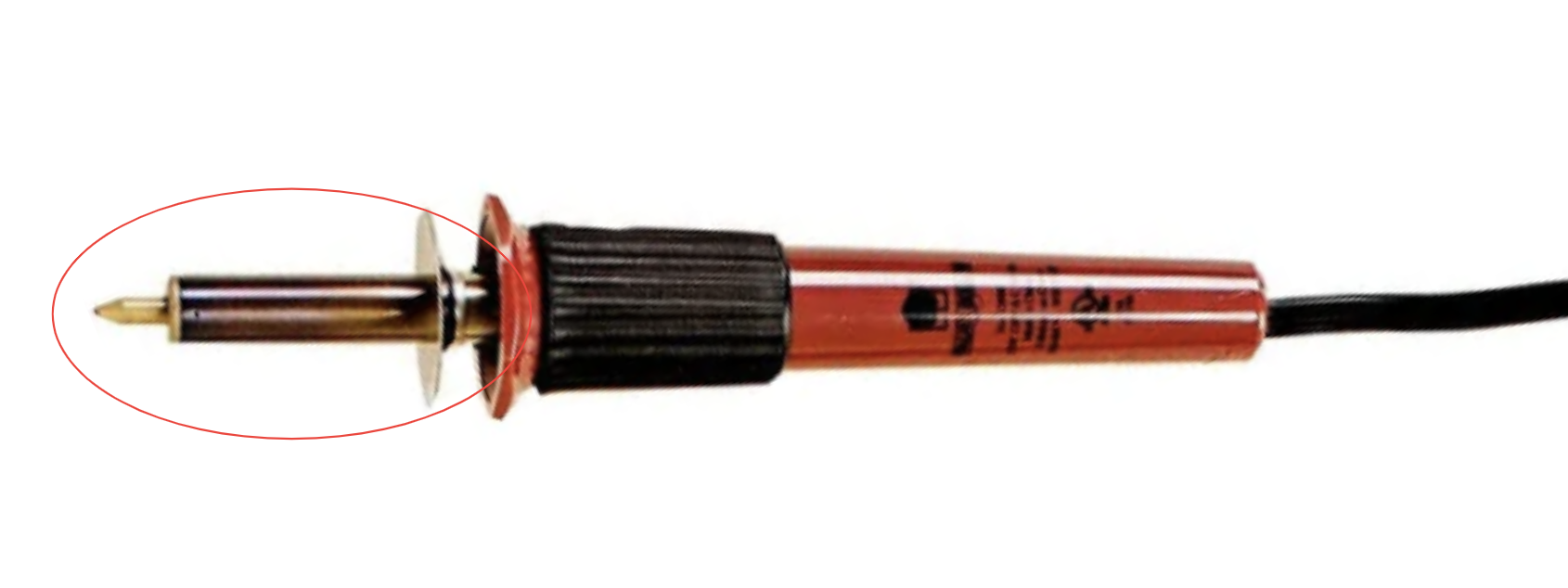
  • Design: Features a pen-like device with a solid brass or copper tip. The tip variety is usually more limited compared to a wire nib, the pen is thicker and clunkier to hold and the grip is usually further away from the nib making it slightly more difficult to control, especially if burning for longer periods of time.

  • Temperature Control: Solid tip burners are usually less precise in temperature control compared to wire tip burners, and adjustments may take longer to affect the tip temperature. However, because they are thick and solid, they do retain the heat better than a wire tip, making them ideal for large projects that require a lot of dark burning.

  • Durability: Solid tips tend to be more durable than wire tips because they are less fragile and less susceptible to bending or breaking.

  • Learning Curve: For beginners, solid tip burners might be easier to start with due to their durability and less delicate handling requirements.

  • Heat Up Time: Solid tips generally take longer to heat up and cool down than wire tips, but, as stated earlier, they retain their hear better than a wire nib does.

Application:

  • Wire Tip Burners are usually preferred for detailed art, fine shading, and where quick temperature adjustment is necessary.

  • Solid Tip Burners are often used when learning the basics of pyrography due to cost and durability. The heat retention and covering large areas with shading is ideal with these style burners.


which one gets hotteR?

In terms of reaching a higher temperature, both types can be capable of very high temperatures suitable for pyrography. The key difference lies in how quickly they reach these temperatures and how precisely those temperatures can be controlled during the work.
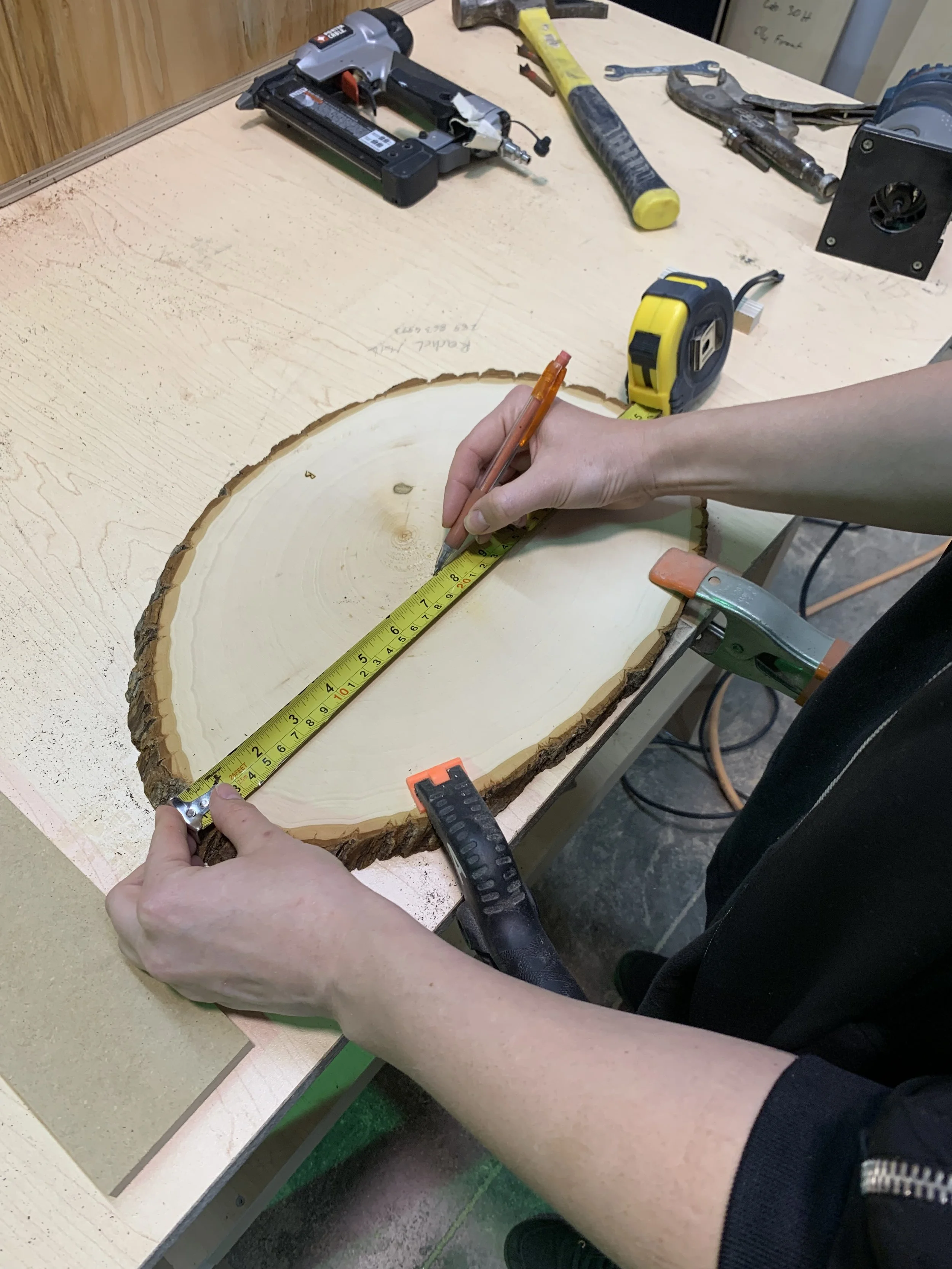
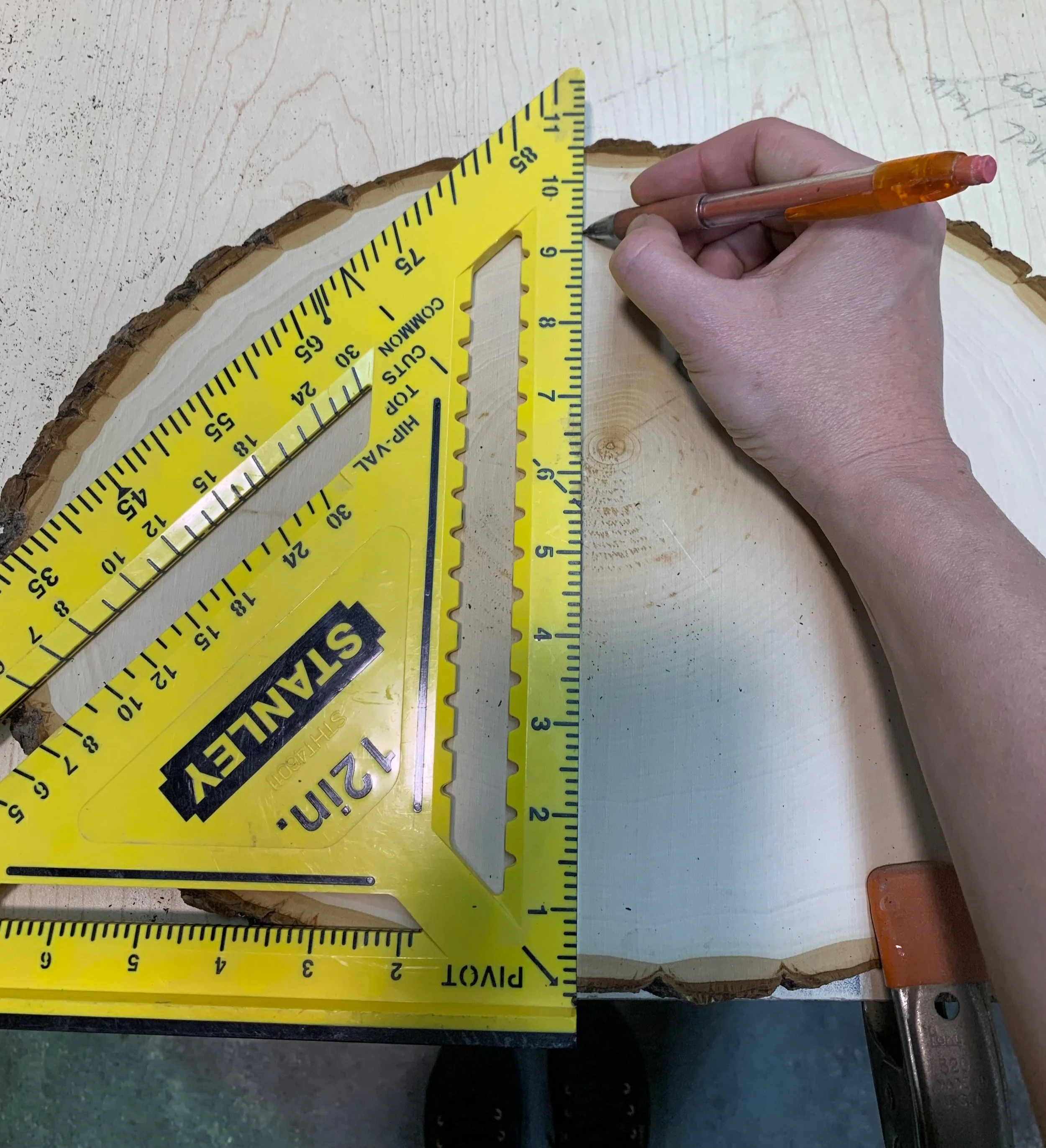
Wire tip burners generally offer faster heat up times and more precise control, making it seem like they can get hotter faster, but in terms of maximum temperature capabilities, it's more about the specific company and its design rather than the tip type alone.

However, there are some general characteristics related to how each type manages and conducts heat that can influence their operating temperatures:

Wire Tip Burners are designed for precise control and can reach very high temperatures quickly due to their thin wire construction, which has less mass to heat. This design allows for rapid heat transfer and adjustment, making them suitable for intricate work that requires changing temperatures quickly for different effects.

Solid Tip Burners, on the other hand, have a larger mass in their tips, which means they take longer to reach the desired temperature. However, once heated, they can retain heat longer due to the larger thermal mass. The heat distribution over the solid tip is more uniform, which can be advantageous for certain types of shading and consistent line work.

Interchangeable nibs on wire tip burners:

pyrography-tip-burner-nib

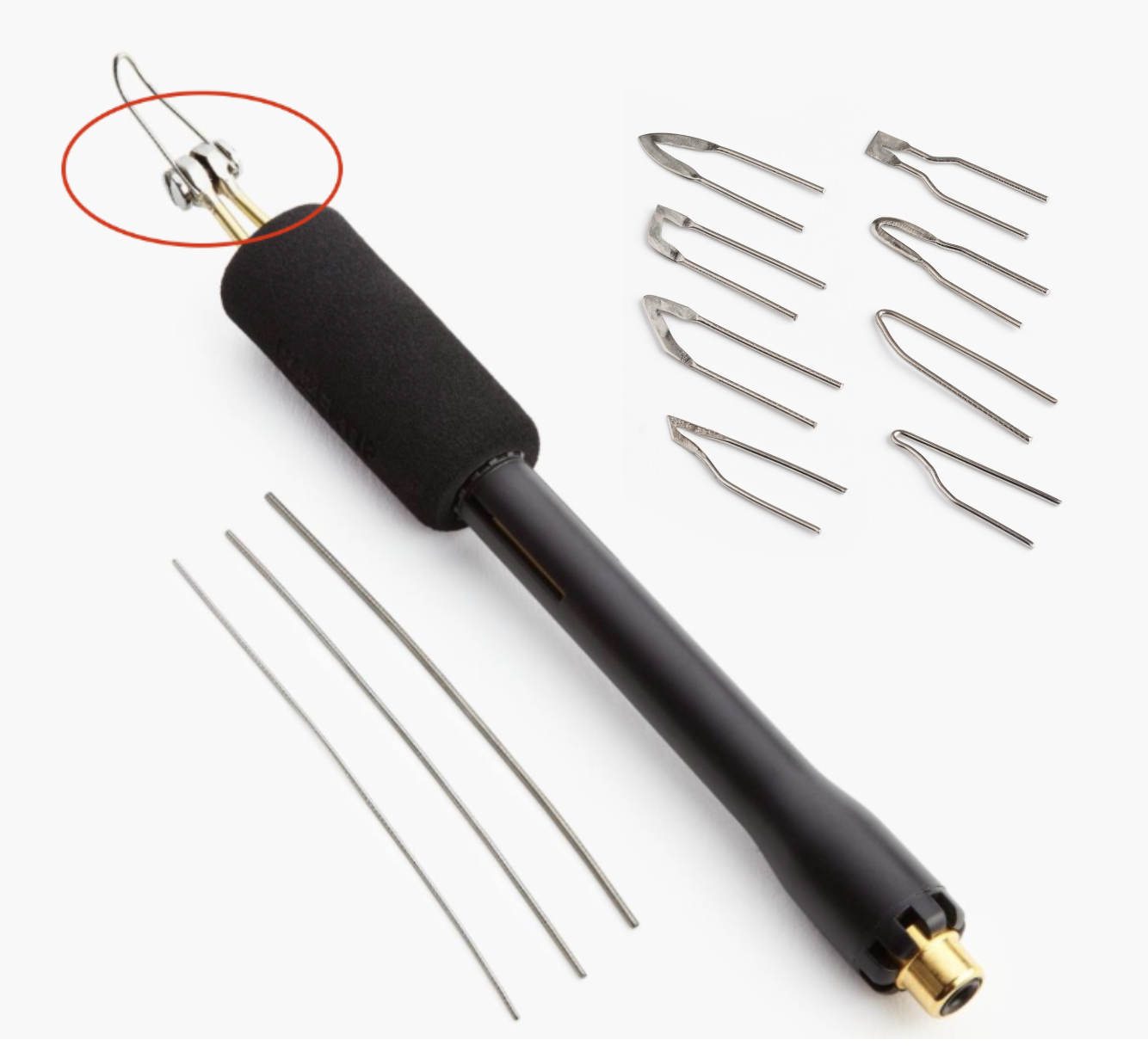
Interchangeable nibs for wood burning tools allow artists to switch between different tip styles for various effects in their projects with only one pen. These nibs can range from fine points for detailed work to larger, flat tips for shading or transferring images.

Pros: Interchangeability offers flexibility and creativity, enabling users to achieve a wide range of textures and depths in their art without needing multiple tools. This versatility is particularly valuable for artists looking to explore different techniques or work on projects that require both detailed and broad work. It’s a good way to learn what you like using without spending loads of money.


Cons: Interchangeable nibs, while versatile, can have drawbacks such as requiring time to switch between nibs, which might interrupt the workflow. There's also a learning curve in mastering different nib types for optimal use. Additionally, the delicate nature of some wire nibs can lead to breakage if not handled with care. Exercise caution when tightening to ensure a complete connection, or your heating may not be even. High-quality interchangeable nibs might come with a higher initial cost, although they offer long-term flexibility and savings from not needing multiple dedicated tools.

In summary

Wire-tip tools are lightweight and heat up quickly, offering precision and flexibility for fine details and shading. Solid-tip tools are sturdier and retain heat longer, making them ideal for bold lines and consistent burning on tougher surfaces.

Choosing between them often comes down to personal preference and the type of project you’re working on.

When starting out, due to the low price point, we recommend a solid tip/nib burner (the Versa Tool from Walnut Hollow is our favorite). It gives you a fair chance to know if you will enjoy burning while keeping the price of starting this hobby at a minimum.

These are a good basic tool to have in your toolkit anyways, even if you upgrade to a wire tip. Some artists never even upgrade to another tool but at least you will have that option without breaking the bank.

If you plan on burning more often, want a faster heat-up time, more variety, a more comfortable grip, consider a wire tip burner. Check out What Wood Burning Tool Is Right For Me to learn more about choosing your new tool.

Woodcare 101: Preserving Your Pyrography Art

Pyrography is a beautiful art form that turns simple pieces of wood into timeless works of art. But like all forms of art, your pyrography projects are subject to the ravages of time, exposure, and wear.

Luckily, there are proven ways to protect your artwork and keep it looking as vibrant as the day you made it (or purchased it!).

Rules of thumb:

Keep Out of Moisture

  • Especially if unfinished, any water (drips or splashes) can leave permanent marks on your wood. Even a sweaty fingerprint can linger on the surface.

  • Enough general moisture can warp and bend the wood. The thinner your wood slice, the less moisture or humidity in the air it takes to start reshaping the wood.

  • Long exposure to moisture can cause warping so hang your wood slices away from kitchen sinks, outdoors or any bathrooms…

  • DO NOT place any wood in dishwashers or let them soak in the kitchen sink. Try not to let them soak in any food items either.

Keep Out Of Sunshine

  • Sun will fade finished and unfinished wood slices. Keep out of direct sun to help prolong the inevitable.

  • Burning deeply will help keep the artwork looking crisp. Shading and light burning will fade much faster.

Choose the Right Wood for your project

Your first line of defense against wear and tear starts with the type of wood you choose for your projects. Hardwoods like oak and birch generally last longer and are less susceptible to damage compared to softwoods like pine. If possible, go for kiln-dried wood, which has reduced moisture content, making it less prone to warping and cracking.

Check out this blog post for more information on wood: Best Wood for Pyrography

Sealing the Wood

Sealing your pyrography artwork with a finish adds a layer of protection against moisture, dirt, and UV rays. It also enhances the visual elements of your design by adding a glossy or matte finish.

If your artwork is going to be displayed outdoors or in a sunny location, consider using a UV-protective sealant. This helps in preventing the colors from fading and the wood from turning gray. For added moisture protection, particularly for outdoor pieces, use marine-grade sealants. Some resin’s also protect your wood from the elements. BE AWARE! Even with the most porotection you can apply, overtime, the weather will alter the look and colour of the wood, especially in harsher climates prone to freezing or humidity.

Check out Finishing Your Wood Burned Art: How and Why to Finish Your Wood Burned Art for more on this topic.

keeping your cutting boards, wooden spoons and other functional art looking like it did on day one is possible with a little bit of maintenance.

To prevent discoloration, cracking, warping and fading, follow the instructions below:

  • Keep away from excessive moisture (do not soak the product or run it through the dishwasher): hand wash only

  • Wax or oil your products: Oiling or waxing your wood will enhance the richness and prevent any cracking.

How to apply a WAX/Oil to your wood slice:

  1. Remove any dust, grime or dirt: Clean the wood surface with a clean, dry cloth. It is imperative to remove any dust or debris, gunk or build up (especially if you will be eating with these things).

  2. Apply the wax or oil: Apply the wax or oil with a clean cloth in small circular motions. I like to really get it into the wood with a little bit of pressure. It’s okay to saturate it here and let it soak in for about 15 minutes before wiping off any excess.

  3. Remove any excess product: Use your cloth to remove any excess product and then grab a new cloth and go over it one more time.

  4. Let it dry: Allow the product to dry completely before handling the wood.

  5. Apply additional coats (optional): Depending on the type of finish, you may need to apply additional coats. Follow the manufacturer's instructions for the recommended drying time between coats.

  6. Buff the finish (optional): After the final coat has dried, use a clean cloth to buff the surface of the wood to a smooth and shiny finish.

Following these steps will help ensure that your wood burned art is protected and looks great for years to come.

When to re-oil/RE-Wax your wood art

The more you use your stuff, the more you will need to oil it. I recommend oiling once a month (or every other month) for products that are used daily.

Look for signs of wear or damage such as cracking, peeling, or discoloration. Use the colour and texture of the wood to judge when to oil; if it looks lighter and dry, it’s time to reapply.

Ultimately, the best way to determine how often you should finish your wood art is to monitor its condition regularly and apply a new coat of finish as needed to maintain its appearance and protection.

Handling and Cleaning

Always handle your pyrography art with clean and dry hands to avoid transferring oils and dirt onto the wood surface. To clean your artwork, gently wipe it down with a soft, lint-free cloth. Avoid using water or cleaning products as they can penetrate the sealant and stain/damage the wood.

Storage Tips

If you need to store your pyrography artwork:

  • Keep it in a cool, dry place away from direct sunlight.

  • Avoid storing it in damp or humid areas to prevent mold and warping.

  • Consider wrapping it in acid-free paper for extra protection.

  • Protect the corners of your art by wrapping with pieces of cardboard and taping them secure.

Your pyrography artwork is not just a piece of wood; it's a piece of you. Like any valuable object, it deserves to be treated with care and respect. Proper preservation techniques will help you enjoy your creations for many years to come.

Burning is Art. Art is Therapy.

pyrography as therapy
 

While many people enjoy pyrography as a hobby or artistic pursuit, it can also be a powerful tool for promoting relaxation and mental well-being.

“Burning is art. Art is therapy”

Rachel Struass

Here are some reasons pyrography can be used to support mental health:

Stress Relief:

One of the benefits of pyrography is its ability to promote stress relief. When engaging in this activity, individuals are often able to disconnect from the stressors in their daily lives and focus solely on their creative pursuits. It can provide a distraction from everyday life. When you're focused on the activity, you may be less likely to ruminate on negative thoughts. This can help reduce stress levels and promote a sense of calm.

Mindfulness:

Pyrography also encourages mindfulness, which is the practice of being present and fully engaged in the moment. When working on a pyrography project, individuals must focus their attention on the details of the design, which can help them remain mindful and present. Wood burning requires us to go slower than we are used to with other mediums. This slowed down pace can induce a state of "flow," which is characterized by complete absorption in the task at hand.

Improved Mood:

Studies have shown that engaging in creative activities can improve mood and promote a sense of well-being. Pyrography is no exception. By providing a creative outlet, this art form can help individuals feel a sense of accomplishment and satisfaction, leading to improved mood.

Increased Self-Expression:

Pyrography allows individuals to express themselves in a unique and personal way. By choosing their own designs and colors, individuals can create pieces that are reflective of their personal style and preferences. Wood burning allowing you to express your emotions, thoughts, and ideas in a nonverbal way. This can help increase self-expression and boost confidence.

Sense of Community:

Here, at Wood Burn Corner we are all about community and sharing each others art with the world. Being part of Burn Club can provide a sense of belonging and social support, which can be beneficial for mental health. We support and healp each other through the ups and downs of learning a new skill and art form as well the trials and tribulations of owning a creative business. If you want to know how to get more involved in the community, click here!

Pyrography is an excellent activity for promoting relaxation, mindfulness, and mental well-being. Whether you are a beginner or an experienced artist, engaging in this activity can provide a range of mental health benefits, including stress relief, improved mood, and increased self-expression.

Now, pair up pyrography with radial symmetry and it becomes a whole new world of practicing mindfulness!


Radial Symmetry patterns, also commonly known as a Mandala, have been recognized by psychology as a therapeutic tool. Swiss psychologist Carl Jung said they’re like representations of our mind. He thought they made it easier for us to concentrate on, transform, and internalize subconscious thoughts. His belief was that we project our emotions and thoughts into the mandala designs.

“For me, a radial symmetry pattern, or a mandala inspired art piece, is the end result of a mindfulness journey.”

-Basia Chmielowic

These repetitive patterns are what I get at the end of a creative meditation, a zone out, a doodle session (whatever you want to call it!).

It is a form of meditation for me as the repetition of each pattern allows me not to think about the end result, but rather a focus on each small section at a time.

Repeating the same design helps me zone out and immerse myself in the moment.

Two ways to learn how to draw your own mandala designs:

1. Read:

Choose from two books full of mandala inspired patterns complete with written instructions on how to draw your own designs from scratch!


The Community Book of Templates offers designs by Basia and the community in a variety of themes as well as pyrography basics.

The Presence Bundle features Basia’s designs inspired by the art deco & art nouveau movements. No pyro information but links to resources to get you started.


These two items each include a radial symmetry guide and a set of their own unique designs to practice pyrography with. Either way, you will learn to create endless unique radial symmetry designs!


2. Watch:

A step-by-step video tutorial on DIY radial symmetry patterns and how to wood burn them:

CA$15.00

Or the video tutorial on DIY radial symmetry patterns without the pyro part:

CA$10.00
 

Intro to Wood as a Pyrography Artist

There are many surfaces one can burn on when it comes to pyrography. From egg shell to canvas, the world is your oyster! One rule of thumb to stick to is burning only on natural surfaces (versus human made or chemically treated items). Grab your Free Safety Guide to stay safe while burning. If you like experimenting, you can check out the blog post: Pyrography on Odd Objects.

The most common surface for pyrography is on wood!

Wood is usually readily available and comes in many different shapes, sizes, and colors It makes for a great canvas for wood burning. There are many different species of wood to choose from. Read on to learn more about wood or check out the Top 9 Wood Species to Burn On according to us and the wood burning community! There are also different ways wood reacts to burning on depending on how it was cut…

Always be mindful of what you are burning on. Some wood smoke is poisonous: check out the blog post about Which Woods to Avoid Burning On.


Wood Basics

Hardwood verus Softwood

The main difference between the two is not necessarily the density of the wood but rather the type of tree they come from.

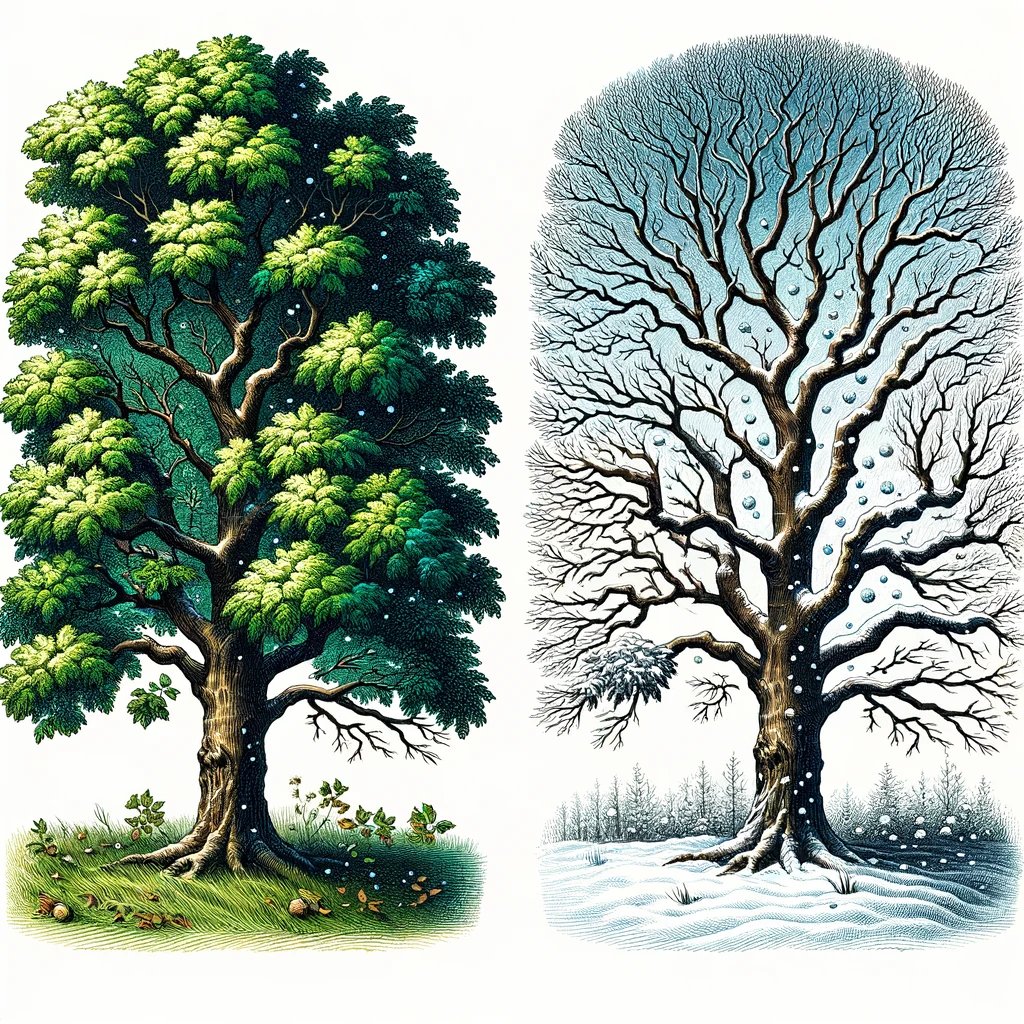
Hardwoods are usually broad-leaved (deciduous) trees - the ones that loose their leaves every fall. Examples include ash, beech, birch, mahogany, maple, oak, teak, and walnut.

what-is-a-deciduous-tree
what-is-a-coniferous-tree

Softwoods are evergeen (coniferous) trees - the tree’s that have needles and cones that stay green year round. Examples include basswood, cedar, cypress, fir, pine, spruce, and redwood.

Generally, softwoods are cheaper because they grow faster and in abundance. Because of this, they are less durable so they are used more for building materials like lumber, plywood, and paper products. Hardwood is more common in high quality furniture, decks and flooring due to its hardness and durability.

The softer the wood is, it can be said that the easier it is to burn on. However, because of the way these tree’s woods differ, they make for very different canvases when burning on them using pyrography techniques…

Softwood tree’s (typically evergreens) create sap. Sap is not our friend in pyrography, especially when first learning the craft. Very often, common woods like pine are sappy and tricky to burn on. Although I have heard of some artists enjoying burning on pine, we would recommend trying a different wood for your first time.

WOOD Slices

The way a log is cut will change your canvas shape and the way your tool works on the wood’s surface.

As you can see here, the edge grain is the outer edge of your slice.

The end grain is the end of a log. This cut is vertical (when looking at a cut tree, like in this photo of the log on the ground) and typically gives you a circular wood slice with bark all around the edges (or none if trimmed off). The grain here is visible in rings.

A face grain cut is the log cut horizontally (on a log laying on the ground) which can give you square or rectangular wood slice canvases and only two edges will be covered in bark (or none if those are trimmed off). The wood grain is visible across the surface and generally spans horizontally across the wood. The wood is usually referred to as planks with this cut.

Wood Grain

and how it Affects pyrography

A common way to explain the grain of wood is using a handful of straws. Renee of @it’sdavidandrenee brought this up at our Pyrography Summit as an example to explain the way finishes (ie. paints, stains etc…) react when applied depending on the way the wood is cut.

This is also true for pyrography. The grain of the wood can affect the flow of your tools on the surface, the texture and appearance of the burned lines, as well as the overall quality of the final artwork.

understanding-wood-grain-face-grain

Imagine the straws as a log. When you cut an end grain piece, you will usually get a circular shape. This makes all the “straws holes” face up. They are porous and will suck in any liquids, stains, paints etc… Burning on this is slightly harder so generally you need more heat and a consistent speed.

understanding-wood-grain-end-grain

Cut it the other way, face grain, and you get the length of the straws. Burning along the grain (following the grain, up and down in the photo to the right) is easier as the nib of the tool usually falls into a grain groove and burn along it. Burn against the grain (side to side) and you can get little blobs of burn, or stop marks as you move across - try turning your heat down and have more of a consistent speed. Look ahead for any grain lines so you can adjust your speed. Reduce your pressure and let the burner do the work as you just gently, but firmly, guide it.

Tree rings and wood grain are closely connected, as both result from the tree’s growth over time. Tree rings form as the tree adds a new layer of wood each year, creating visible bands that vary in width depending on environmental conditions. To learn more about tree rings, check out: What Do Tree Rings Mean?

These rings influence the wood grain, which refers to the pattern of fibers running through the wood. The spacing and direction of the rings determine whether the grain is fine and smooth or coarse and uneven. When wood is cut in different ways, the grain pattern changes based on how the rings are sliced. For pyrography, understanding wood grain is essential because it affects how the surface absorbs heat and how smoothly the burning tool moves, influencing the overall detail and control of the artwork.

The rings on the wood

So what wood is the best to burn on?

We have compiled a list of woods that we enjoy burning on for a variety of reasons. These include Amazon Associate links to great options for these particular wood varieties. In a nutshell, below are our top 9 woods for pyrography.

You can check out this blog post to see why: Best Wood for Pyrography


Want to learn more about pyrography?

Join the Burn Club Community

or check out this blog post: Start Here if you are NEW to Wood Burning


Finishing Your Wood Burned Art: How and Why to Finish Your Wood Burned Art

Finishing wood slice art can provide several benefits, including protection from environmental factors, enhancement of its natural beauty, increased durability, ease of cleaning, and personal preference.

By applying a finish, the wood slice art can be preserved for a longer period of time while also making it more resistant to scratches, dents, and other types of wear and tear. Wood burned marks and designs on the wood, especially shallow burns; such as shading, naturally fade with age and exposure to air, and particularly sunlight!

The finish can also bring out the unique grain patterns and color of the wood slice art, adding to its aesthetic appeal. It can also darken the wood considerably, sometimes even making wood burned designs non visible (especially light shading) so make sure you test it on the back of the wood slice before committing to the whole piece. Learn more about how to avoid this here: Isolation Coat/Primer and Wood

When choosing the right finish for your project, there are a few things you should consider. 

Time, cost, use, and desired effect.

  • How long do you want to wait for it to dry/cure? 

  • How much money do you want to spend? 

  • Will your item be used with food? 

  • Will children be playing with the item? 

  • Do you want it shiny or matte?


Here are 5 of our favorite finishes to use and why we like to use them:


No matter which finish you select, be sure to try it on your specific type of wood before you apply it to your finished art piece that you have worked so hard on.

The number of art pieces that have been ruined by finishes makes our heart hurt. Don’t let it happen to you: test before you apply! Each finish looks different on different types of wood. Always test!

***Also, be warned, if your wood has spots or imperfections in it, the majority if finishes will cause them to stand out even more. This includes sanding lines (if you didn’t use a fine grit to finish smoothing our your wood, or if you sanded in the wrong direction, the lines from sandpaper may show).


Please note: These include Amazon Assoicate links for our favorite products. We receive a very small portion if you choose to purchase our recommendations.


Food Safe Finishes

The most important thing to consider, or the thing to consider first, is will the wood slice be used with food? General finishes are not safe to be used on items like cutting boards and wooden utensils. Be sure you are using cutting board oil or cutting board wax, because many companies also have oils that are meant for furniture which is not food safe. Always look for the words “food safe”

Key differences between oils and waxes:

  • Penetration vs. Protection: Oil conditioners and finishing oils penetrate into the material to nourish and protect from within, whereas waxes primarily provide a protective surface coating.

  • Appearance: Waxes can alter the appearance more significantly by adding a sheen or gloss, while oils and conditioners tend to enhance the natural look of the material.

  • Maintenance: Wax finishes may need more frequent reapplication but offer more immediate surface protection against water and scratches. Oils and conditioners may provide longer-lasting nourishment but might not offer as strong a barrier against surface damage.

A combination of wax and oil can provide both protection and a natural, safe finish for wood. If using wax and oil finishes separately, apply the oils first to allow them to penetrate the wood, and then the wax to seal all that goodness in.


Here are our top two food safe oils we use:

Walrus oil

This us one of our favourite companies, and one the community likes to use as well. Please note, they do not harm any animals!

Walrus Oil Cutting Board Oil uses coconut oil, mineral oil, vitamin E and beeswax (be mindful of people who have a coconut allergy). Walrus cutting board oil is liquid and doesn't solidify. It adds a rich color (the more layers you put, the richer the colors and deeper the grain will be), it won't leave a funky taste, and goes on nice and smooth. You can finish it simply with their Wood Wax for Cutting Boards or even just use the the mentioned wax on its own.

Howards Products, Inc.

The Cutting Board Oil contains food grade mineral oil stabilized with Vitamin E, will not go rancid and is odourless and tasteless.

The one thing I will say about the Conditioner is that dirt and grime can collect a little more easily on it once finished, but the color it brings out of the wood, especially basswood, is gorgeous. This one is a mix of oil and wax.

The Wax is probably one of the best we have used for wood surfaces that are used with more wet items (i.e. pickles, cucumbers, tomatoes…) We found it to give the charcuterie boards the most protection from stains and marks.


General Finishes

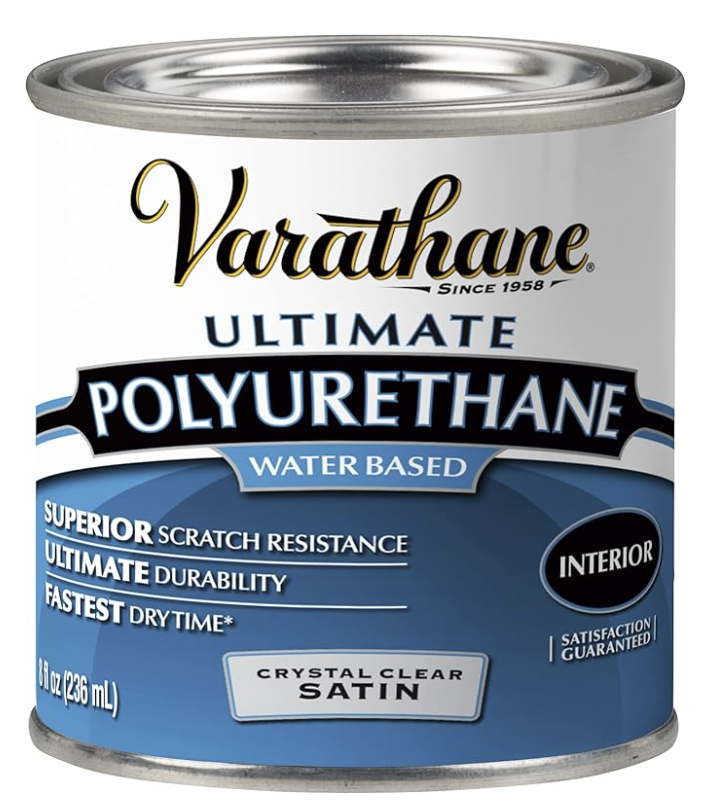
Minwax Fast Drying PolyURETHANE 

polyurethane

It is a good idea to use a spray version versus a brush-on version with pieces that have added mediums on it (like watercolour, gold leaf etc…) because wiping/brushing the finish can cause the color to spread or bleed or come off.

Choosing gloss, semi-gloss, or matte are all based on personal preference. Some of us love that shine, and some of us want it to be completely matte. A shiny glossed coat can help protect it from finger prints showing and dirt collecting but may show brush stroked more...

Water Based PolyCRYLIC 

We got a lot of responses with polyacrylic, and this is one we like to use as well. Polyacrylic spray-on and brush-on only comes as water based, but comes in satin, gloss, and high gloss sheens. It dries quickly, but can take a long time to fully cure, so be careful setting anything on top of something finished in polyacrylic. It is not as durable as polyurethane, but it isn't as toxic to your lungs or as smelly. It is fairly clear (get the crystal clear kind) but can get milky if you put it on too thick over a dark burn. Also, because it's fairly thin in viscosity and dries quickly, you can get brush strokes from the application that stay, It can be hard to get a really smooth finish.

Key Differences between a polyurethane and a polycrylic:

  • Composition and Odor: Polyurethane can be oil or water-based, with oil-based versions having a stronger odor and longer drying times. Polyacrylic is water-based, with low odor and quick drying times.

  • Appearance and Yellowing: Oil-based polyurethane deepens the color of the wood and may yellow over time, which is less desirable for light woods. Polyacrylic remains clear, making it suitable for maintaining the natural color of the wood.

  • Durability and Application: While both finishes provide good protection, oil-based polyurethane is generally more durable. However, polyacrylic is easier to apply, dries faster, and is better for quick projects..

What we use for Longevity and ultimate protection: Resin

Epoxy Resin makes for a gorgeous, well-protected finish, just don't put it in the sun or moisture, it may cloud it depending on the brand. We like Art Resin as our Resin of choice and find it lasts the longest without clouding or yellowing. Also, any information you may need to finsish a project is easy to find on their website and if you are really stuck, the customer service is absolutely amazing!

Resin takes a while to cure, is super thick, and requires precise mixing (it has a super easy mixing guide online). You also need other tools like a level and a heated tool to remove bubbles and smooth it. Depending on how large your piece is, a lighter can work. For larger pieces, using a torch is much easier.

It can also be messy to work with because it will spill over the edges, but the finished look is gorgeous. Keeping it out of dust particles while its drying is crucial (we cover our slices with a simple cardboard box).

It makes whatever you burned or added to the slice pop! It resists yellowing from the sun but can eventually yellow over time.

You have to make a new batch every time you use it, and it is also a bit pricey, but it is gorgeous!

Fun Tip:

If you don't want the color of the wood to change, Aly of @alyoopsartistry suggests to use isolation coat  before adding your finish. This is awesome to use when you want the colour of your piece to stay as is before adding the resin. To learn more about this, check out: Isolation Coat/Primer and Wood

Click here to read about why you may consider leaving your wood slice unfinished.


How to apply a finish to your wood slice:

Finishing wood burned art can help protect it and enhance its appearance. Here are some steps you can follow to finish your wood burned art:

  1. Sand the wood: Use sandpaper to smooth the surface of the wood and remove any rough spots. Click here to see the best way to sand your slices. Having a smooth surface is crucial as the sanding lines will be more visible with majority of finishes added.

  2. Remove dust: Clean the wood surface with a clean, dry cloth to remove any dust or debris.

  3. Apply a wood conditioner or oil: This will help the wood absorb the finish evenly. Apply the wood conditioner or oil with a clean cloth and let it soak in for about 15 minutes before wiping off any excess.

  4. Choose your finish: There are many types of finishes you can use on wood burned art, such as polyurethane, lacquer, or wax. Choose the finish that best fits your desired outcome.

  5. Apply the finish: Apply the finish with a brush, foam brush, or cloth according to the manufacturer's instructions. Make sure to apply an even coat and avoid drips.

  6. Let it dry: Allow the finish to dry completely before handling the wood.

  7. Apply additional coats: Depending on the type of finish, you may need to apply additional coats. Follow the manufacturer's instructions for the recommended drying time between coats.

  8. Buff the finish: After the final coat has dried, use a clean cloth to buff the surface of the wood to a smooth and shiny finish.

Following these steps will help ensure that your wood burned art is protected and looks great for years to come.


When to re-finish your wood art

In general, it is recommended to reapply a finish to wood art every 1-3 years to maintain its appearance and protect it from wear and tear. However, if the wood art is exposed to harsh conditions such as direct sunlight, high humidity, or frequent handling, you may need to apply a finish more often.

It's important to also keep an eye on the finish and look for signs of wear or damage such as cracking, peeling, or discoloration. If you notice any of these signs, it's time to refinish the wood art to prevent further damage.

Ultimately, the best way to determine how often you should finish your wood art is to monitor its condition regularly and apply a new coat of finish as needed to maintain its appearance and protection.

Functional wood art, such as cutting boards, serving trays, and furniture, may require more frequent refinishing than decorative wood art since they are exposed to more wear and tear.

To learn more about how to care for your functional wood burned artwork (and all other types of wood art), check out: Woodcare 101: Preserving Your Pyrography Art


A Radial Symmetry Guide and Colouring Book

 
Grab a hardcopy
Download the digital version
 

This is a radial symmetry guide, a collection of 25 unique colouring designs, three blank grids and six outlines to doodle in providing a gateway to a world of mesmerizing patterns, relaxing mindfulness and endless creativity.

For all you pyrography artists, the 25 designs are also made for traceability so you can transfer/trace and burn them! Instructions to that are included on the initial download with the digital version.

Designed to help both novices and seasoned artists explore the captivating realm of radial symmetry, this book guides you step-by-step through the creation of intricate and balanced designs.

The first half of the book dives into all the details from making a grid, to 7 different creative variations of a circular pattern.

The intention is to give you the knowledge and easy to follow instructions for you to continue making one-of-a-kind radial symmetry patterns using only a few basic tools.


It includes 3 blank grids for you to practice on.

Print out as many as you like with the digital download!


And it also includes 6 outlines (in 3 different styles) for you to practice on and doodle in along with a simple creativity exersize to get you going.


The second half of the book has 25 original patterns for you to colour and reimagine. Inspired by the art deco and art nouveau artistic movements, the intention with these finished patterns is the get you inspired, relaxed and also hone in your artistic skills.


Not only can you grab your favourite colouring tools, let your imagination soar, and get ready for a transformative artistic journey, you can also learn a new hobby.


Learn How to Wood Burn

pyrography-templates-ideas

The book includes links to free resources that help you take the patterns off the page and onto wood.

If you’ve ever wanted to go beyond coloring and actually try your hand at wood burning, this is your invitation.

You’ll learn exactly how to transfer the designs and start burning your own radial symmetry art—no guesswork, just a clear path into a whole new creative world.

 
Purchase the hardcopy

OR download a digital copy to easily resize any design in the book and wood burn onto a wood slice using the art of pyrography!

Links to all the resources you need are included and are free.

Download the digital version
 

Embracing the New Year: A Guide to Setting Goals

 
goal-setting-2024
 

As the New Year approaches, the air fills with a sense of renewal and opportunity. It's a time when many of us reflect on the past year's journey and set our sights on what lies ahead. Setting goals for the New Year is a tradition as old as time, serving as a catalyst for personal growth and achievement. But how do we set goals that inspire us, push us forward, and are realistically achievable?

A great podcast to listen to is by Dr. Andrew Huberman, a neuroscientist and professor, who makes goal setting less intimidating and more impactful. Take a listen here: The Science of Setting & Achieving Goals and read on!

Here's a guide, with the help of our own experiences, Burn Club Plussers experiences, and Hubermans expertise to setting meaningful goals for the New Year:

Reflect on the Past, Envision the Future

Before setting new goals, take a moment to reflect on the past year. Really block out time here from all distractions and find yourself a quiet spot to think. What were your successes and setbacks? What lessons did you learn? Reflection provides valuable insights that can shape your future goals.

Envision what you want the upcoming year to look like. Imagine the accomplishments, the personal growth, and the happiness you wish to achieve. Huberman emphasizes the importance of having clear, defined goals. He suggests visualizing not just the end goal but the process required to achieve it. This mental rehearsal can prepare the mind and body for the tasks ahead and increase the likelihood of success.

Personally, this exersize of visualization really helped clarify the larger goals and all its smaller steps. It can be in the form of a mental exersize, a Pinterest collage, or even a magazine collage. Whatever works for you to really see what you want clearly.

Set SMART Goals


SMART goals are Specific, Measurable, Achievable, Relevant, and Time-bound. This framework helps in setting clear and attainable objectives. For example, instead of saying, "I want to be healthier," a SMART goal would be, "I want to exercise for 30 minutes, five days a week, and eat five servings of fruits and vegetables daily."

Break Bigger Goals into Actionable Steps

Large goals can often seem daunting. Break them down into smaller, manageable tasks. If your goal is to write a book, start with writing a certain number of words each day or outline one chapter per week. Small steps lead to big achievements over time and provide the opportunity to celebrate along the way!

Dopamine, a neurotransmitter associated with pleasure and motivation, plays a significant role in goal setting and achievement. Huberman advises understanding how to manage and optimize dopamine levels through rewarding progress, breaking down goals into smaller, achievable tasks, and maintaining a balance between challenge and reward.

He also discusses how moderate stress can be beneficial in the context of goal setting. It can enhance focus and performance, acting as a motivator. However, managing stress levels is crucial, as too much stress can be counterproductive. Along with self care and life balance, breaking up goals can be a great way to manage the stress and not overwhelm oneself with a large goal.

Hold Yourself Accountable

track-your-goals

Keep track of your progress and celebrate small victories along the way. Consider maintaining a journal or using an app to monitor your journey towards your goals. Or if you, like me, prefer using the old fashion pen and paper, try an accountability tracker. Not only is it satisfying to mark off each day’s goals, but it is also a visual reminder of your progress

Click here for the radial symmetry Trackers we use (like you see here).

Dr. Andrew Huberman emphasizes the importance of strategic goal setting and accountability. According to Huberman, sharing goals with others can sometimes trigger a premature sense of accomplishment, reducing the drive to actually achieve the goal. He suggests a more nuanced approach: share your goals selectively with those who can offer constructive feedback or support, rather than seeking widespread validation.

Huberman also highlights the value of internal accountability, where setting clear, measurable objectives and regularly reviewing progress can significantly enhance motivation and likelihood of success. He encourages individuals to leverage the brain's reward system by celebrating small wins along the way, which can sustain momentum and foster a sense of achievement throughout the journey toward larger goals. By understanding the neurological and psychological aspects of goal setting and accountability, individuals can tailor their approach for maximum effectiveness and personal fulfillment.

Prioritize Self-Care

While pursuing goals, remember to prioritize your well-being. Set goals that encourage a balanced life, incorporating elements of work, rest, play, and personal growth.

In his podcast, Huberman speaks about creating an environment conducive to success. This includes managing distractions, ensuring adequate sleep for brain function, and considering the timing of tasks aligned with individual circadian rhythms.

Self-care isn't just about relaxation; it's about doing what's necessary to maintain your mental, emotional, and physical health.

Embrace Flexibility

Life is unpredictable, and your path to achieving goals may need to adjust. Be flexible and open to change. It's important to remember that the path to any worthwhile achievement is often laden with obstacles and setbacks. Rather than viewing these as failures, consider them part of the learning and growth process.

If an approach isn't working, pivot and try something new. Flexibility helps you stay resilient and persistent.

Stay Positive and Patient

Goal setting is an optimistic endeavor. Stay positive and patient with yourself. Some goals will require more time and effort than anticipated. Embrace the journey, learn from the process, and keep pushing forward.

One thing Basia loves to do is create affirmations that she can personalize using Canva. She have them show up on her phone so she can be reminded about her goals, ambitions or just to provide a little motivation everyday to keep at it.


As you embark on this New Year, remember that setting goals is about more than just listing desires—it's about creating a roadmap for a fulfilling year ahead. It's about understanding where you are, deciding where you want to be, and taking proactive steps to get there. With thoughtful planning, commitment, and a positive mindset, you're well on your way to making this New Year a truly transformative one.

Remember also that goal setting isn't only confined to the start of a new year; it's a beneficial practice that can be undertaken at any time. Engaging in goal setting sessions throughout the year allows for continuous growth, adaptation to change, and the ability to seize the moment whenever inspiration strikes.

Happy goal setting!


Donate to One Tree Planted - 2023

One thing that is really important to us, here at Wood Burn Corner, is giving back!

Each year we give back to our community in as many ways as possible. We donate our time, products, money, and also love sharing information for free with our community.

THIS YEAR (2023) WE ARE PROUD TO ANNOUNCE THAT 1,100 TREES HAVE BEEN PLANTED BECAUSE OF OUR LITTLE BUSINESS.


@onetreeplanted is such an incredible organization that takes $1 and plants 1 tree with it, which means, because of you all, Wood Burn Corner planted 1,100 trees this year.

Thanks to all your support and purchases, we were able to give our largest donation to date to the non-profit organization, One Tree Planted!

One Tree Planted makes it easier for both individuals and businesses to give back to the environment, create a healthier climate, protect biodiversity, and help reforestation efforts.

Here is how it works:

trees-for-the-environment

Trees play such an integral role in our World, and we want to be part of the solution.

DID YOU KNOW?

Every 1.2 seconds, man destroys an area of forest as big as a football field. This is why we feel the need to give back to the trees that make it so we can create our art and why we choose to use wood from sustainable sources.

Click here for some more interesting facts about trees and the impact of deforestation around the world.

WANT TO HELP THE ENVIRONMENT?

Plant some trees
 

Pyrography + Sustainability

In addition to being a form of artistic expression, pyrography can also be used to promote sustainability and environmental awareness.

Keep reading to see some of the ways on how pyrography can do that!

One: Sourcing sustainable materials

Sourcing your wood from companies who care about the environment ensures the wood is harvested with minimal environmental impact.

Here’s what to look out for:

1. Sustainability Practices of the Supplier:

Review the company's environmental policies. Look for transparency in how they manage the forests they harvest from, such as replanting efforts, reduced chemical usage, and preservation of wildlife habitats. Check if the supplier follows carbon-neutral operations, uses renewable energy, or has sustainability reports available to the public.

2. FSC Certification:

Look for wood that is Forest Stewardship Council (FSC) certified. This certification ensures the wood comes from responsibly managed forests that provide environmental, social, and economic benefits. FSC-certified forests promote biodiversity and prevent deforestation.

3. PEFC Certification:

The Programme for the Endorsement of Forest Certification (PEFC) is another global certification that guarantees sustainable forest management. PEFC-certified products ensure wood is sourced ethically and sustainably.

4. Avoiding Illegal Logging:

Ensure the company complies with regulations like the Lacey Act (in the U.S.) or the EU Timber Regulation to avoid wood that comes from illegal or harmful logging practices.

Here are some alternative options for wood sourcing:

Reclaimed or Salvaged Wood:

Sourcing reclaimed wood from old buildings, shipping pallets, or other recycled sources is an excellent sustainable option. This method reduces the need for new wood and minimizes waste. HOWEVER! It is really important to know what you are burning on as some woods can emit very harmful chemicals when heated, especially ones treated with chemicals. This is really hard to tell sometimes so this is not always the best option… For a list of woods not to burn, check out Common Wood Types To Avoid. Always follow the safety precautions set out by the manufacturer and check out our Safety Guide for best practices when it comes to buying anything.

Local Sourcing:

Buying from local suppliers reduces the carbon footprint associated with transporting wood over long distances. Supporting local woodworkers or sawmills can ensure more transparency about where the wood originates.


TWO: Promoting Environmental awareness through words and design

One way to use pyrography in a sustainable way is by creating designs that promote environmental awareness. For example, you could create a design of a forest with the message "Save the Trees" or a design of a sea turtle with the message "Protect Our Forests." These designs not only showcase the beauty of nature, but also help to raise awareness about the importance of conservation and protecting our planet.

By showcasing the natural world in their art, pyrographers can help to inspire others to appreciate and protect the environment. A mountain landscape, for example, could inspire someone to take a hike and experience the beauty of nature firsthand.

 
mountain-wood-burn-art-on-turkish-marbling
 

THREE: Promoting Environmental awareness through Events, auctions and donations

To promote environmental awareness through events, auctions, and donations, focus on creating eco-conscious experiences that engage and educate participants. Host pyro workshops that teach wood burning techniques paired with sustainability and green living.

Organize green auctions, featuring eco-friendly art or services, and partner with local businesses to offer environmentally responsible products.

Raise funds through donation-based events or crowdfunding campaigns for environmental causes, and encourage corporate partnerships for sustainable challenges. Ensure your events are eco-friendly by reducing waste, using digital or plantable invitations, and incorporating education booths or online content to spread awareness.

Parts of a sale can be donated to companies that support the environment. We love to donate a part of all our sales to One Tree Planted which plants tree’s around the world! To this date, we have donated over 15,000 tree’s. Our donations have planted trees in places like the Andes as well as 10,000 fruit trees in India, where not only will it help with air quality, but will also provide food and jobs for people of that region.


Four: Functional Sustainability

Pyrography can also be used to create functional items that promote sustainability. Here is a list of some items you may burn that are also functional:

  • Kitchen utensils (spoons, spatulas, cutting boards, and serving trays…)

  • Coasters

  • Jewelry or trinket boxes

  • Serving platters

  • Wall hooks or hangers

  • Coatracks

  • Plant markers or garden stakes

  • Phone or tablet stands

  • Candle holders

  • Picture frames

  • Serving bowls

  • Storage crates

  • Bookmarks

By using sustainable materials and creating items that can be used again and again, pyrographers can help to reduce waste and promote eco-friendly practices.


Five: Keeping It Natural

A natural wood slice is a biodegradable material that can return to the earth without causing harm, especially when untreated. Wood art slices (or those with function, such as in the above paragraph) can be kept natural or use only natural stains or finishes (more on this down below).

I recently learned about the Cradle to Cradle philosophy which focuses on designing products that can be reused or naturally decomposed, promoting a closed-loop system where nothing is wasted.

For further reading, the original concept is explored in Cradle to Cradle: Remaking the Way We Make Things by William McDonough and Michael Braungart, which outlines the framework in detail.


What can you do to make your wood slice sustainable?

Here are some alternatives to finishes and mediums often used with pyrography:

Finishing Options

Many pyrography artists opt for natural, non-toxic finishes like beeswax, linseed oil, or plant-based varnishes. These finishes not only protect the artwork but also reduce harmful chemical emissions and protect indoor air quality.


Hanging Options

A common solution to hanging wood slice art is to add a hanger on the back. This little metal piece can easily be added to majority of wood, however, it would have to be removed at the end of the lifecycle of that slice. A great option, if you have the tools, access to them, is to create a keyhole style hanger!


Alternative Stains

Natural stains are a great way to enhance pyrography projects while maintaining a commitment to sustainability. Unlike conventional wood stains, which often contain synthetic chemicals and solvents, natural stains are made from plant-based, food-safe ingredients. Here are a few popular options for creating and using natural stains in pyrography:

  • Coffee or Tea Stains: Brewed coffee or tea can be used as a stain to give wood a rich, earthy tone. The colour intensity can be adjusted depending on the strength of the brew and the number of coats applied.

  • Vinegar and Steel Wool: Soaking steel wool in vinegar creates a chemical reaction that can stain wood a weathered, aged look. The longer the steel wool sits in the vinegar, the darker the effect.

  • Beet Juice or Other Vegetable Dyes: Natural vegetable dyes, like beet juice, spinach, or onion skins, can be used to create colourful wood stains. These are made by boiling the vegetable matter in water and applying the resulting liquid to the wood.

  • Turmeric Stain: Turmeric powder can be mixed with water or alcohol to create a yellow stain. It's often used for giving wood a golden, warm tone.

  • Walnut Stain: Boiling walnut hulls in water creates a rich, dark brown stain. Walnut stains have been used for centuries in traditional woodworking.

  • Blackberry or Blueberry Juice: These fruits can be boiled down to create a stain that imparts a purple or reddish hue to the wood.


Natural Paints

Natural paints can be an excellent addition to pyrography projects, especially if you're looking for sustainable, eco-friendly alternatives to synthetic paints. Like natural stains, these paints are made from non-toxic, biodegradable ingredients, and they can add vibrant colours or subtle accents to wood-burned art without harming the environment. There are more and more options available, just make sure to read the fine print. Some companies like to use words like “natural” and “organic” or “earth” but they do not come chemical free. Another option is to go the DIY route. There are loads of tutorials on how to make your own paint.


Pyrography is a versatile and beautiful medium that can be used to promote sustainability and environmental awareness. Whether by using wood from sustainable companies, creating designs that promote conservation (or conversation), or making functional items that can be used again and again, pyrographers can help to reduce waste, protect our planet, and celebrate the natural world.

Thank you and happy burning!

How to Make a Keyhole Hanger by Hand

how-to-make-a-keyhole-hanger

One way to hang your wood slice art is by using a keyhole hanger (also known as a mounting slot), which allows the slice to be hung flush against the wall.

In this guide, I will provide step-by-step instructions on how to make a keyhole hanger on a wood slice.

By following these simple steps, you can create a unique and personalized way to display your wood slice art.

how-to-make-a-keyhole-hanger-with-a-router

This method uses a hand held router (which you can borrow from someone or rent from your local tool library if available!) along with a specific bit called the keyhole bit.

You can also use a router table if you have one.

Please note, any links below are affiliate links to the exact tools I am actually using and love!

Materials needed:

  • Your wood slice

  • Pencil and eraser

  • Measuring tape

  • Clamps or easy DIY guide: a straight edged scrap wood piece and nail gun or hammer and nails

  • Sandpaper

  • Router and a Tipped Keyhole Bit

Wood comes in all different sizes, thicknesses and shapes.

Measure the router bit with your wood slice to ensure the length is correct and doesn't go through your slice.

woodworking-tools

How to make a keyhole hanger on a wood slice

Step 1: Determine the Placement of the Keyhole Hanger

measure-your-wood

Decide where you want to place the keyhole hanger on the back of the wood slice. Make sure it is centered and level. Use a pencil to mark the spot.

I like to measure 2 inches from the top of all my wood slices to ensure there is enough space for the hole and enough wood left at the top to keep the hole strong. If it is too close to the edge, the wood can split or crack.

Measuring a square or rectangle piece is easy, but rounds are a little trickier, especially if they are imperfect circles, ovals or other shapes…

My trick to measure a wood slice that is not a square or rectangle:

This is not a 100% exact method. Wood rounds are often imperfect and come in all kinds of unique shapes and sizes. What I like about the keyhole hanger technique is that when the slice is hanging, it’s flush against the wall. So even if your measurements were off slightly, the friction of the wood on the wall allows for some forgiveness in the levelling and you can tweak it a bit once it is up. For really stubborn pieces that you may have mismeasured and they really don’t hang level, you can apply a tiny amount of double sided sticky tape or even sticky tack to the back side to make it more level. Do not try adjusting the keyhole by making it bigger or longer as the structure of the wood will deteriorate when manipulated enough times… Also, know that any sticky substances on wood will stain in, but this will be on the back of the wood piece.

First measure the largest point across your wood slice.

 
easy-diy-woodworking-project
 

Then take a square tool and roughly eyeball the level. I use the edge of the table that I am working as a guide, lining up the bottom of my square to the edge.

 
easy-diy-woodworking-project
 

Once I draw a line up, 2 inches away from the tops, I test how it hangs before I drill a hole by holding it up on the mark I just made and roughly seeing if it hangs level.

 
how-to-hang-a-wood-slice


step 2: make a quick guide (optional) and clamp down your slice

This DIY guide is optional because you can essentially free-hand the hole. I like to make the guide because it only takes seconds and then keeps my holes nice and straight.

Start by grabbing any scrap wood (ensure it has a straight edge - this edge will be your guide) and attach it to your artwork. I am nailing it in temporarily but you can use clamps if you do not have a nail gun (clamps get in the way a little which is why I prefer to nail it). If your wood slice is big enough, you can hang the clamps over the edge of the table, or clamp the guide AND the slice to the table for maximum stability.

First, I measure the distance from the furthest edge at the top, and then the bottom - this ensures that it’s level.

how-to-hang-a-wood-slice
how-to-easily-hang-a-wood-slice

Make sure to measure for the size of your tool.

Tip: Once I measure everything out, before I nail down my guide, I line up the router to where I am about to drill the hole just to double check my measurements!

 
tempImageI2U8np.jpghow-to-hang-wood-slice-flush-to-the-wall
 

Ensure that the nail you choose will not go through your wood slice. I used a 23 gauge headless finishing nailer because the nails are small and short which make them easy to take off once complete and you don’t have a big nail hole after the guide comes off. You can simply hammer in two temporary nails (two so the guide stays in one spot - one at the top and one at the bottom of your scrap wood).

Once my guide is on, I clamp my art down to the table.

 
how-to-hang-wood-slice-flush-to-the-wall


step 3: drill your hole

Now comes the fun part, drilling the hole.

how-to-hang-wood-slice-flush-to-the-wall

Using the router, I line up my bit against my guide and over the mark I made on the wood slice and I drill a hole, but only straight down at first.

I like to slightly lean the edge of the tool on the guide, coming in on a bit of an angle so the weight and pressure of the tool is on the guide, not me trying to hold it up in position. If you are doing it freehand, make sure to keep a sturdy grip.

Once you've drilled your hole, your tool will lay flat on the wood.

The hole should be at least 1/4 inch deep so a nail can fit snugly in the slot, just make sure your wood is thick enough so the hole doesn’t go through.

With the bit inside the hole, move the router up, away from you, very slowly to create the nook for the nail to sit in.

Move slowly.

Once you have gone up about 3/4 of an inch, turn off your tool, wait for it to stop and remove the tool from the hole by carefully sliding the bit down and out of the hole at the bottom.

Step 4: Sand the Wood Slice

Use sandpaper to smooth out any rough edges around the drilled hole and the wood slice.

And voila! You made a keyhole hanger!

You can now hang your art, flush to a wall anywhere you like by sliding the wood slice onto a screw. Adjust the wood slice until it is level and centered on the screw.

 
how-to-hang-wood-slice-flush-to-the-wall
 

Spring Burnt Week 2023

Burnt Challenges are a call to artists of all skill levels to create an original piece of pyrography artwork based on a specific word, or what we like to call, a prompt! Check out Some past challenges here.

This challenge is an excellent way for wood burning artists to grow their portfolio, try new things, push their craft, meet other pyrographers, hone their skills, gain followers, sell art, and have a ton of fun while they are at it!

Having a restriction, like following a specific prompt, can really bring out creativity in people. These prompts are known to get people inspired and trying new things. Things they perhaps wouldn’t have tried otherwise.

The challenges are living in the wood burning community on Instagram. Follow us there or join Burn Club+ to get your prompts in advance for the next Burnt Challenge and to suggest your own prompts.


Spring Burnt Week 2023

We are so excited to be teaming up with our sponsor, Walnut Hollow, to bring you this #SpringBurntWeek challenge that runs from May 22nd to May 26th, 2023!!

The prompts were suggested by the Burn Club+ Community. We got a whole list of really funny and unique but very random nouns + adjectives. To make it even more fun and to keep artists thinking outside of the box, we pulled one noun and one adjective randomly out of a hat and put the two together!


OUR FEATURED ARTISTS


TINY + PARTY by @ambers_afire


@ambers_afire created this stunning piece for the TINY PARTY prompt and we fell in love. It’s so whimsical and sweet. All of the little details, the mushroom clothing, the gradient background, are on point. Just zoom in on the ground! So much great dark texture. Beautifully done @ambers_afire! Everyone, please go give Amber a follow for more beautiful art in this unique style.


Imperfect + Path by @blindlove.woodburning


@blindlove.woodburning created this scene for the IMPERFECT PATH 🔥 Well done @blindlove.woodburning! The textures make that tree look so real along the iconic seattle skyline. Love that elephant butt and the tiny pops of color! Everyone, please go give Krista a follow for more beautiful art in this unique style.


WILD + SIGN @wild.earth.artwork


@wild.earth.artwork is the winner for todays prompt: WILD SIGN. It’s just fabulous! The soft colors of this #flower background down to the details and shading in the flowers and the hand ✌️Great work by @wild.earth.artwork


DRIPPY GARDEN by @bz_furfur


@bz_furfur created this beautiful piece for the prompt of DRIPPY GARDEN! The celebration of nature sprouting after the rain, the little fairies, the colors and that sparkle! Well done, @bz_furfur. Everyone please go follow this awesome artist. Let’s show them all the love!


PLAYFUL RIVULET @driftwood_aptos


@driftwood_aptos created this stunning piece for the prompt PLAYFUL RIVULET. The details, the textures, the magical vibe of the colors! What a fantastic interpretation of the prompt too! Everyone go give @driftwood_aptos a follow!


How Do I join in on the next challenge?

To participate in this 5 day wood burning challenge, post a photo of your prompt-inspired piece (on instagram) on the date listed using #SpringBurntWeek and mention both @woodburncorner + @walnuthollow.

That’s it! It’s that easy.

You can burn on any surface (it doesn’t have to be on wood) and you can interpret each prompt in absolutely any way you like - the more creative the better!

Learn about the next challenge first by joining Burn Club+. Then Burn Club hears about the challenge next and then we announce publicly.

Where Do you feature me and my artwork?

This challenge is a great way to get your name and artwork in front of more eyes! Both @walnuthollow (our Sponsor) + @woodburncorner select artists for each prompt to feature in:

  • both Walnut Hollow + Wood Burn Corner Instagram posts + stories

  • on this blog post once the challenge is over

  • our Facebook page

  • as well as on Pinterest

What CAN I win?

There are many prizes and a pre-challenge giveaway just for sharing about the challenge.

Wood Burn Corner gives away a daily prize! Each winner got to choose from the following:

  • Digital Copy of Template Book (Volume 1)

  • Digital Copy of Template Book (Volume 2)

  • Digital Copy of Template Book (Radial Symmetry Edition)

  • Access to The Sessions Recordings (Value $100)

  • Complete Wood Burning and Business Toolkit (Value $749)

  • Access to Pyrography and Business Summit Recordings (Value $240)

Walnut Hollow also gives away a daily prize; a mystery box of goodies from www.walnuthollow.com!


Can I still join in but not burn?

If you are not able to participate by making art, you can still show your fellow pyro pals some love by sharing, commenting, saving, and liking all the art! Spread the news about the event by posting about it in your stories, reels and posts.

We are always blown away at what your uniquely creative minds come up with.

Make sure to follow #SpringBurntWeek to see the all the artworks made during the challenge or Check out Some past challenges here.

Let’s join our voices together and raise the entire community up. Keep spreading the love and happy burning!